Thermodynamics
38 previous year questions.
High-Yield Trend
Chapter Questions 38 MCQs
Which one of the figures correctly represents the T–S diagram of a Carnot engine? 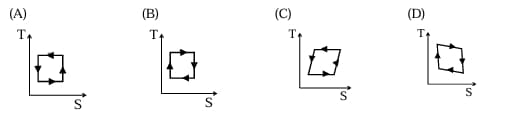
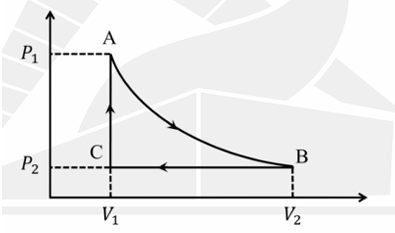
A monoatomic ideal gas undergoes a closed cycle shown in the P–V diagram. The ratio is ........... (Specify your answer up to two digits after the decimal point.)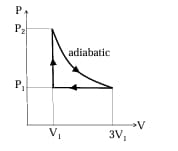
An ideal gas undergoes an isothermal expansion along path AB, adiabatic expansion along BC, isobaric compression along CD, isothermal compression along DE, and adiabatic compression along EA, as shown in the figure. The work done by the gas along the process BC is 10 J. The change in the internal energy along process EA is 16 J. The absolute value of the change in the internal energy along the process CD is ............ J. 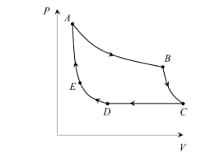
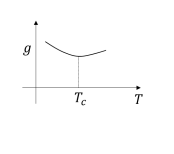
For a system undergoing a first-order phase transition at a temperature , which one of the following graphs best describes the variation of entropy (S) as a function of temperature (T)? 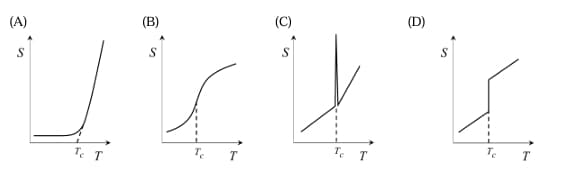
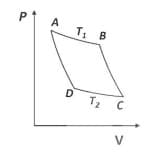
[Take the specific heat capacity of water to be 4200 J/kg K. Neglect any loss of heat to the vessel and air and change in the volume of water.]
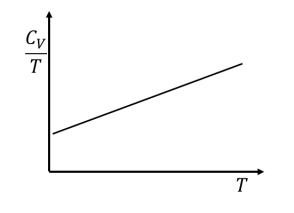
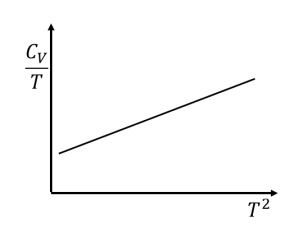
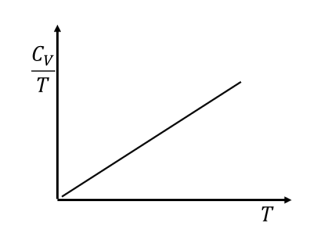
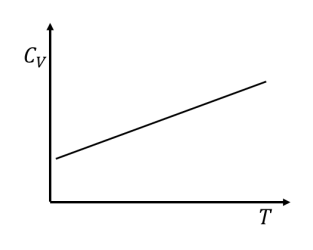
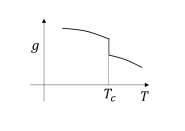
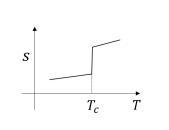
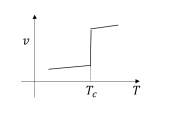
(R is the ideal gas constant)
The P-V diagram of an engine is shown in the figure below. The temperatures at points 1, 2, 3 and 4 are T1, T2, T3 and T4, respectively. 1→2 and 3→4 are adiabatic processes, and 2→3 and 4→1 are isochoric processes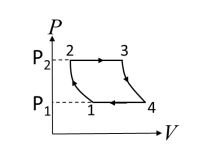
Identify the correct statement(s).
[γ is the ratio of specific heats Cp (at constant P) and Cv (at constant V)]
Take specific heat at constant pressure of water as 1 cal/(g K)}
About Thermodynamics - IIT-JAM-PH
Thermodynamics is a vital chapter for IIT-JAM-PH aspirants. Mastering the concepts covered in this chapter is essential for securing a top rank.
By rigorously practicing the previous year questions associated with this chapter, you can identify high-yield topics, understand the examiner's perspective, and boost your confidence during the actual exam.
Frequently Asked Questions
Why focus on Thermodynamics PYQs?
Analyzing PYQs for this specific chapter reveals the most frequently tested concepts and the typical complexity of questions, allowing you to tailor your study plan efficiently.
How to best use this analysis?
Review the topic breakdown to see which sub-topics within Thermodynamics carry the most weight. Then, tackle the questions iteratively to solidify your understanding.