Mechanics
33 previous year questions.
High-Yield Trend
Chapter Questions 33 MCQs
The linear mass density of a rod of length varies from one end to the other as , where is the distance from one end with tensions and in them (see figure), and is a constant. The rod is suspended from a ceiling by two massless strings. Then, which of the following statement(s) is (are) correct? 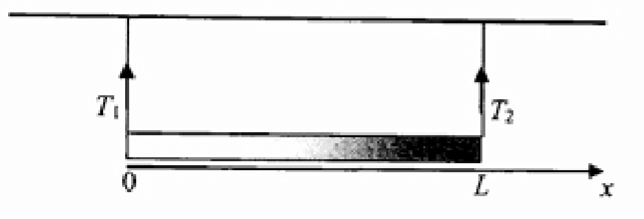
To demonstrate Bernoulli's principle, an instructor arranges two circular horizontal plates of radii each with distance ( ) between them (see figure). The upper plate has a hole of radius in the middle. On blowing air at a speed through the hole so that the flow rate of air is , it is seen that the lower plate does not fall. If the density of air is , the upward force on the lower plate is well approximated by the formula (assume that the region with does not contribute to the upward force and the speed of air at the edges is negligible): 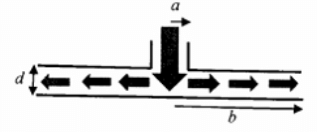
To demonstrate Bernoulli's principle, an instructor arranges two circular horizontal plates of radii each with distance ( ) between them (see figure). The upper plate has a hole of radius in the middle. On blowing air at a speed through the hole so that the flow rate of air is , it is seen that the lower plate does not fall. If the density of air is , the upward force on the lower plate is well approximated by the formula (assume that the region with does not contribute to the upward force and the speed of air at the edges is negligible): 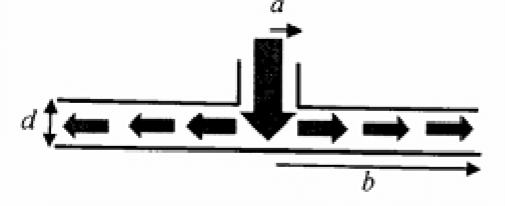
Three planets orbit a star at distances . Their orbital periods are proportional to . If the smallest planet has period , after how long will all three be aligned again?
A particle of mass is constrained to move on the surface of a cylinder under a force as shown in the figure ( is a positive constant). Neglect friction. Which of the following statements is correct?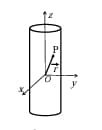
A planet has the same average density as Earth but only the mass of Earth. If and are the surface gravities on the planet and Earth, then ............ (Specify your answer up to one digit after decimal.)
A body of mass 1 kg moves in an elliptical orbit with semi-major axis 1000 m and semi-minor axis 100 m. The orbital angular momentum is 100 kg m s . The time period of motion is ............. hours. (Specify answer up to two digits after the decimal point.)
A particle of mass moves in a circular orbit with and observed in inertial frame . Another frame moves with velocity with respect to , and origins coincide at . The angular momentum at as observed in about its origin is . Then is ............. (Specify answer up to two digits after decimal.)
(Boltzmann constant eV/K)
At a particular temperature T, Planck's energy density of black body radiation in terms of frequency is at Hz. Then Planck's energy density at the corresponding wavelength ( ) has the value \rule{1cm}{0.15mm} . (in integer)
[Speed of light m/s]
(Note: The unit for in the original problem was given as J/m³, which is dimensionally incorrect for a spectral density. The correct unit J/(m³·Hz) or J·s/m³ is used here for the solution.)
(Take MeV fm, and the rest mass energy of neutron = 1 GeV.)}
For masses and , respectively, \begin{itemize
and are the constant distances from the center of mass,
and are the magnitudes of the angular momenta about the center of mass, and
and are the kinetic energies.
Which of the following is(are) correct?
(G is the universal gravitational constant)}
,
then V(x) is ( , and are constants of appropriate dimensions)
Galilean invariance implies that
(g is the acceleration due to gravity)
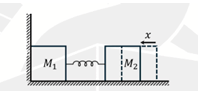
(G is the universal gravitational constant)
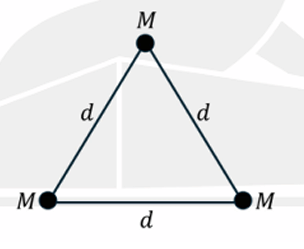
About Mechanics - IIT-JAM-PH
Mechanics is a vital chapter for IIT-JAM-PH aspirants. Mastering the concepts covered in this chapter is essential for securing a top rank.
By rigorously practicing the previous year questions associated with this chapter, you can identify high-yield topics, understand the examiner's perspective, and boost your confidence during the actual exam.
Frequently Asked Questions
Why focus on Mechanics PYQs?
Analyzing PYQs for this specific chapter reveals the most frequently tested concepts and the typical complexity of questions, allowing you to tailor your study plan efficiently.
How to best use this analysis?
Review the topic breakdown to see which sub-topics within Mechanics carry the most weight. Then, tackle the questions iteratively to solidify your understanding.