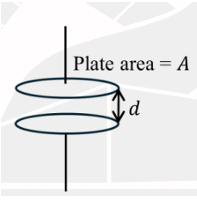
Consider a circular parallel plate capacitor of radius with separation between the plates ( ). The plates are placed symmetrically about the origin. If a sinusoidal voltage is applied between the plates, which of the following statement(s) is (are) true?
1
The maximum value of the Poynting vector at is .
2
The average energy per cycle flowing out of the capacitor is .
3
The magnetic field inside the capacitor is constant.
4
The magnetic field lines inside the capacitor are circular with the current flowing in the -direction.
Official Solution
Correct Option: (1)
Step 1: Understanding the capacitor's behavior.
The time-varying electric field inside the capacitor generates a magnetic field in the surrounding region. The Poynting vector, which represents the power flow, reaches its maximum value at and is given by . Additionally, the average energy per cycle flowing out of the capacitor is . The current inside the capacitor creates circular magnetic field lines in the -direction. Step 2: Conclusion.
Thus, the correct answers are options (A), (B), and (D).
02
PYQ 2018
medium
physicsID: iit-jam-
In presence of magnetic field and electric field , a particle moves undeflected. Which statement is correct?
1
The particle has positive charge, velocity =
2
The particle has positive charge, velocity =
3
The particle has negative charge, velocity =
4
The particle has negative charge, velocity =
Official Solution
Correct Option: (2)
Step 1: Condition for undeflected motion. Lorentz force must vanish:
Step 2: Substitute fields. , . Let velocity = . Compute cross product: Force condition:
Step 3: Charge sign. Force cancels only if . Thus particle is positive and moves along +x direction.
Step 4: Conclusion. Correct answer is (B).
03
PYQ 2019
medium
physicsID: iit-jam-
Which of the following statement(s) is/are true?
1
Newton’s laws of motion and Maxwell’s equations are both invariant under Lorentz transformations.
2
Newton’s laws of motion and Maxwell’s equations are both invariant under Galilean transformations.
3
Newton’s laws of motion are invariant under Galilean transformations and Maxwell’s equations are invariant under Lorentz transformations.
4
Newton’s laws of motion are invariant under Lorentz transformations and Maxwell’s equations are invariant under Galilean transformations.
Official Solution
Correct Option: (3)
Step 1: Understanding the invariance of physical laws. Newton’s laws of motion are formulated within classical mechanics and are invariant under Galilean transformations, which relate the coordinates of two inertial frames moving at constant velocity relative to each other. Maxwell’s equations, which describe electromagnetism, are invariant under Lorentz transformations, which are the appropriate transformations in special relativity.
Step 2: Analyzing the options. (A) Newton’s laws of motion and Maxwell’s equations are both invariant under Lorentz transformations: Incorrect. Newton’s laws of motion are not Lorentz invariant, they are Galilean invariant. (B) Newton’s laws of motion and Maxwell’s equations are both invariant under Galilean transformations: Incorrect. Maxwell’s equations are not invariant under Galilean transformations, they are Lorentz invariant. (C) Newton’s laws of motion are invariant under Galilean transformations and Maxwell’s equations are invariant under Lorentz transformations: Correct. This is the correct statement, as it correctly describes the invariance properties of both Newton's laws and Maxwell’s equations. (D) Newton’s laws of motion are invariant under Lorentz transformations and Maxwell’s equations are invariant under Galilean transformations: Incorrect. Newton’s laws are not Lorentz invariant.
Step 3: Conclusion. The correct answer is (C) because it correctly describes the invariance of Newton's laws and Maxwell's equations.
04
PYQ 2019
medium
physicsID: iit-jam-
A surface current flows on the surface , which separates two media with magnetic permeabilities and as shown in the figure. If the magnetic field in the region 1 is , then the magnitude of the normal component of will be ............. mT.
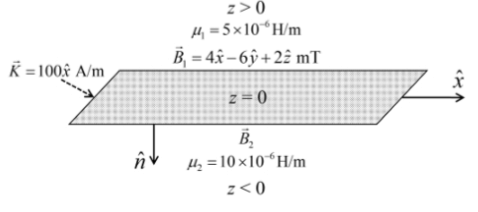
Official Solution
Correct Option: (1)
Step 1: Use the boundary condition for the magnetic field across a surface current. The boundary condition for the magnetic field across the surface of a current is given by:
where is the surface current, and is the unit normal vector to the surface, which is in the -direction (since the surface lies at ). Step 2: Compute the cross product. The cross product is:
Step 3: Apply the boundary condition. Now, using the boundary condition equation:
We have , so the equation becomes:
Step 4: Find the normal component of . The normal component of is in the -direction, which does not change in this case. The normal component of is 2 mT, and using the given values of and , we can calculate the normal component of as . Step 5: Conclusion. Thus, the magnitude of the normal component of is 3.2 mT.
05
PYQ 2025
medium
physicsID: iit-jam-
Consider two media 1 and 2 having permittivities and , respectively. The interface between the two media aligns with the x-y plane. An electric field exists in medium 1. The magnitude of the displacement vector in medium 2 is \rule{1cm{0.15mm} . (up to two decimal places)}
Official Solution
Correct Option: (1)
Step 1: Understanding the Concept:
This problem requires the application of boundary conditions for electromagnetic fields at the interface between two linear dielectric media. The key principle is that the tangential component of the electric field ( ) and the normal component of the electric displacement ( ) are continuous across a boundary with no free surface charge. Step 2: Key Formula or Approach:
The boundary conditions at the interface ( ) are:
1. Tangential component of is continuous:
2. Normal component of is continuous:
The relation between and is .
The interface is the x-y plane, so the normal vector is and tangential vectors lie in the x-y plane. Step 3: Detailed Explanation:
Given:
Permittivity of medium 1:
Permittivity of medium 2:
Electric field in medium 1: First, we separate into its tangential and normal components:
Tangential component (parallel to x-y plane):
Normal component (perpendicular to x-y plane): Apply the boundary condition for the tangential field:
Now, we find the electric displacement vector in medium 1:
Separate into its normal component:
Normal component: (the coefficient of ) Apply the boundary condition for the normal field:
We now have the components to construct the vector . The vector is composed of its tangential part and its normal part .
The normal part is .
So, the full displacement vector in medium 2 is:
The question asks for the magnitude of :
Calculating the numerical value:
The magnitude of in units of , up to two decimal places, is 12.85. Step 4: Final Answer:
The magnitude of the displacement vector is 12.85 .
06
PYQ 2025
medium
physicsID: iit-jam-
Which of the following relations is(are) valid for linear dielectrics?
= Electric field, = Polarization, = Electric displacement, = Permittivity of free space, = Dielectric permittivity, = Electric susceptibility, = Free charge density, = Bound charge density
1
2
3
4
Official Solution
Correct Option: (1)
Step 1: Understanding the Concept:
This question asks to identify the fundamental relations that define and describe the behavior of linear dielectric materials in the presence of an electric field. Linear dielectrics are materials where the induced polarization is directly proportional to the applied electric field. Step 2: Key Formula or Approach:
We need to examine each given equation and determine its validity based on the standard definitions and relationships in the theory of dielectrics. Step 3: Detailed Explanation: (A)
This is the definition of a linear dielectric. The polarization (dipole moment per unit volume) is proportional to the total electric field inside the material. The constant of proportionality is , where is the electric susceptibility, a dimensionless measure of how easily the material polarizes. So, this relation is valid for linear dielectrics by definition. Statement (A) is correct. (B)
The electric displacement is defined as . For a linear dielectric, we can substitute into this definition:
We also define the relationship between and in a linear material as , where is the permittivity of the material.
Comparing the two expressions for , we get:
This is a standard and valid relation for linear dielectrics. Statement (B) is correct. (C)
This is the general definition of the electric displacement vector . It is a fundamental equation in electromagnetism that is valid for all materials, including linear dielectrics, non-linear dielectrics, and even vacuum (where ). Since it is universally valid, it is certainly valid for the specific case of linear dielectrics. Statement (C) is correct. (D)
One of Maxwell's equations (Gauss's law in differential form) states that .
The divergence of the polarization is related to the bound charge density by .
Let's take the divergence of the definition of from (C):
Substitute the expressions for and :
So, the correct relation is . This is Gauss's law for dielectrics, and its main utility is that is related only to the free charges. The statement is incorrect. Statement (D) is incorrect. Step 4: Final Answer:
The valid relations for linear dielectrics are (A), (B), and (C).
07
PYQ 2025
medium
physicsID: iit-jam-
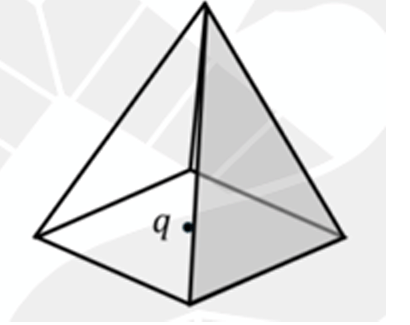
A charge q is placed at the centre of the base of a square pyramid. The net outward electric flux across each of the slanted faces is (Consider permittivity as )
1
2
3
4
Official Solution
Correct Option: (4)
Step 1: Understanding the Concept:
This problem requires finding the electric flux through a part of a surface that encloses a charge. The key tool for solving such problems is Gauss's Law, which relates the total electric flux through a closed surface to the net charge enclosed by it. Since the pyramid is an open surface, we must use a symmetry argument to construct a closed Gaussian surface. Step 2: Key Formula or Approach:
Gauss's Law states that the total electric flux through any closed surface is equal to the net charge enclosed divided by the permittivity of free space .
We will use a symmetry argument by constructing a closed surface where the charge is at a point of high symmetry. Step 3: Detailed Explanation:
1. Constructing a Closed Surface: The given surface is a square pyramid, which is an open surface. The charge is located at the center of its square base. To apply Gauss's Law, we need a closed surface. We can create a symmetrical closed surface by placing an identical, inverted pyramid below the given pyramid, such that they share the same square base. This construction forms a closed square bipyramid (which looks like an octahedron if the faces are equilateral triangles, though that's not required). 2. Applying Gauss's Law: The charge is now at the geometric center of this closed bipyramid. According to Gauss's Law, the total electric flux emanating from the charge through the entire closed surface of the bipyramid is: 3. Using Symmetry: The bipyramid is composed of two identical pyramids (the original one and the inverted one). The charge is symmetrically placed with respect to both pyramids. Therefore, the total flux must be shared equally between the upper pyramid and the lower pyramid. The flux through all the slanted faces of the original (upper) pyramid, , is half of the total flux. Note that there is no flux through the base of the pyramid because the charge lies in the plane of the base, so the electric field lines are parallel to the base surface, making for the base area. 4. Finding Flux through a Single Face: The question asks for the flux across \textit{each} of the slanted faces. The original pyramid has 4 identical slanted faces. Since the charge is at the center of the square base, the flux is distributed equally among these 4 faces due to symmetry. Therefore, the flux through a single slanted face, , is: Step 4: Final Answer:
The net outward electric flux across each of the slanted faces is . Therefore, option (D) is the correct answer.
08
PYQ 2025
medium
physicsID: iit-jam-
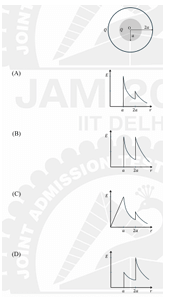
Consider a metal sphere enclosed concentrically within a spherical shell. The inner sphere of radius a carries charge Q. The outer shell of radius 2a also has charge Q. The variation of the magnitude E of the electric field as a function of distance r from the center O is
1
A
2
B
3
C
4
D
Official Solution
Correct Option: (1)
Step 1: Understanding the Concept: The problem asks for the electric field as a function of distance for a system of two concentric spherical conductors. The inner sphere has radius and charge . The outer spherical shell has radius and also has a charge . We need to find in three regions: , , and . The key tool is Gauss's Law for spherically symmetric charge distributions. Step 2: Key Formula or Approach: Gauss's Law for a spherical Gaussian surface of radius concentric with the charge distribution is: We need to determine the enclosed charge for each region. Also, remember that the electric field inside a conductor in electrostatic equilibrium is zero. Step 3: Detailed Explanation: 1. Region 1: (Inside the inner metal sphere) Since the inner sphere is a conductor, the electric field inside it must be zero in electrostatic equilibrium. 2.
Region 2: (Between the inner sphere and the outer shell) Draw a Gaussian surface of radius such that . The charge enclosed, , is the charge on the inner sphere, which is . This field is non-zero and decreases as . At , the field just outside the surface is . This shows a discontinuity, jumping from 0 to a finite value. 3. Inside the material of the outer shell (radius 2a) The outer shell is also a conductor, so the electric field within its material must be zero. To achieve this, the charge from the inner sphere must induce a charge of on the inner surface of the outer shell. The outer shell itself has a total charge of . So, the charge on its outer surface will be . 4.
Region 3: (Outside the outer shell) Draw a Gaussian surface of radius such that . The total charge enclosed, , is the sum of the charge on the inner sphere and the charge on the outer shell. This field also decreases as . Let's check the field values at the boundary . Just inside the outer shell ( ), . Just outside the outer shell ( ), . The field jumps up at . Specifically, .
Summary of E(r) behavior:
: : Discontinuity, jumps from 0 to : , decreases from to : Discontinuity, jumps from to : , decreases from Matching with graphs:
All graphs correctly show for decay for . We need to check the behavior at . The field must jump upwards. Graph (A): Shows an upward jump at . Graph (B): Shows a downward jump at . (Incorrect) Graph (C): Shows a continuous field at . (Incorrect) Graph (D): Shows a downward jump at . (Incorrect) Only Graph (A) correctly shows the upward jump in the electric field at , which is due to the positive charge residing on the outer surface of the shell. Step 4: Final Answer: The electric field is zero inside the inner sphere, varies as between the spheres, and varies as outside the outer shell. There are upward discontinuities at and . Graph (A) correctly depicts this behavior.
09
PYQ 2025
medium
physicsID: iit-jam-
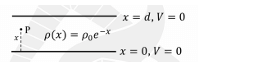
Consider a parallel plate capacitor (distance between the plates d, and permittivity ) as shown in the figure below. The space charge density between the plates varies as . Voltage both at and . The voltage at point P between the plates is} is a constant of appropriate dimensions
1
2
3
4
Official Solution
Correct Option: (1)
Step 1: Understanding the Concept:
This problem involves finding the electric potential in a region between two parallel plates where there is a non-uniform space charge density . The relationship between potential and charge density is given by Poisson's equation. We need to solve this differential equation with the given boundary conditions. Step 2: Key Formula or Approach:
The one-dimensional Poisson's equation relates the second derivative of the electric potential to the charge density and the permittivity :
The electric field is related to the potential by .
The boundary conditions are and . Step 3: Detailed Explanation:
1. Set up the differential equation:
Substitute into Poisson's equation:
2. Integrate to find the Electric Field :
Integrate the equation once with respect to to find the electric field :
where is the first integration constant.
So, .
3. Integrate to find the Potential :
Integrate again with respect to to find the potential :
where is the second integration constant.
4. Apply Boundary Conditions to find the constants:
We are given two boundary conditions: and .
At , : So the potential equation becomes: At , : Solve for :
5. Substitute the constants back into the potential equation:
Let's check the option (A) form: .
This is the negative of our derived expression: .
There seems to be a sign error in the question or the options. Let's re-examine Poisson's equation. In some conventions, it is . If we use that convention, .
Integrating twice gives .
Applying boundary conditions:
.
.
Substituting back:
This exactly matches option (A). The standard definition is and , which gives . The question likely uses the non-standard sign convention for Poisson's equation. Step 4: Final Answer:
By solving the one-dimensional Poisson's equation with a sign convention that leads to a positive result matching the options, we find that . This corresponds to option (A).
10
PYQ 2025
medium
physicsID: iit-jam-
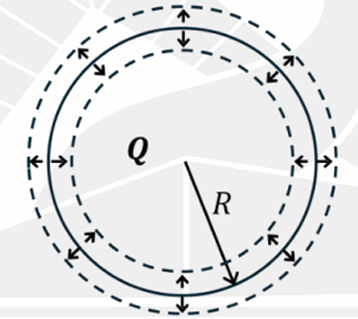
A spherical ball having a uniformly distributed charge Q and radius R pulsates with frequency such that the radius changes by , as shown in the figure below. Which of the following is(are) correct?
1
The net outward electric flux across a spherical surface of radius pulsates with a frequency
2
The net outward electric flux across a spherical surface of radius is
3
The potential fluctuates with frequency at
4
The electric field inside the sphere at will not be time dependent
Official Solution
Correct Option: (2)
Step 1: Understanding the Concept:
This problem involves the application of Gauss's Law to a spherically symmetric charge distribution that is changing in size over time. We need to analyze how the electric flux, electric field, and electric potential behave both inside and outside this pulsating sphere. Step 2: Key Formula or Approach:
1. Gauss's Law: The net electric flux through a closed surface is equal to the total charge enclosed ( ) divided by the permittivity of free space ( ).
2. Electric Field of a Spherical Charge Distribution: For a point outside a spherically symmetric charge distribution (at distance from the center), the electric field is the same as that of a point charge Q located at the center: . Inside the distribution, the field depends on the charge enclosed within radius .
3. Electric Potential: The potential at a distance from the center (outside the sphere) is . Step 3: Detailed Explanation: (A) The net outward electric flux across a spherical surface of radius pulsates with a frequency .
Let the Gaussian surface be a sphere of radius . The radius of the charged ball is , which pulsates. The maximum radius is and the minimum is . The condition ensures that the Gaussian surface is always outside the pulsating charged ball. According to Gauss's Law, the flux depends only on the enclosed charge, . Since the Gaussian surface always encloses the entire charge Q, the enclosed charge is constant and equal to Q. Therefore, the net outward electric flux is constant and does not pulsate. Statement (A) is incorrect. (B) The net outward electric flux across a spherical surface of radius is .
Similar to the reasoning for (A), a spherical surface of radius is always outside the pulsating sphere (since its maximum radius is ). Therefore, this surface always encloses the total charge Q. By Gauss's Law, the net outward electric flux is . This value is constant. Statement (B) is correct. (C) The potential fluctuates with frequency at .
For any point outside a spherically symmetric charge distribution, the electric potential is given by . The point of observation is at a fixed radius , and the total charge Q is constant. The potential at this fixed point depends only on Q and r, neither of which is changing. The pulsation of the sphere's radius does not affect the potential at a fixed point outside the sphere. Therefore, the potential does not fluctuate. Statement (C) is incorrect.
\textit{Note: This is true in electrostatics. If we consider radiation due to accelerating charges (as the pulsating surface charges are accelerating), there would be an electromagnetic wave, and the potential would become more complex (Liénard-Wiechert potential). However, for a typical electrostatics problem context, we assume the quasi-static approximation holds, where the fields adjust instantaneously. In this approximation, C is incorrect.} (D) The electric field inside the sphere at will not be time dependent.
Let the time-varying radius of the sphere be . The charge Q is uniformly distributed throughout the volume of the sphere. The charge density is .
Consider a point at a fixed radius . The radius of the sphere varies between and . Thus, the point is always inside the sphere.
Using Gauss's Law for a point inside the sphere, the electric field is due to the charge enclosed within radius :
The enclosed charge is .
So, the electric field is:
Since is pulsating with frequency , the electric field at the fixed point is time-dependent. It fluctuates as . Statement (D) is incorrect. Step 4: Final Answer:
Based on the analysis, only statement (B) is correct.
11
PYQ 2025
medium
physicsID: iit-jam-
A magnetic field is given by where is the magnetic vector potential. If , the corresponding current density is
(a and b are non-zero constants)}
1
2
3
4
Official Solution
Correct Option: (4)
Step 1: Understanding the Concept:
The relationship between magnetic vector potential , magnetic field , and current density is governed by Maxwell's equations. Specifically, the magnetic field is the curl of the vector potential, and for steady currents, the curl of the magnetic field is proportional to the current density (Ampere's Law). Step 2: Key Formula or Approach:
1. First, calculate the magnetic field from the magnetic vector potential using the relation:
2. Second, calculate the current density from the magnetic field using Ampere's Law in differential form: Step 3: Detailed Explanation: Part 1: Calculate
Given . In component form, , , .
The curl in Cartesian coordinates is given by: Part 2: Calculate
Now we find the curl of . In component form, , , .
Finally, using Ampere's law: Step 4: Final Answer:
The corresponding current density is . This matches option (D).
12
PYQ 2025
medium
physicsID: iit-jam-
A surface current density exists on a thin strip of width b, as shown in the figure below. The associated surface current is (a is a constant of appropriate dimensions)
1
2
3
4
Official Solution
Correct Option: (1)
Step 1: Understanding the Concept:
The problem asks for the total surface current ( ) flowing through a strip, given the surface current density ( ). Surface current density is defined as the current per unit length perpendicular to the flow. To find the total current, we need to integrate the current density over the width of the strip. Step 2: Key Formula or Approach:
The total current flowing through a surface is found by integrating the surface current density over the path perpendicular to the current flow. If the current flows in the x-direction and varies with y, the infinitesimal current through a small width is . The total current is:
The integration is performed over the width of the strip. Step 3: Detailed Explanation:
1. Identify the given quantities: The surface current density is given as . The diagram indicates that the current is flowing in the positive x-direction ( ). The current density is uniform in x but varies with y. The strip extends from to .
2. Set up the integral for the total current: To find the total current passing through the strip, we need to integrate the magnitude of the current density, , over the width of the strip, which is along the y-axis from 0 to b.
3. Evaluate the integral: The constant can be taken out of the integral. The integral of is . Now, apply the limits of integration: Since : Step 4: Final Answer:
The associated surface current is . This corresponds to option (A).
13
PYQ 2025
medium
physicsID: iit-jam-
Consider a slowly charging parallel plate capacitor (distance between the plates is d) having circular plates each with an area A, as shown in the figure below. An electric field of magnitude exists between the plates while charging. The associated magnitude of the magnetic field B at the periphery (outer edge) of the capacitor is (Neglect fringe effects)
1
2
3
4
Official Solution
Correct Option: (1)
Step 1: Understanding the Concept:
This problem deals with the magnetic field produced by a changing electric field, a concept central to Maxwell's equations. Specifically, we need to use the Ampere-Maxwell law, which includes the displacement current term responsible for generating a magnetic field from a time-varying electric flux. Step 2: Key Formula or Approach:
The integral form of the Ampere-Maxwell law is:
where is the displacement current, given by .
Inside the capacitor, there is no conduction current ( ). The electric flux is .
We will apply this law to a circular Amperian loop of radius R at the periphery of the capacitor plates. We also use the relation . Step 3: Detailed Explanation:
1. Set up the Amperian loop: Consider a circular Amperian loop of radius R, where R is the radius of the capacitor plates. The periphery of this loop coincides with the outer edge of the capacitor. The area of the plates is , so the radius is .
2. Apply Ampere-Maxwell Law: The law states . By symmetry, the magnetic field has a constant magnitude B along the Amperian loop and is tangential to it. The left-hand side (LHS) becomes:
3. Calculate the electric flux and its time derivative: The electric field is uniform between the plates and given by . The electric flux through the Amperian loop is: The time derivative of the electric flux is:
4. Equate and solve for B: Substitute the LHS and the derivative of flux into the Ampere-Maxwell equation: Using : Solve for B:
5. Substitute the radius R in terms of area A: We have . Substitute this into the expression for B: Rewriting this to match the options:
This matches option (A). Step 4: Final Answer:
The magnitude of the magnetic field B at the periphery of the capacitor is .