Electrostatics
17 previous year questions.
High-Yield Trend
Chapter Questions 17 MCQs
A sphere of radius has a uniform charge density . A sphere of smaller radius is cut out from the original sphere, as shown in the figure. The center of the cut-out sphere lies at . After the smaller sphere has been cut out, the magnitude of the electric field at is . The value of the integer is: 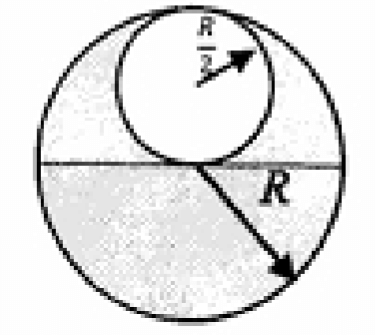
In a coaxial cable, the radius of the inner conductor is 2 mm and that of the outer one is 5 mm. The inner conductor is at a potential of 10 V, while the outer conductor is grounded. The value of the potential at a distance of 3.5 mm from the axis is: 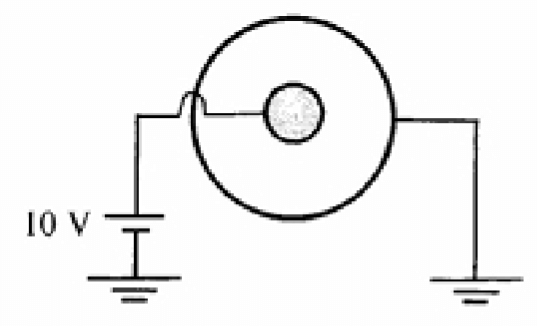
A sphere of radius has a uniform charge density . A sphere of smaller radius is cut out from the original sphere, as shown in the figure below. The center of the cut-out sphere lies at . After the smaller sphere has been cut out, the magnitude of the electric field at is . The value of the integer is: 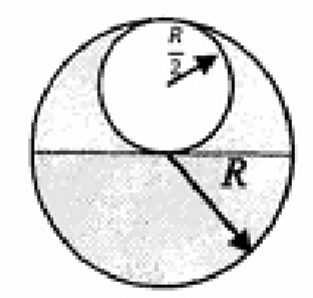
In a coaxial cable, the radius of the inner conductor is 2 mm and that of the outer one is 5 mm. The inner conductor is at a potential of 10 V, while the outer conductor is grounded. The value of the potential at a distance of 3.5 mm from the axis is: 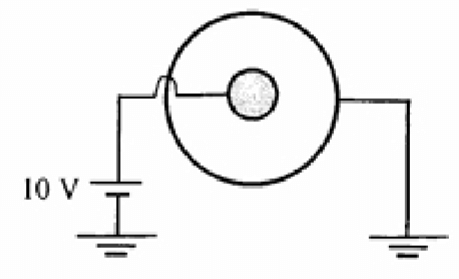
Given a spherically symmetric charge density (k being a constant), the electric field for is (take the total charge as )
Let the electric field in some region be given by . From this we conclude that
A small spherical ball having charge and mass , is tied to a thin massless non-conducting string of length . The other end of the string is fixed to an infinitely extended thin non-conducting sheet with uniform surface charge density . Under equilibrium, the string makes an angle of 45° with the sheet as shown in the figure. Then is given by 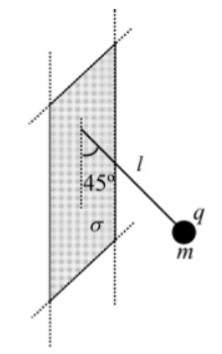
The surface density of bound charges on the inner and outer surfaces are and , respectively. The volume density of bound charges inside the dielectric is zero.
About Electrostatics - IIT-JAM-PH
Electrostatics is a vital chapter for IIT-JAM-PH aspirants. Mastering the concepts covered in this chapter is essential for securing a top rank.
By rigorously practicing the previous year questions associated with this chapter, you can identify high-yield topics, understand the examiner's perspective, and boost your confidence during the actual exam.
Frequently Asked Questions
Why focus on Electrostatics PYQs?
Analyzing PYQs for this specific chapter reveals the most frequently tested concepts and the typical complexity of questions, allowing you to tailor your study plan efficiently.
How to best use this analysis?
Review the topic breakdown to see which sub-topics within Electrostatics carry the most weight. Then, tackle the questions iteratively to solidify your understanding.