Rotational Motion And Torque
11 previous year questions.
High-Yield Trend
Chapter Questions 11 MCQs
A pendulum is made of a massless string of length and a small bob of negligible size and mass . It is released making an angle (<< 1 rad) from the vertical. When passing through the vertical, the string slips a bit from the pivot so that its length increases by a small amount ( ) in negligible time. If it swings up to angle on the other side before starting to swing back, then to a good approximation, which of the following expressions is correct? 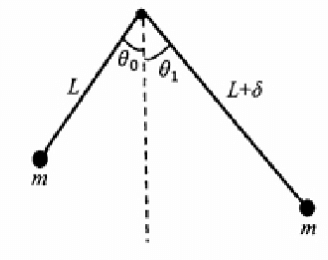
A uniform rigid meter-scale is held horizontally with one of its end at the edge of a table and the other supported by hand. Some coins of negligible mass are kept on the meter scale as shown in the figure. As the hand supporting the scale is removed, the scale starts rotating about its edge on the table and the coins start moving. If a photograph of the rotating scale is taken soon after, it will look closest to: 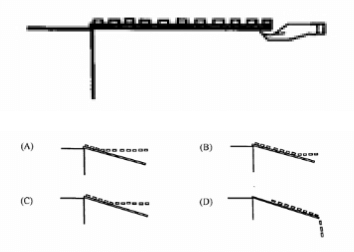
A uniform rigid meter-scale is held horizontally with one of its end at the edge of a table and the other supported by hand. Some coins of negligible mass are kept on the meter scale as shown in the figure. As the hand supporting the scale is removed, the scale starts rotating about its edge on the table and the coins start moving. If a photograph of the rotating scale is taken soon after, it will look closest to: 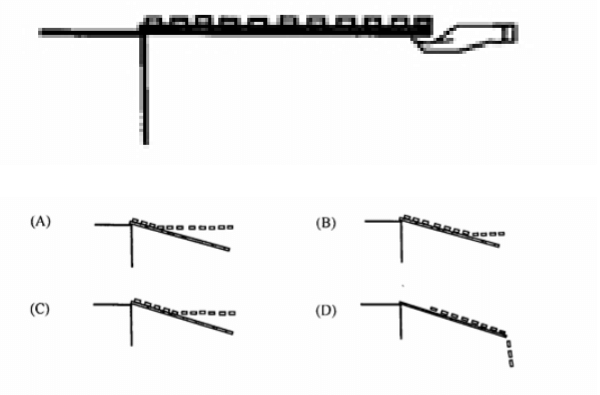
(Take the length of the day before the increment as 24 hours. Assume the Earth to be a sphere with uniform density.)
The angular momentum of a particle relative to the origin varies with time ( ) as , where . The angle between and the torque acting on the particle becomes after a time of ............ s.
About Rotational Motion And Torque - IIT-JAM-PH
Rotational Motion And Torque is a vital chapter for IIT-JAM-PH aspirants. Mastering the concepts covered in this chapter is essential for securing a top rank.
By rigorously practicing the previous year questions associated with this chapter, you can identify high-yield topics, understand the examiner's perspective, and boost your confidence during the actual exam.
Frequently Asked Questions
Why focus on Rotational Motion And Torque PYQs?
Analyzing PYQs for this specific chapter reveals the most frequently tested concepts and the typical complexity of questions, allowing you to tailor your study plan efficiently.
How to best use this analysis?
Review the topic breakdown to see which sub-topics within Rotational Motion And Torque carry the most weight. Then, tackle the questions iteratively to solidify your understanding.