Chemical Kinetics
13 previous year questions.
High-Yield Trend
Chapter Questions 13 MCQs
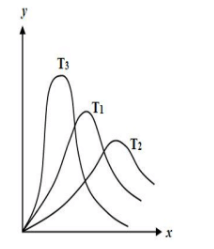
The following graph is obtained for a gas at different temperatures (T1, T2, T3). What is the correct order of temperature? (x-axis = velocity; y-axis = number of molecules)
At 298 K, for a first order reaction (A → P) the following graph is obtained. The rate constant (in s ) and initial concentration (in mol L ) of ‘A’ are respectively:
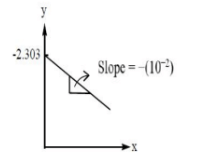
(R = 8.3 J mol K , )
Identify the correct statements from the following:
For an ideal gas, the compressibility factor is 1.0.
The kinetic energy of NO (g) (molar mass = 30 g mol-1) at T(K) is J mol-1. The kinetic energy of N2O4 (g) (molar mass = 92 g mol-1) at T(K) is J mol-1.
The rate of diffusion of a gas is inversely proportional to the square root of its density.
A hydrocarbon containing C and H has 92.3% C. When 39 g of hydrocarbon was completely burnt in O2, x moles of water and y moles of CO2 were formed. x moles of water is sufficient to liberate 0.75 moles of H2 with Na metal. What is the weight (in g) of oxygen consumed?
Statement - I: For isothermal irreversible change of an ideal gas, Statement - II: For adiabatic change, The correct answer is:
Observe the following stoichiometric equation
P4 + 3 OH- + 3 H2O → PH3 + 3 OH-.
What is the conjugate acid of OH- ?
Given below are two statements:
Statement I: Viscosity of liquid decreases with an increase in temperature.
Statement II: The units of viscosity are kg m-1 s-2.
At 300 K, for the reaction A → P, the ∆Ssys is 5 J K-1 mol-1. What is the heat absorbed (in kJ mol-1) by the system?
About Chemical Kinetics - AP-EAMCET
Chemical Kinetics is a vital chapter for AP-EAMCET aspirants. Mastering the concepts covered in this chapter is essential for securing a top rank.
By rigorously practicing the previous year questions associated with this chapter, you can identify high-yield topics, understand the examiner's perspective, and boost your confidence during the actual exam.
Frequently Asked Questions
Why focus on Chemical Kinetics PYQs?
Analyzing PYQs for this specific chapter reveals the most frequently tested concepts and the typical complexity of questions, allowing you to tailor your study plan efficiently.
How to best use this analysis?
Review the topic breakdown to see which sub-topics within Chemical Kinetics carry the most weight. Then, tackle the questions iteratively to solidify your understanding.