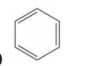
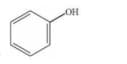
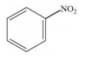
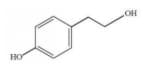
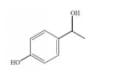
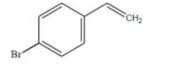
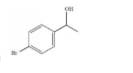
In the Wurtz-Fitting reaction, a compound reacts with an alkyl halide. What is ?
1
2
3
4
Official Solution
Correct Option:
(2)
- The Wurtz-Fitting reaction involves coupling an alkyl halide with an aromatic halide in the presence of sodium. - The correct compound must be a halogenated benzene that can react in this process. - Among the options, Option (2) has a halogen-substituted benzene ring, making it the correct choice.
02
PYQ 2024
medium
chemistryID: ap-eamce
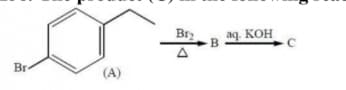
The product (C) in the given reaction sequence is:
1
2
3
4
Official Solution
Correct Option:
(4)
- The reaction sequence involves bromination followed by nucleophilic substitution with aqueous . - The final product is hydroxylated benzene where bromine is replaced with -OH. Thus, the correct answer is Option (4).
03
PYQ 2024
easy
chemistryID: ap-eamce
The diffraction pattern of a crystalline solid gave a peak at . What is the distance (in cm) between the layers that gave this peak?
1
cm
2
cm
3
cm
4
cm
Official Solution
Correct Option:
(3)
Step 1: Using Bragg’s Law. Bragg’s equation:
For first-order diffraction ( ):
Step 2: Substituting Values.
Thus, the correct answer is (3).
04
PYQ 2024
hard
chemistryID: ap-eamce
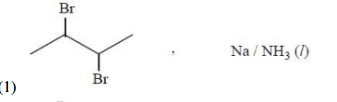
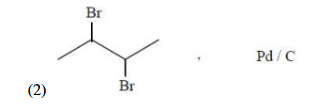
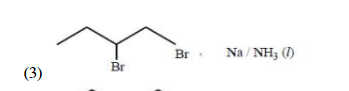
A dibromide on dehydrohalogenation gave , which on reduction with gave a non-polar isomer of . What are and respectively?
1
2
3
4
Official Solution
Correct Option:
(1)
Step 1: Identifying and . - is a vicinal dibromide (contains two Br atoms on adjacent carbons). - Dehydrohalogenation ( ) leads to the formation of an alkyne (Y).
Step 2: Identifying . - Reduction of using Na/NH (liq) results in a non-polar alkene (trans-isomer). - Pd/C reduction would give a cis-alkene, which is polar. Since the question specifies a non-polar product, the reduction must have been performed using Na/NH (liq), leading to a trans-alkene. Thus, the correct answer is (1).
05
PYQ 2024
medium
chemistryID: ap-eamce
The sequence of reagents required to convert ethyl bromide to propanal is:
1
2
3
4
Official Solution
Correct Option:
(1)
Step 1: Understanding the conversion steps 1. Ethyl bromide reacts with silver acetate (CH₃COOAg) to form ethyl acetate. 2. DIBAL-H (Diisobutylaluminium hydride) selectively reduces ethyl acetate to propanal. 3. Hydrolysis ensures complete conversion to aldehyde without further reduction to alcohol.
06
PYQ 2024
medium
chemistryID: ap-eamce
Some substances are given below Ag: CO (s); SiO (s); ZnS (s) SO (s); A/N: HCl (s); H O (s) The number of molecular solids and network solids in the above list is respectively.
1
3, 3
2
2, 4
3
1, 4
4
4, 2
Official Solution
Correct Option:
(4)
- Molecular solids are those which consist of discrete molecules held together by van der Waals forces. - Network solids are those where atoms are covalently bonded in a continuous network. From the list: - Ag (Silver) is a metallic solid, so it is not counted. - CO , SiO , and ZnS are network solids. - SO , HCl, and H O are molecular solids. Thus, the number of molecular solids is 2, and the number of network solids is 4.
07
PYQ 2024
medium
chemistryID: ap-eamce
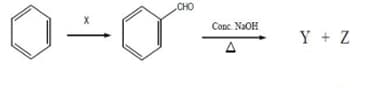
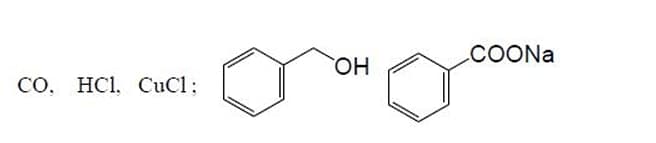
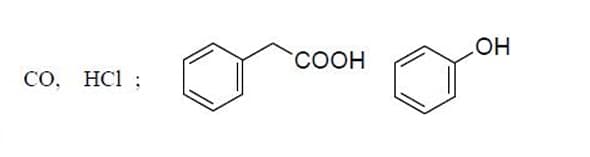
What are X, Y, Z in the following reaction sequence respectively?
1
2
3
4
Official Solution
Correct Option:
(2)
Step 1: Understanding the reaction sequence 1. Gattermann-Koch reaction: The first step involves CO, HCl, and CuCl, leading to the formation of benzaldehyde. 2. Cannizzaro reaction: Strong base (NaOH) induces disproportionation, producing hydroxybenzyl benzoate and sodium benzoate.
About Organic Reactions - AP-EAMCET
Organic Reactions is a vital chapter for AP-EAMCET aspirants. Mastering the concepts covered in this chapter is essential for securing a top rank.
By rigorously practicing the previous year questions associated with this chapter, you can identify high-yield topics, understand the examiner's perspective, and boost your confidence during the actual exam.
Frequently Asked Questions
Why focus on Organic Reactions PYQs?
Analyzing PYQs for this specific chapter reveals the most frequently tested concepts and the typical complexity of questions, allowing you to tailor your study plan efficiently.
How to best use this analysis?
Review the topic breakdown to see which sub-topics within Organic Reactions carry the most weight. Then, tackle the questions iteratively to solidify your understanding.