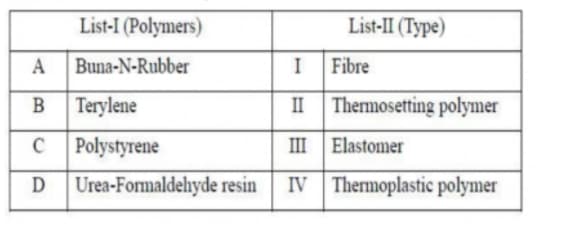
- Buna-N rubber is categorized as an Elastomer, making match with III.
- Terylene is a Fibre polymer, which aligns with I.
- Polystyrene falls under Thermoplastic polymers, so corresponds to IV.
- Urea-Formaldehyde resin is a Thermosetting polymer, thus aligns with II. Therefore, the correct answer is Option (1): .
02
PYQ 2024
medium
chemistryID: ap-eamce
Polymers that can be softened on heating and hardened on cooling are called
1
Thermosetting polymers
2
Bakelite
3
Fibres
4
Thermoplastic polymers
Official Solution
Correct Option:
(4)
Polymer Behavior on Heating Analysis
Thermoplastic polymers are materials that can be softened when heated and hardened when cooled. This is due to their molecular structure, which allows the polymer chains to slide past each other when heated, making them moldable. Upon cooling, they solidify into the desired shape. Examples include polythene, polystyrene, and PVC.
In contrast, thermosetting polymers, like Bakelite, harden permanently when heated and cannot be reshaped after that. Fibres are not specific to this property but are a type of polymer used in textiles.
Conclusion:
Therefore, the correct answer is thermoplastic polymers.
03
PYQ 2024
medium
chemistryID: ap-eamce
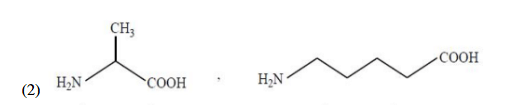
A polymer X is biodegradable and is obtained from the monomers Y, Z. What are Y and Z?
1
2
3
4
Official Solution
Correct Option:
(4)
Step 1: Identifying the Biodegradable Polymer Components. Biodegradable polymers are those that can be broken down by microorganisms into natural substances such as water and carbon dioxide.
Step 2: Recognizing Monomers. - A well-known biodegradable polymer is Polyhydroxyalkanoates (PHAs), which are derived from hydroxy acids. - The monomers given in option (4) contain hydroxyl (-OH) and carboxyl (-COOH) functional groups, making them ideal candidates for forming biodegradable polymers. - Other options include amino acids and linear dicarboxylic acids, which are less commonly used in biodegradable polymer formation.
Step 3: Conclusion. Since hydroxy acids serve as monomers for biodegradable polymers like polyhydroxybutyrate (PHB), option (4) is the correct choice.
04
PYQ 2024
medium
chemistryID: ap-eamce
PHBV is a biodegradable polymer of two monomers X and Y. X and Y respectively are:
1
2
3
4
Official Solution
Correct Option:
(2)
Step 1: Understanding PHBV PHBV (Poly(3-hydroxybutyrate-co-3-hydroxyvalerate)) is a biodegradable polymer synthesized from two monomers: - -hydroxybutanoic acid ( ) - -hydroxypentanoic acid ( )
Step 2: Identifying the Correct Answer Since option (2) correctly matches these monomers, it is the right answer.
05
PYQ 2024
medium
chemistryID: ap-eamce
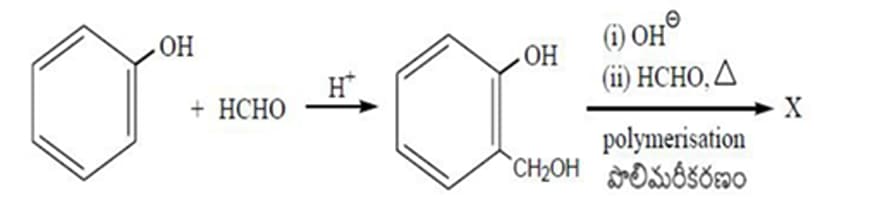
The X formed in the following reaction sequence and its structural type are respectively.
1
Novolac - linear polymer
2
Bakelite - cross linked polymer
3
Novolac - cross linked polymer
4
Bakelite - linear polymer
Official Solution
Correct Option:
(2)
The reaction sequence shown is for Bakelite synthesis, which is a cross-linked polymer. The initial reaction involves the condensation of formaldehyde (HCHO) with phenol, followed by polymerisation under heat. This results in a three-dimensional network, characteristic of Bakelite, which is a cross-linked polymer.
About Polymers - AP-EAMCET
Polymers is a vital chapter for AP-EAMCET aspirants. Mastering the concepts covered in this chapter is essential for securing a top rank.
By rigorously practicing the previous year questions associated with this chapter, you can identify high-yield topics, understand the examiner's perspective, and boost your confidence during the actual exam.
Frequently Asked Questions
Why focus on Polymers PYQs?
Analyzing PYQs for this specific chapter reveals the most frequently tested concepts and the typical complexity of questions, allowing you to tailor your study plan efficiently.
How to best use this analysis?
Review the topic breakdown to see which sub-topics within Polymers carry the most weight. Then, tackle the questions iteratively to solidify your understanding.