AP-EAMCET SERIES
Chemistry

Rate Of A Chemical Reaction

26 previous year questions.

Volume: 26 Ques
Yield: High

High-Yield Trend

25
2024
1
2019

Chapter Questions
26 MCQs

01
PYQ 2019
medium
chemistry ID: ap-eamce
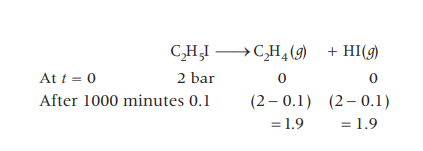
In the first order thermal decomposition of , the reactant in the beginning exerts a pressure of bar in a closed vessel at . If the partial pressure of the reactant is bar after minutes at the same temperature the rate constant in is
1
2
3
4
02
PYQ 2024
medium
chemistry ID: ap-eamce

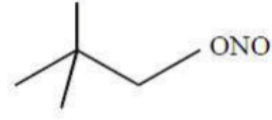
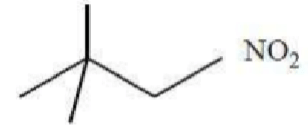
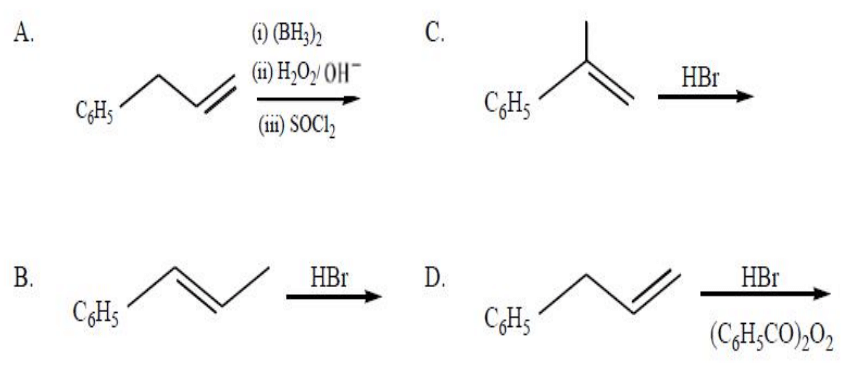
The product of which of the following reactions undergo hydrolysis by SN1 mechanism?
1
C,D ONLY
2
A,B,C ONLY
3
B,C ONLY
4
A,D ONLY
03
PYQ 2024
medium
chemistry ID: ap-eamce
A mixture of ethyl iodide and n-propyl iodide is subjected to Wurtz reaction. The hydrocarbon which will not be formed is:
1
Butane
2
Propane
3
Pentane
4
Hexane
04
PYQ 2024
medium
chemistry ID: ap-eamce

Two statements are given below:
Statement I: Octet theory accounts for the shape of the molecules.
Statement II: Octet theory does not explain the relative stability of the molecules.
The correct answer is:

1
Both statement-I and statement-II are correct
2
Both statement-I and statement-II are not correct
3
Statement-I is correct but statement-II is not correct
4
Statement-I is not correct but statement-II is correct
05
PYQ 2024
medium
chemistry ID: ap-eamce
Observe the following reactions. Identify the reaction in which the hybridisation of the underlined atom is changed:
1
2
3
4
06
PYQ 2024
medium
chemistry ID: ap-eamce

Which of the following orders are correct regarding their covalent bond character?
i. KF KI
ii. SnCl2 SnCl4
iii. NaCl CuCl

1

i, ii, iii

2

i, iii only

3

ii, iii only

4

i, ii only

07
PYQ 2024
medium
chemistry ID: ap-eamce

The correct statements about the adsorption of gas on solid adsorbent are:
Adsorption is always exothermic. Physisorption may transform into chemisorption at high temperature. Physisorption increases with increasing temperature but chemisorption decreases with increasing temperature. In physisorption enthalpy of adsorption is 100 kJ mol .

1

II & IV only

2

III & IV only

3

II & III only

4

I & II only

08
PYQ 2024
medium
chemistry ID: ap-eamce
What are and respectively in the following reaction sequence? \begin{center} \includegraphics[]{139.png} \end{center}
1
\includegraphics[]{139a.png}
2
\includegraphics[]{139b.png}
3
\includegraphics[]{139c.png}
4
\includegraphics[]{139d.png}
09
PYQ 2024
medium
chemistry ID: ap-eamce

Kc for the reaction is 39.0. In a closed one-litre flask, one mole of was heated to . What are the concentrations of and (in mol L ) respectively at equilibrium?
1
2
3
4
10
PYQ 2024
easy
chemistry ID: ap-eamce
In the reaction of sulfur with concentrated sulfuric acid, the oxidised product is X and reduced product is Y. X and Y are respectively:
1
2
3
4
11
PYQ 2024
easy
chemistry ID: ap-eamce
An isomer of C₆H₁₂ on reaction with Br₂/ light gave only one isomer C₆H₁₁Br (X). Reaction of X with AgNO₃ gave Y as the major product. What is Y?
1

2

3

4

12
PYQ 2024
medium
chemistry ID: ap-eamce
Styrene on reaction with reagent X gave Y, which on hydrolysis followed by oxidation gave Z. Z gives positive 2,4-DNP test but does not give iodoform test. What are X and Z respectively?
1

2

3

4
13
PYQ 2024
hard
chemistry ID: ap-eamce

The standard reduction potentials of , , , and are 0.0, +0.34, -0.76, and +0.97 V respectively. Observe the following reactions:
I.
II.
III.
Which reactions do not liberate gas?

1
II, III only
2
I, II only
3
I, III only
4
I, II, III
14
PYQ 2024
medium
chemistry ID: ap-eamce

Identify the sets of species having the same bond order:
(i)
(ii) CO, NO
(iii) ,
(iv) ,
The correct option is:

1
ii only
2
i, ii, iv only
3
ii, iv only
4
i, ii, iii only
15
PYQ 2024
medium
chemistry ID: ap-eamce
A P is a first-order reaction. At 27°C, the time taken for the completion of 20% of the reaction is min. The time taken for the completion of 80% of the reaction is min at the same temperature. What is the value of ?
1
2
3
4
16
PYQ 2024
medium
chemistry ID: ap-eamce
The rate constant of a first-order reaction is at 298K. What is the rate constant of the reaction at 350 K if its activation energy is 50.1 kJ mol (R = 8.314 J K mol )?
1
0.592 s
2
0.692 s
3
0.792 s
4
0.892 s
17
PYQ 2024
medium
chemistry ID: ap-eamce
What are Y and Z respectively in the following reaction sequence? \begin{center} \includegraphics[]{155.png} \end{center}
1
\includegraphics[]{155a.png}
2
\includegraphics[]{155b.png}
3
\includegraphics[]{155c.png}
4
\includegraphics[]{155d.png}
18
PYQ 2024
medium
chemistry ID: ap-eamce
The ratio of Xe: required in the above reaction is:
1

2

3

4

19
PYQ 2024
medium
chemistry ID: ap-eamce

At 298 K, the value of for the reaction is mol min . What is the rate (in mol min ) of this reaction?

1

2

3

4

20
PYQ 2024
easy
chemistry ID: ap-eamce

Observe the following reactions:


The enthalpy of dilution, in kJ/mol , is:

1
2
3
4
21
PYQ 2024
medium
chemistry ID: ap-eamce
Hydrolysis of an alkyl bromide X (C H Br) follows first-order kinetics. Reaction of X with Mg in dry ether followed by treatment of D O gave Y. What is Y?
1
\includegraphics[]{156a.png}
2
\includegraphics[]{156b.png}
3
\includegraphics[]{156c.png}
4
\includegraphics[]{156d.png}
22
PYQ 2024
medium
chemistry ID: ap-eamce
At K, the equilibrium constant for the reaction is 1.6 10 . If 10 bar of HBr is introduced into a sealed vessel at K, the equilibrium pressure of HBr (in bar) is approximately:
1

2

3

4
23
PYQ 2024
medium
chemistry ID: ap-eamce
At T(K), the decomposition of N2O5(g) is a first-order reaction. The initial pressure of N2O5(g) is 'a' atm. After time, t, the total pressure of the reaction is 'p' atm. The rate constant (k) of the reaction is
1
2
3
4
24
PYQ 2024
medium
chemistry ID: ap-eamce
Arrange the following molecules in decreasing order of their dipole moments:

1
2
3
4
25
PYQ 2024
medium
chemistry ID: ap-eamce
The wavenumber of the first line of the Lyman series of the hydrogen spectrum is equal to the wavenumber of the second line of the Balmer series of ion. What is ?
1
2
3
4
26
PYQ 2024
medium
chemistry ID: ap-eamce
The rate constant of a first order reaction at 400 K and 500 K is respectively and . What is the approximate activation energy (in kJ/mol )? (R = 8.3 J mol K , log 2 = 0.3)
1

2

3

4