The number of –OH groups in open chain and ring structures of D-glucose are respectively
1
4, 5
2
5, 4
3
5, 5
4
6, 5
Official Solution
Correct Option:
(2)
D-Glucose Functional Group Analysis
Step 1: Understanding the structure of D-glucose
D-glucose exists in two structural forms:
Open-chain form: The open-chain structure of D-glucose contains one aldehyde (-CHO) functional group and five hydroxyl (-OH) groups attached to the carbon atoms.
Cyclic (ring) form: When D-glucose undergoes cyclization to form a pyranose ring (as in the Haworth projection), the aldehyde group reacts with one of the hydroxyl groups to form a hemiacetal, resulting in the formation of a six-membered ring. In this form, the number of hydroxyl groups remains five.
Step 2: Identifying the correct answer
In the open-chain form, there are five hydroxyl (-OH) groups.
In the ring form, there are still five hydroxyl (-OH) groups (since the aldehyde group forms a hemiacetal but does not contribute an additional hydroxyl group).
Conclusion:
Thus, the correct answer is: (B) 5, 5
02
PYQ 2024
medium
chemistryID: ap-eamce
Which complex among the following is most paramagnetic?
1
[Co(NH ) ]
2
[Co(NH ) ]
3
[Co(H O) ]
4
[Co(H O) ]
Official Solution
Correct Option:
(4)
Paramagnetism of Cobalt Complexes Analysis
The paramagnetism of a complex is determined by the presence of unpaired electrons. For the given complexes:
In , Co is in a +3 oxidation state (Co3+), which has a configuration, leading to fewer unpaired electrons and lower paramagnetism.
In , Co is in a +2 oxidation state (Co2+), which has a configuration, allowing for more unpaired electrons and higher paramagnetism.
In , Co is in a +2 oxidation state (Co2+), again with a configuration, which is paramagnetic but not as much as the next complex.
In , Co is in a +3 oxidation state (Co3+), which leads to a configuration. The water ligands are weak field ligands, so the electrons do not pair up, resulting in the maximum number of unpaired electrons and the highest paramagnetism.
Conclusion:
Therefore, the complex is the most paramagnetic.
Note: There seems to be a contradiction within the provided reasoning. A configuration, in a *strong field* environment, leads to all electrons paired and *diamagnetism*. A weak field would have unpaired electrons and be *paramagnetic*. This needs careful checking against spectrochemical series and ligand field theory. The initial claim that [Co(H2O)6]3+ has *maximum* unpaired electrons needs rigorous justification.
03
PYQ 2024
medium
chemistryID: ap-eamce
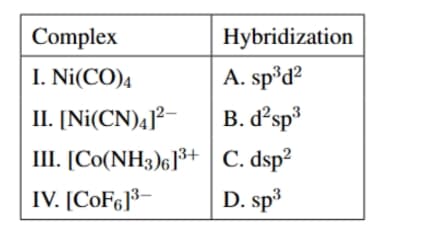
Match the complexes in list-I with their hybridization in list-II.
1
I-C, II-D, III-A, IV-B
2
I-D, II-C, III-A, IV-B
3
I-D, II-C, III-B, IV-A
4
I-C, II-D, III-B, IV-A
Official Solution
Correct Option:
(3)
The hybridization of the complexes can be determined by the number of ligands and their geometry. Here are the correct matches:
- Ni(CO) : The complex is tetrahedral, hence sp .
- [Ni(CN) ] : The complex is square planar, requiring dsp hybridization.
- [Co(NH ) ] : The complex is octahedral, so the hybridization is d sp .
- [CoF ] : The complex is octahedral, so sp hybridization.
About Coordination Chemistry - AP-EAMCET
Coordination Chemistry is a vital chapter for AP-EAMCET aspirants. Mastering the concepts covered in this chapter is essential for securing a top rank.
By rigorously practicing the previous year questions associated with this chapter, you can identify high-yield topics, understand the examiner's perspective, and boost your confidence during the actual exam.
Frequently Asked Questions
Why focus on Coordination Chemistry PYQs?
Analyzing PYQs for this specific chapter reveals the most frequently tested concepts and the typical complexity of questions, allowing you to tailor your study plan efficiently.
How to best use this analysis?
Review the topic breakdown to see which sub-topics within Coordination Chemistry carry the most weight. Then, tackle the questions iteratively to solidify your understanding.