A mixture consists of two radioactive materials and with half-lives of 20 s and 10 s respectively. Initially, the mixture has 40 g of and 160 g of . The amount of the two in the mixture will become equal after
1
60 s
2
80 s
3
20 s
4
40 s
Official Solution
Correct Option: (4)
The decay equation for a radioactive substance is: For : For : Setting : Solving for : Thus, the correct answer is 40 s.
02
PYQ 2024
easy
physicsID: ap-eamce
A hydrogen atom falls from nth higher energy orbit to first energy orbit (n = 1).
The energy released is equal to 12.75 eV. The nth orbit is
1
2
3
4
Official Solution
Correct Option: (1)
Step 1: The energy released during the transition is given by the Rydberg formula: Step 2: Substituting and , the energy released is: Step 3: Given that eV, we solve for : Step 4: Solving for : Thus, the correct answer is option (1), .
03
PYQ 2024
medium
physicsID: ap-eamce
The principal quantum number corresponding to the excited state of ion, if on transition to the ground state two photons in succession with wavelengths and are emitted:
1
2
3
4
Official Solution
Correct Option: (3)
Step 1: Using the Rydberg Formula For hydrogen-like species, the Rydberg formula for the wavelength of emitted photons is: where: - (Rydberg constant),
- for ,
- and are the quantum numbers of the final and initial states. Step 2: Determining the Energy Levels For the first transition, the given wavelength is , so: Solving for and , this corresponds to the transition from to . For the second transition with : This corresponds to the transition from to . Thus, the electron was initially in the state before transitioning to the ground state. Final Answer: The principal quantum number for the excited state of is , which matches option (3).
04
PYQ 2024
medium
physicsID: ap-eamce
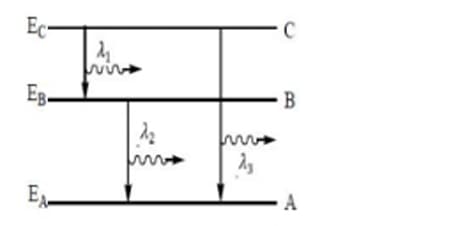
Energy levels A, B, and C of a certain atom correspond to increasing values of energy, i.e., . If and are the wavelengths of a photon corresponding to the transitions shown, then:
1
2
3
4
Official Solution
Correct Option: (4)
Step 1: Use the Energy Relation for Wavelengths From energy conservation:
Since energy and wavelength are related by:
we get:
Dividing by :
Step 2: Solve for
05
PYQ 2024
medium
physicsID: ap-eamce
If the bonding energy of the electron in a hydrogen atom is 13.6 eV, then the energy required to remove an electron from the first excited state of Li is
1
122.4 eV
2
3.4 eV
3
13.6 eV
4
30.6 eV
Official Solution
Correct Option: (4)
Energy levels for hydrogen-like atoms are given by: For Li (Z = 3), the first excited state corresponds to : Thus, the correct answer is 30.6 eV.
06
PYQ 2024
easy
physicsID: ap-eamce
The decrease in each day in the Uranium mass of the material in a Uranium reactor operating at a power of 12 MW is (Energy released in one fission is about 200 MeV)
1
kg
2
g
3
kg
4
g
Official Solution
Correct Option: (4)
Step 1: Energy released per fission of Uranium is 200 MeV. Step 2: Power given as 12 MW. We convert it into joules per second: Step 3: Convert the energy released per fission into joules: Step 4: Calculate the number of fissions per second: Step 5: Total mass lost per second: Thus, the correct answer is option (4), g.