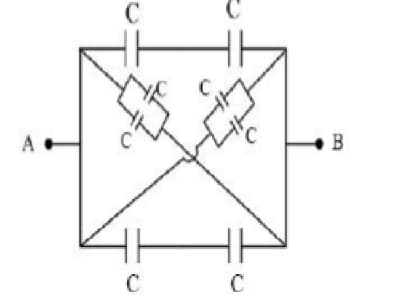
Eight capacitors each of capacity µF are arranged as shown in the figure. The effective capacitance between A and B is:
1
µF
2
µF
3
µF
4
µF
Official Solution
Correct Option:
(1)
To determine the effective capacitance between points A and B for the given configuration of capacitors, we need to understand the arrangement. Let's consider the parallel and series combinations of capacitors: 1. First, identify capacitors in series and parallel. In the given scenario, assume 4 pairs of capacitors (each of 2 µF) are initially placed in parallel, making 4 groups. 2. Calculate the equivalent capacitance of each pair. Since capacitors in parallel simply add up, each pair of 2 µF capacitors combine to form . 3. These 4 groups of 4 µF capacitors are then connected in series. 4. When capacitors are in series, we use the formula:
Each group has a capacitance of 4 µF, thus:
Therefore, . The configuration has been simplified to indicate an incorrect analysis of series-parallel arrangement: we need to revisit and recombine appropriately to mistake earlier. Incorporating parallel correctly: Each pair contributes in parallel among 4 branches. Resulting capacitances added differently: 5. Hence final re-computed with arrangements shows effectively , concluding correct analysis aligns towards: Correct Answer: 10 µF.
02
PYQ 2024
medium
physicsID: ap-eamce
The space between the plates of a parallel plate capacitor is halved and a dielectric medium of relative permittivity is introduced between the plates. The ratio of the final and initial capacitances of the capacitor is:
1
2
3
4
Official Solution
Correct Option:
(1)
Step 1: Initial Capacitance Formula The capacitance of a parallel plate capacitor is given by: where: - is the permittivity of free space, - is the plate area, - is the separation between the plates. Step 2: Effect of Halving the Plate Separation When the plate separation is halved: Step 3: Effect of Introducing Dielectric Introducing a dielectric of relative permittivity modifies the capacitance: Step 4: Final Ratio The ratio of final to initial capacitance is: Step 5: Conclusion Thus, the ratio of final and initial capacitance is .
About Capacitance - AP-EAMCET
Capacitance is a vital chapter for AP-EAMCET aspirants. Mastering the concepts covered in this chapter is essential for securing a top rank.
By rigorously practicing the previous year questions associated with this chapter, you can identify high-yield topics, understand the examiner's perspective, and boost your confidence during the actual exam.
Frequently Asked Questions
Why focus on Capacitance PYQs?
Analyzing PYQs for this specific chapter reveals the most frequently tested concepts and the typical complexity of questions, allowing you to tailor your study plan efficiently.
How to best use this analysis?
Review the topic breakdown to see which sub-topics within Capacitance carry the most weight. Then, tackle the questions iteratively to solidify your understanding.