A particle of mass 'm' having charge '(-q)' moves in a circular orbit of radius 'r' around a fixed charge '(+Q)'. The relation between time period and radius of the orbit 'r' is:
1
2
3
4
Official Solution
Correct Option: (2)
1. Understand the Concept
A charged particle (-q) is moving in a circular orbit around a fixed charge (+Q). The electrostatic force between the charges provides the necessary centripetal force for the circular motion.
2. Electrostatic Force
The electrostatic force ( ) between the charges is given by Coulomb's law:
where:
is Coulomb's constant,
and are the magnitudes of the charges,
is the radius of the orbit.
3. Centripetal Force
The centripetal force ( ) required for the circular motion is:
where:
is the mass of the particle,
is the velocity of the particle.
4. Equate the Forces
Since the electrostatic force provides the centripetal force:
5. Relate Velocity to Time Period
The velocity ( ) of the particle is related to the time period ( ) and the radius ( ) by:
6. Substitute Velocity into the Equation
Substitute the expression for into the equation from step 4:
Simplify:
7. Solve for the Relation between T and r
Substitute :
Rearrange to solve for :
Therefore, the relation between the time period and the radius of the orbit is:The correct answer is (2) .
02
PYQ 2024
medium
physicsID: ap-eamce
The total internal energy of 2 moles of a monoatomic gas at a temperature 27°C is . The total internal energy of 3 moles of a diatomic gas at a temperature 127°C is:
1
2
3
4
Official Solution
Correct Option: (2)
Step 1: Understanding the Internal Energy Formula The internal energy of an ideal gas is given by:
where: - is the degrees of freedom, - is the number of moles, - is the universal gas constant, - is the absolute temperature. Step 2: Internal Energy for Monoatomic Gas For a monoatomic gas ( ):
Given that at , the internal energy is:
Step 3: Internal Energy for Diatomic Gas For a diatomic gas ( ):
Given that , we calculate:
Step 4: Conclusion Thus, the correct answer is option (B) .
03
PYQ 2024
medium
physicsID: ap-eamce
The ratio of kinetic energy of a molecule of neon to that of the oxygen gas at 27°C is
1
2
3
4
Official Solution
Correct Option: (2)
We are tasked with finding the ratio of the kinetic energy of a molecule of neon (Ne) to that of oxygen (Oâ‚‚) at . Step 1: Kinetic energy of a gas molecule The average kinetic energy of a gas molecule is given by: where is the degrees of freedom, is the Boltzmann constant, and is the temperature in Kelvin. Step 2: Degrees of freedom For neon (monatomic gas), . For oxygen (diatomic gas), . Step 3: Ratio of kinetic energies The ratio of the kinetic energy of neon to that of oxygen is: Step 4: Match with the options The ratio matches option (2). Final Answer:
04
PYQ 2024
medium
physicsID: ap-eamce
The work done by an ideal gas of 2 moles in increasing its volume from to at constant temperature is . The work done by an ideal gas of 4 moles in increasing its volume from to at constant temperature is
1
2
3
4
Official Solution
Correct Option: (3)
The work done in an isothermal process is given by: For the first process: For the second process: Thus, the correct answer is 3W.
05
PYQ 2024
easy
physicsID: ap-eamce
Initially the pressure of 1 mole of an ideal gas is Nm and its volume is 16 liters. When it is adiabatically compressed, its final volume is 2 liters. Work done on the gas is (molar specific heat at constant volume ):
1
kJ
2
kJ
3
kJ
4
kJ
Official Solution
Correct Option: (2)
Step 1: Recall the formula for work done in an adiabatic process The work done in an adiabatic process is given by: Where: - - - The ratio of specific heats is: Step 2: Finding the final pressure using the adiabatic condition From the adiabatic relation: Since , Step 3: Calculate the Work Done (Note: The negative sign indicates work is done *on* the gas.)
06
PYQ 2024
medium
physicsID: ap-eamce
In which of the following thermodynamic processes, the total amount of heat supplied to the system is only used to rise the temperature?
1
Isothermal process
2
Adiabatic process
3
Isobaric process
4
Isochoric process
Official Solution
Correct Option: (4)
In an Isochoric process, the volume of the system remains constant. In this case, the heat supplied to the system only raises the temperature, as there is no work done due to no volume change (i.e., ). All the heat energy supplied is used to increase the internal energy and thus the temperature. Final Answer: Isochoric process.
07
PYQ 2024
medium
physicsID: ap-eamce
The oxygen gas of 5 moles is heated at constant pressure from 300 K to 320 K. The amount of energy spent during this expansion is (For oxygen , )
1
200 Cal
2
250 Cal
3
350 Cal
4
100 Cal
Official Solution
Correct Option: (1)
The problem asks for the energy spent during the expansion, which is the work done. We know that , where is the ideal gas constant. Given and , we can find : The work done at constant pressure is given by: We are given moles and . Substituting the values, we get: Therefore, the amount of energy spent during the expansion is 200 Cal.
08
PYQ 2024
hard
physicsID: ap-eamce
When 80 J of heat is absorbed by a monotonic gas, its volume increases by . The pressure of the gas is:
1
2
3
4
Official Solution
Correct Option: (1)
Step 1: Using the First Law of Thermodynamics The first law of thermodynamics states:
where:
- J (heat absorbed),
- is the internal energy change,
- is the work done by the gas. For a monotonic ideal gas, the internal energy change is given by:
But, since work done by a gas in an isothermal expansion is:
Step 2: Finding the Pressure From the first law:
Solving for :
09
PYQ 2024
hard
physicsID: ap-eamce
In a Carnot engine, the absolute temperature of the source is 25% more than the absolute temperature of the sink. The efficiency of the engine is
1
10%
2
50%
3
25%
4
20%
Official Solution
Correct Option: (4)
The efficiency of a Carnot engine is given by: Given that , we substitute: Thus, the efficiency of the engine is 20\%.
10
PYQ 2024
medium
physicsID: ap-eamce
One mole of a gas having is mixed with one mole of a gas having . The value of for the mixture is ( is the ratio of the specific heats of the gas)
1
2
3
4
Official Solution
Correct Option: (3)
For a mixture of two gases, the value of for the mixture can be calculated using the formula: Since the number of moles of each gas is 1, we can use the individual values of and to find . Using the relation and the specific heat capacities, we can derive the mixture's value of : Simplifying: Thus, the value of for the mixture is .
11
PYQ 2024
medium
physicsID: ap-eamce
The rate of emission of radiation of a black body at 27°C is . If the temperature increased to 327°C the emission is , then is:
1
2
3
4
Official Solution
Correct Option: (3)
The rate of emission of radiation from a black body is given by Stefan's Law, which states that the power emitted per unit area is proportional to the fourth power of the absolute temperature:
where:
is the rate of emission of radiation,
is the Stefan-Boltzmann constant,
is the absolute temperature in Kelvin.
Let the initial temperature be and the final temperature be .
According to Stefan's Law, the ratio of the emissions is given by:
Substituting the values of and :
Thus, .
So, the correct answer is Option (3), .
12
PYQ 2024
medium
physicsID: ap-eamce
When 40 J of heat is absorbed by a monatomic gas, the increase in the internal energy of the gas is
1
12 J
2
16 J
3
24 J
4
32 J
Official Solution
Correct Option: (3)
For a monatomic gas, the first law of thermodynamics states: Given: Thus, the increase in internal energy is 24 J.
13
PYQ 2024
easy
physicsID: ap-eamce
Two ideal gases A and B of the same number of moles expand at constant temperatures and respectively such that the pressure of gas A decreases by and the pressure of gas B decreases by . If the work done by both the gases is the same, then the ratio is:
1
2
3
4
Official Solution
Correct Option: (4)
Step 1: Work done during isothermal expansion For an ideal gas undergoing isothermal expansion, the work done is given by:
where is the number of moles, is the universal gas constant, is the temperature, and and are the initial and final pressures, respectively. Step 2: Work done for gases A and B For gas A:
For gas B:
Step 3: Equating the work done for both gases
Since , we can rewrite the equation as:
Dividing by , we get:
Step 4: ConclusionThus, the correct answer is option (D) 2:1.
14
PYQ 2024
medium
physicsID: ap-eamce
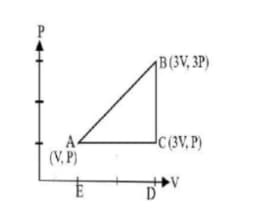
An ideal gas is taken around ABCA as shown in the P-V diagram. The work done during a cycle is:
1
2
3
4
Zero
Official Solution
Correct Option: (1)
Step 1: Understanding Work Done in a Cycle - The work done in a closed cycle in a P-V diagram is equal to the area enclosed by the cycle. - The given process forms a right-angled triangle in the P-V diagram. Step 2: Calculating the Enclosed Area - The base of the triangle along the V-axis extends from to , so the length is: - The height of the triangle along the P-axis extends from to , so the height is: Step 3: Using the Area Formula Thus, the correct answer is:
15
PYQ 2024
medium
physicsID: ap-eamce
A substance of mass requires a power input of to remain in the molten state at its melting point. When the power is turned off, the sample completely solidifies in time . The latent heat of the substance is
1
2
3
4
Official Solution
Correct Option: (1)
The latent heat is the heat required to melt or solidify a substance. The amount of heat required is given by: This heat is supplied by the power over a time , so: Equating both expressions: Solving for the latent heat : Thus, the latent heat of the substance is . Final Answer: .
16
PYQ 2024
easy
physicsID: ap-eamce
An aircraft executes a horizontal loop of radius 1 km with a speed of 900 kmph. Then, the ratio of its centripetal acceleration to the acceleration due to gravity is:
1
6.38
2
3.19
3
12.76
4
5.38
Official Solution
Correct Option: (1)
Step 1: Convert speed to m/s and calculate centripetal acceleration. Speed in m/s: Centripetal acceleration : Step 2: Compare to gravitational acceleration. Gravitational acceleration :
17
PYQ 2024
medium
physicsID: ap-eamce
A gas is initially at a state of . If is work done in isobaric expansion to volume and is the work done in isothermal expansion to volume , then:
1
2
3
4
Official Solution
Correct Option: (3)
Step 1: Calculate work done in isobaric process.Step 2: Calculate work done in isothermal process.Step 3: Compare and .
For most practical ranges of and , is greater than due to the nature of the logarithmic function in the isothermal process.
18
PYQ 2024
medium
physicsID: ap-eamce
Two soap bubbles of radii and are kept in vacuum at constant temperature, the ratio of masses of air inside them are:
1
2
3
4
Official Solution
Correct Option: (4)
Step 1: Apply the gas law under constant temperature. Assuming the pressure inside each bubble is proportional to the surface tension divided by the radius and that both bubbles contain the same type of gas at the same temperature, the number of moles is proportional to the volume. Step 2: Relate the volumes and masses of the bubbles. The volume of a sphere (bubble) is , so the ratio of the volumes (and thus the ratio of masses under constant density and temperature) is: Adjusting for the proportional relationship of the radii squared:
19
PYQ 2024
medium
physicsID: ap-eamce
The efficiency of a Carnot heat engine is 25% and the temperature of its source is 127°C. Without changing the temperature of the source, if the absolute temperature of the sink is decreased by 10%, the efficiency of the engine is:
1
2
3
4
Official Solution
Correct Option: (3)
Step 1: Understanding the Carnot Efficiency Formula The efficiency of a Carnot engine is given by:
where: - is the efficiency, - is the absolute temperature of the source, - is the absolute temperature of the sink. Step 2: Convert Given Temperatures to Absolute Scale The given source temperature is 127°C:
Let the initial sink temperature be . From the efficiency formula:
Solving for :
Step 3: New Efficiency After Sink Temperature Decrease If the absolute temperature of the sink is decreased by 10%, the new sink temperature is:
The new efficiency is:
Step 4: Conclusion Thus, the correct answer is option (C) .
20
PYQ 2024
medium
physicsID: ap-eamce
One kilogram of a diatomic gas is at a pressure of and the density of the gas is . The internal energy of this gas:
1
2
3
4
Official Solution
Correct Option: (1)
We are given: Pressure , Density , Mass . For a diatomic gas, the internal energy can be calculated using the formula for the internal energy of an ideal gas: where is the number of degrees of freedom (for a diatomic gas, ), is the number of moles, and is the universal gas constant ( ). However, we can also use the equation , where is the molar mass of the gas. Rearranging, we get: Now, substituting the given values: - , - , - . We calculate : Next, we calculate the internal energy using the formula for the internal energy of a diatomic gas: Substituting the values for , , and : Thus, the internal energy of the gas is , so the correct answer is (1). Conclusion: The internal energy of the gas is , so the correct answer is (1).
21
PYQ 2024
medium
physicsID: ap-eamce
Two ideal gases at absolute temperature and are mixed. In this process there is no loss of energy. If the molecular masses are and , and mole number of the gases are and , then the final temperature of the mixture is:
1
2
3
4
Official Solution
Correct Option: (1)
When two ideal gases at absolute temperatures and are mixed, the total energy is conserved, and there is no loss of energy in the process. The total internal energy of the system is the sum of the internal energies of the individual gases.
The internal energy of an ideal gas is proportional to its temperature, and for each gas, we have:
where:
and are the number of moles of gases 1 and 2,
is the molar specific heat at constant volume (which is constant for both gases),
and are the absolute temperatures of the two gases.
When the two gases are mixed, the total internal energy becomes:
The final temperature is such that the total energy is divided between the two gases. So, we have:
Equating the total energy before and after mixing:
Simplifying:
Thus, the final temperature is:
Therefore, the correct answer is Option (1), .
22
PYQ 2024
medium
physicsID: ap-eamce
An unknown gas in which each molecule has mass escaped from a planet at a temperature . The radius of the planet is , acceleration due to gravity is , and the Boltzmann constant is . The temperature is:
1
2
3
4
Official Solution
Correct Option: (4)
Solution:
This problem involves the escape velocity of gas molecules from a planet. We'll use the following concepts:
Escape velocity:
Kinetic energy:
Average kinetic energy of a gas molecule:
where:
is the universal gravitational constant,
is the mass of the planet,
is the radius of the planet,
is the mass of the molecule,
is the velocity of the molecule,
is the Boltzmann constant,
is the temperature.
To find the minimum temperature for escape, we equate the kinetic energy to the gravitational potential energy:
Substitute the escape velocity formula and simplify:
Since we have the acceleration due to gravity ( ), we can write:
Now, plug in the given values:
Therefore, the temperature is approximately K.
The correct answer is (4) K.
23
PYQ 2024
medium
physicsID: ap-eamce
When 2 moles of a monatomic gas expands adiabatically from a temperature of 80°C to 50°C, the work done is . The work done when 3 moles of a diatomic gas expands adiabatically from 50°C to 20°C is:
1
7 W
2
5 W
3
2.5 W
4
3.5 W
Official Solution
Correct Option: (3)
Given: Monatomic gas: 2 moles, expanding adiabatically from to . Diatomic gas: 3 moles, expanding adiabatically from to .
Step 1: Work done by a gas in an adiabatic process The work done in an adiabatic expansion or compression is given by the formula: Where: = number of moles, = molar heat capacity at constant volume, = adiabatic index ( ), = temperature change.
Step 2: Work done by the monatomic gas For a monatomic gas, . For 2 moles of the monatomic gas, the temperature change . The work done is: Substitute the values: Thus, the work done by the monatomic gas is .
Step 3: Work done by the diatomic gas For a diatomic gas, . For 3 moles of the diatomic gas, the temperature change . The work done is: Substitute the values: Thus, the work done by the diatomic gas is .
Step 4: Ratio of work done Now, we find the ratio of the work done by the diatomic gas to the work done by the monatomic gas:
Thus, the work done by the diatomic gas is times the work done by the monatomic gas.
24
PYQ 2024
medium
physicsID: ap-eamce
A vessel contains 8 g of air at 400 K. Some amount of air leaks out through the hole provided to it. After some time, pressure is halved and temperature is changed to 300 K. Find the mass of the air escaped.
1
2
3
4
Official Solution
Correct Option: (2)
Step 1: Use the ideal gas law. Initially, let be the number of moles of air, the volume, and the ideal gas constant: where moles (assuming air is mostly nitrogen, ), and . Step 2: Calculate the final number of moles and the difference. From the equations, it follows that: The moles of air escaped: The mass of the air escaped:
25
PYQ 2024
medium
physicsID: ap-eamce
A Carnot heat engine has an efficiency of 10%. If the same engine is worked backward to obtain a refrigerator, then the coefficient of performance of the refrigerator is
1
8
2
9
3
5
4
6
Official Solution
Correct Option: (2)
The coefficient of performance of a refrigerator is given by the formula: Given that the efficiency of the Carnot engine is 10\%, we can calculate the temperatures. The efficiency is related to the temperatures by: For a Carnot engine, , so: Solving for : Now, using the COP formula for a refrigerator: Thus, the coefficient of performance of the refrigerator is 9.
26
PYQ 2024
easy
physicsID: ap-eamce
If the ratio of the absolute temperature of the sink and source of a Carnot engine is changed from 2:3 to 3:4, the efficiency of the engine changes by:
1
2
3
4
Official Solution
Correct Option: (1)
To determine how the efficiency of a Carnot engine changes when the ratio of the absolute temperatures of the sink and source changes, we follow these steps: Given: - Initial temperature ratio: - New temperature ratio:
Step 1: Calculate the Initial Efficiency The efficiency of a Carnot engine is given by: For the initial ratio:
Step 2: Calculate the New Efficiency For the new ratio:
Step 3: Determine the Change in Efficiency The change in efficiency is: However, we are interested in the absolute change relative to the initial efficiency:
Final Answer: This corresponds to option (1).
27
PYQ 2024
medium
physicsID: ap-eamce
A gas with a ratio of specific heats, , is heated isobarically. The percentage of the given heat used in external work done is
1
15 %
2
25 %
3
50 %
4
60 %
Official Solution
Correct Option: (2)
Given: - Ratio of specific heats, Step 1: Determine the fraction of heat used for work in an isobaric process For an isobaric process, the heat added to the gas is used to increase the internal energy and to do work . The relationship is given by: For an ideal gas, the work done in an isobaric process is: The change in internal energy is: The total heat added is: The fraction of heat used for work is: Given that and , we can express as: Thus, Substituting : Step 2: Convert the fraction to a percentage Final Answer: 25 %
28
PYQ 2024
medium
physicsID: ap-eamce
A gas absorbs 18 J of heat and work done on the gas is 12 J. Then the change in internal energy of the gas is:
1
J
2
J
3
J
4
J
Official Solution
Correct Option: (4)
Step 1: Apply First Law of Thermodynamics The first law of thermodynamics states:
where is the heat absorbed by the system and is the work done on the system. Step 2: Substitute Given Values Given J and J:
29
PYQ 2024
medium
physicsID: ap-eamce
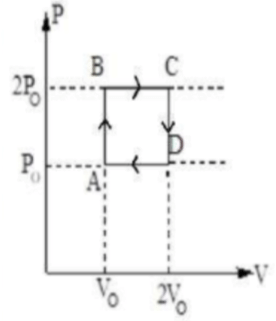
Helium gas goes through a cycle ABCDA (consisting of two isochoric and isobaric lines) as shown in figure. Assuming the gas to be an ideal gas. Efficiency of this cycle is nearly:
1
2
3
4
Official Solution
Correct Option: (4)
The cycle ABCDA consists of: A B: Isochoric process (Volume constant, ). Pressure increases from to . B C: Isobaric process (Pressure constant, ). Volume increases from to . C D: Isochoric process (Volume constant, ). Pressure decreases from to . D A: Isobaric process (Pressure constant, ). Volume decreases from to . 1. Work done in each process: (Isochoric process)
(Isochoric process)
Net work done, . 2. Heat input in each process: For Helium (monatomic gas), and . Process A B (Isochoric): . Using ideal gas law , . , . . Process B C (Isobaric): . , . . Process C D (Isochoric): (Heat rejected). Process D A (Isobaric): (Heat rejected). Total heat input . 3. Efficiency of the cycle: Efficiency . Correct Answer: (4) 15.4%