A wire of length and area of cross-section is stretched by two forces of each applied at the ends of the wire in opposite directions along the length of the wire. If the elongation of the wire is , the Young’s modulus of the material of the wire is:
1
2
3
4
Official Solution
Correct Option:
(2)
Step 1: Understanding Young’s modulus formula Young’s modulus is given by:
where: - (applied force), - (original length), - (cross-sectional area), - (elongation). Step 2: Substituting the values Step 3: Simplifying the expressionThus, the correct answer is option (B) .
02
PYQ 2024
hard
physicsID: ap-eamce
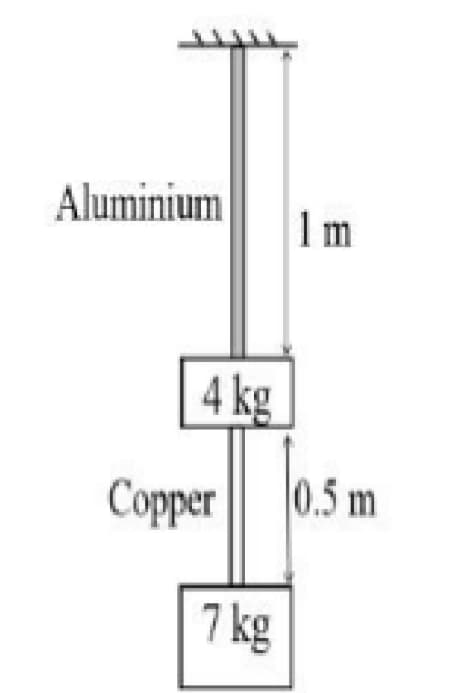
The elongation of a copper wire of cross-sectional area , in the figure shown, is $ $
1
2
3
4
Official Solution
Correct Option:
(1)
The elongation of the wire under its own weight is given by: Where:
- = Mass of the wire
- = Acceleration due to gravity
- = Length of the wire
- = Cross-sectional area
- = Young's modulus
Step 2: Calculate the mass of the wire Mass Simplifying, Step 3: Substitute known values Given:
- Density of copper
- Length
-
-
Step 4: Final Calculation Since this is closest to , the correct answer is:
03
PYQ 2024
medium
physicsID: ap-eamce
The work done on a wire of volume cm is J. If the Young's modulus of the material of the wire is Nm , then the strain produced in the wire is
1
m
2
m
3
m
4
m
Official Solution
Correct Option:
(4)
Let be the volume of the wire, be the work done, be the Young's modulus, and be the strain. Given: The work done on the wire is given by We know that Young's modulus , so . Then Substituting the given values: The strain produced in the wire is .
About Elasticity - AP-EAMCET
Elasticity is a vital chapter for AP-EAMCET aspirants. Mastering the concepts covered in this chapter is essential for securing a top rank.
By rigorously practicing the previous year questions associated with this chapter, you can identify high-yield topics, understand the examiner's perspective, and boost your confidence during the actual exam.
Frequently Asked Questions
Why focus on Elasticity PYQs?
Analyzing PYQs for this specific chapter reveals the most frequently tested concepts and the typical complexity of questions, allowing you to tailor your study plan efficiently.
How to best use this analysis?
Review the topic breakdown to see which sub-topics within Elasticity carry the most weight. Then, tackle the questions iteratively to solidify your understanding.