Assertion (A): Eukaryotic cells have the ability to adopt a variety of shapes and carry out directed movement.
Reason (R): Microfilaments, microtubules and intermediate filaments, constitute the cytoskeleton.
1
Both A and R are correct and R is the correct explanation of A.
2
Both A and R are correct but R is not the correct explanation of A.
3
A is correct but R is incorrect.
4
A is incorrect but R is correct.
Official Solution
Correct Option:
(1)
The assertion is correct because eukaryotic cells can adopt a variety of shapes and perform directed movement, which is essential for many biological processes like tissue formation, immune responses, and wound healing. The reason is also correct — microfilaments, microtubules, and intermediate filaments together form the cytoskeleton. This network provides mechanical support, maintains cell shape, and enables motility by acting like a scaffold inside the cell. Moreover, R correctly explains A. The cytoskeleton is directly responsible for the shape variability and motility of eukaryotic cells. Microfilaments (actin filaments) are particularly important for cell movement and shape changes. Thus, both Assertion and Reason are true, and the Reason correctly explains the Assertion.
02
PYQ 2023
medium
botanyID: ap-eapce
This type of cells are not present in phloem of a monocot stem.
1
Phloem parenchyma.
2
Sieve tubes.
3
Companion cells.
4
Phloem fibres.
Official Solution
Correct Option:
(1)
Phloem is a complex permanent tissue that transports food in plants. It generally consists of four components: sieve tubes, companion cells, phloem fibres, and phloem parenchyma. However, there is a significant difference in the composition of phloem in dicot and monocot stems: - In dicots, all four components are present.
- In monocots, phloem parenchyma is absent. Monocot phloem typically includes sieve tubes, companion cells, and phloem fibres, but lacks phloem parenchyma, which is responsible for storing food and helping in lateral transport. Therefore, the type of cell not found in the phloem of a monocot stem is phloem parenchyma.
03
PYQ 2025
medium
botanyID: ap-eapce
Choose the incorrect statement among the following
1
Parenchymatous cells usually present in cortex and pericycle of monocot stem.
2
Closed vascular bundles can not form secondary tissues.
3
Vessels are devoid of protoplasm and are connected with perforations.
4
Xylem conducts water and mineral from root to shoots
Official Solution
Correct Option:
(1)
Step 1: Analyze Statement (1)
Statement (1) says: "Parenchymatous cells usually present in cortex and pericycle of monocot stem."
In monocot stems, the ground tissue (which includes cortex and pericycle) is generally undifferentiated, meaning there isn't a distinct cortex or pericycle like in dicot stems. The vascular bundles are scattered throughout the ground tissue, which is primarily parenchymatous. While parenchyma cells are abundant in the ground tissue of monocot stems, the distinct regions of "cortex" and "pericycle" as separate layers are typically absent or poorly defined. Monocot stems typically have a large, undifferentiated ground parenchyma. Hence, this statement is likely Incorrect. Step 2: Analyze Statement (2)
Statement (2) says: "Closed vascular bundles can not form secondary tissues."
Closed vascular bundles (found in monocots) lack cambium. Cambium is the meristematic tissue responsible for producing secondary xylem and secondary phloem (secondary growth). Since closed vascular bundles do not have cambium, they are indeed incapable of forming secondary tissues and undergoing secondary growth. This statement is Correct. Step 3: Analyze Statement (3)
Statement (3) says: "Vessels are devoid of protoplasm and are connected with perforations."
Vessels are components of xylem. Mature vessel elements (vessel members) are dead cells, meaning they are devoid of protoplasm. They are arranged end-to-end to form long tubes, and their end walls have perforations (pores) that allow for continuous water flow, forming a continuous pipeline. This statement is Correct. Step 4: Analyze Statement (4)
Statement (4) says: "Xylem conducts water and mineral from root to shoots."
Xylem is the primary water-conducting tissue in plants. Its main function is to transport water and dissolved mineral nutrients absorbed by the roots upwards to the stem, leaves, and other aerial parts of the plant. This statement is Correct. Step 5: Identify the incorrect statement
Based on the analysis:
Statement (1) is Incorrect.
Statement (2) is Correct.
Statement (3) is Correct.
Statement (4) is Correct. Therefore, the incorrect statement is (1).
04
PYQ 2025
medium
botanyID: ap-eapce
Identify the wrongly matched one
1
Bicollateral vascular bundles – Solanum
2
Gymnosperms – Albuminous cells
3
Sclerenchymatous pericycle – Monocot stem
4
Bulliform cells – Isobilateral leaf
Official Solution
Correct Option:
(3)
Bicollateral vascular bundles are seen in Solanum — correct.
Gymnosperms possess albuminous cells — correct.
Monocot stem has sclerenchymatous hypodermis but not pericycle — incorrect match.
Bulliform cells are found in isobilateral leaves — correct.
05
PYQ 2025
medium
botanyID: ap-eapce
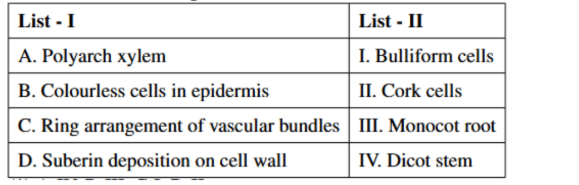
Match the following
1
A-IV, B-III, C-I, D-II
2
A-III, B-II, C-I, D-IV
3
A-III, B-I, C-IV, D-II
4
A-III, B-IV, C-I, D-II
Official Solution
Correct Option:
(3)
Step 1: Match A) Polyarch xylem
Polyarch xylem refers to a condition where there are many (more than six) protoxylem strands. This arrangement is characteristic of Monocot roots. In dicot roots, the xylem is typically diarch to hexarch.
So, A III. Monocot root. Step 2: Match B) Colourless cells in epidermis
Colourless (or empty) cells in the epidermis, specifically large, empty, and colorless epidermal cells, are known as Bulliform cells. These are typically found in the epidermis of monocot leaves (especially grasses) and help in the rolling and unrolling of leaves in response to water availability.
So, B I. Bulliform cells. Step 3: Match C) Ring arrangement of vascular bundles
The arrangement of vascular bundles in a ring is a characteristic feature of Dicot stems. In dicot stems, the vascular bundles are arranged in a specific ring, with cambium present between xylem and phloem, allowing for secondary growth. In contrast, monocot stems have scattered vascular bundles.
So, C IV. Dicot stem. Step 4: Match D) Suberin deposition on cell wall
Suberin is a waxy, water-repellent substance that is deposited on the cell walls of certain plant cells, making them impermeable to water and gases. This deposition is characteristic of Cork cells (phellem), which are part of the periderm and provide protection to the plant. It's also found in the Casparian strips of endodermis, but in the context of cell wall deposition for protection, cork cells are a primary example.
So, D II. Cork cells. Step 5: Formulate the complete match and check options
Combining the matches from Steps 1, 2, 3, and 4:
A III (Monocot root)
B I (Bulliform cells)
C IV (Dicot stem)
D II (Cork cells) The correct sequence is A-III, B-I, C-IV, D-II.
Let's check the given options:
% Option
(1) A-IV, B-III, C-I, D-II (Incorrect)
% Option
(2) A-III, B-II, C-I, D-IV (Incorrect)
% Option
(3) A-III, B-I, C-IV, D-II (Matches our derived sequence)
% Option
(4) A-III, B-IV, C-I, D-II (Incorrect) Therefore, Option (3) is the correct answer.
06
PYQ 2025
medium
botanyID: ap-eapce
Each annual ring in dicot stem comprises
1
one ring of spring wood and one ring of early wood.
2
one ring of autumn wood and one ring of late wood.
3
one ring of spring wood and one ring of autumn wood.
4
one ring of spring wood only.
Official Solution
Correct Option:
(3)
Annual ring consists of spring wood formed in favorable season and autumn wood formed in less favorable season.
Together they make one annual ring in dicot stems.
About Plant Anatomy - AP-EAPCET
Plant Anatomy is a vital chapter for AP-EAPCET aspirants. Mastering the concepts covered in this chapter is essential for securing a top rank.
By rigorously practicing the previous year questions associated with this chapter, you can identify high-yield topics, understand the examiner's perspective, and boost your confidence during the actual exam.
Frequently Asked Questions
Why focus on Plant Anatomy PYQs?
Analyzing PYQs for this specific chapter reveals the most frequently tested concepts and the typical complexity of questions, allowing you to tailor your study plan efficiently.
How to best use this analysis?
Review the topic breakdown to see which sub-topics within Plant Anatomy carry the most weight. Then, tackle the questions iteratively to solidify your understanding.