Plant Biotechnology
8 previous year questions.
High-Yield Trend
Chapter Questions 8 MCQs
[A.] Asexual reproduction preserves genetic information.
[B.] Hybridization leads to multiply desirable genes.
[C.] Restriction enzyme adds methyl group to DNA.
[D.] Genetic engineering changes the phenotype of the organism.
Reason (R): There is transfer of new genes into related wild species through natural out crossing.
[I.] DNA fragments moved towards anode under electric field
[II.] Exposure to UV radiation
[III.] DNA fragments stained with EtBr (Ethidium Bromide)
[IV.] Gel electrophoresis
[V.] Elution
E. coli
Match the following 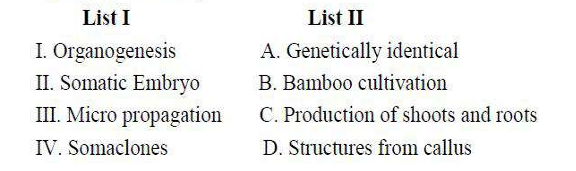
Match the following
| List - I | List - II | ||
|---|---|---|---|
| A. | cry II Ab | I. | Resistance to pest |
| B. | cry I Ab | II. | Control Bollworm |
| C. | RNAi | III. | Control corborer |
| D. | Bt cotton | IV. | Prevent nematode pathogen |
I. Recognise palindromic nucleotide sequence.
II. Cut the strand of DNA a little away from the centre of palindrome site.
III. Help to form complementary cut counter parts.
About Plant Biotechnology - AP-EAPCET
Plant Biotechnology is a vital chapter for AP-EAPCET aspirants. Mastering the concepts covered in this chapter is essential for securing a top rank.
By rigorously practicing the previous year questions associated with this chapter, you can identify high-yield topics, understand the examiner's perspective, and boost your confidence during the actual exam.
Frequently Asked Questions
Why focus on Plant Biotechnology PYQs?
Analyzing PYQs for this specific chapter reveals the most frequently tested concepts and the typical complexity of questions, allowing you to tailor your study plan efficiently.
How to best use this analysis?
Review the topic breakdown to see which sub-topics within Plant Biotechnology carry the most weight. Then, tackle the questions iteratively to solidify your understanding.