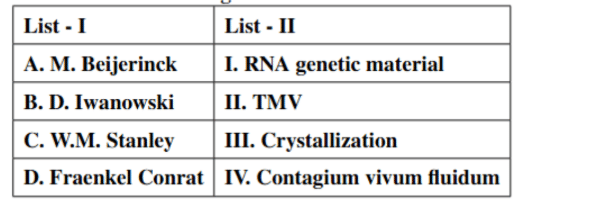
Step 1: Analyze each scientist in List - I and their contributions to match with List - II. \begin{itemize} \item A. M. Beijerinck (Martinus Beijerinck): He is credited with coining the term "virus" and developing the concept of "Contagium vivum fluidum" (contagious living fluid) to describe the non-bacterial nature of the causative agent of tobacco mosaic disease, implying it was a living fluid. \item Therefore, A matches with IV. Contagium vivum fluidum. \item B. D. Iwanowski (Dmitri Ivanovsky): He was the first to demonstrate that an infectious agent (later identified as Tobacco Mosaic Virus, TMV) could pass through porcelain filters that retained bacteria, suggesting it was smaller than bacteria. His work was pivotal in the discovery of viruses. \item Therefore, B matches with II. TMV. \item C. W.M. Stanley (Wendell M. Stanley): He successfully crystallized Tobacco Mosaic Virus (TMV) and showed that viruses are not cells but rather complex chemicals (nucleoproteins), demonstrating that they could be crystallized like salts. This work earned him a Nobel Prize. \item Therefore, C matches with III. Crystallization. \item D. Fraenkel Conrat (Heinz Fraenkel-Conrat): He conducted experiments (along with Robley Williams) demonstrating that the genetic material of TMV is RNA. They were able to separate the RNA and protein components of TMV and then reconstitute infectious virus particles from these components, proving that RNA carries the genetic information. \item Therefore, D matches with I. RNA genetic material.
\end{itemize} Step 2: Combine the matches.
A - IV
B - II
C - III
D - I Step 3: Check against the given options.
\begin{itemize} \item Option (1) A - IV, B - II, C - III, D - I. This matches our derived combinations. \item Option (2) A - IV, B - III, C - II, D - I. Incorrect. \item Option (3) A - I, B - II, C - III, D - IV. Incorrect. \item Option (4) A - I, B - III, C - II, D - IV. Incorrect.
\end{itemize} The final answer is .
About Virology And Mycology - AP-EAPCET
Virology And Mycology is a vital chapter for AP-EAPCET aspirants. Mastering the concepts covered in this chapter is essential for securing a top rank.
By rigorously practicing the previous year questions associated with this chapter, you can identify high-yield topics, understand the examiner's perspective, and boost your confidence during the actual exam.
Frequently Asked Questions
Why focus on Virology And Mycology PYQs?
Analyzing PYQs for this specific chapter reveals the most frequently tested concepts and the typical complexity of questions, allowing you to tailor your study plan efficiently.
How to best use this analysis?
Review the topic breakdown to see which sub-topics within Virology And Mycology carry the most weight. Then, tackle the questions iteratively to solidify your understanding.