AP-EAPCET SERIES Botany
Plant Physiology
11 previous year questions.
Volume: 11 Ques
Yield: Medium
High-Yield Trend
8
2025 3
2023 Chapter Questions 11 MCQs
01
PYQ 2023
medium
botany ID: ap-eapce
Hydroponics was first demonstrated by
1
Daniel E. Koshland
2
Cornelius Van Niel
3
Julius Von Sachs
4
T. W. Englemann
02
PYQ 2023
medium
botany ID: ap-eapce
With reference to stomatal movement, choose the correct statements:
[a.] Proton efflux increases pH of guard cells.
[b.] Efflux of K and Cl decreases water potential of guard cells.
[c.] In the absence of light, K and Cl efflux from guard cells.
[d.] Presence of ABA in guard cells causes efflux of K .
[a.] Proton efflux increases pH of guard cells.
[b.] Efflux of K and Cl decreases water potential of guard cells.
[c.] In the absence of light, K and Cl efflux from guard cells.
[d.] Presence of ABA in guard cells causes efflux of K .
1
a, b, c, d
2
a, c, d
3
b, c, d
4
b, d
03
PYQ 2023
medium
botany ID: ap-eapce
In a dorsiventral leaf, the position of xylem
1
Xylem surrounds phloem.
2
Xylem is towards adaxial epidermis.
3
Xylem is surrounded by phloem.
4
Xylem is towards abaxial epidermis.
04
PYQ 2025
medium
botany ID: ap-eapce
Choose the correct statement from the following
(I) In Hatch-Slack pathway mesophyll cells lack RuBisCO enzyme
(II) PEP carboxylase is present in bundle sheath of chloroplast
(III) OAA is formed in mesophyll cells
(IV) PEP is primary CO2 acceptor present in chloroplast of bundle sheath cells
(I) In Hatch-Slack pathway mesophyll cells lack RuBisCO enzyme
(II) PEP carboxylase is present in bundle sheath of chloroplast
(III) OAA is formed in mesophyll cells
(IV) PEP is primary CO2 acceptor present in chloroplast of bundle sheath cells
1
I, II
2
II, III
3
III, IV
4
I, IV
05
PYQ 2025
medium
botany ID: ap-eapce
Assertion (A): In plant vacuole, the concentration is higher than the cytoplasm.
Reason (R): Tonoplast facilitates the transport of ions and other materials against concentration gradient.
Identify the correct option from the following
Options:
Reason (R): Tonoplast facilitates the transport of ions and other materials against concentration gradient.
Identify the correct option from the following
Options:
1
(A) and (R) are true, (R) is correct explanation for (A)
2
(A) and (R) are true, but (R) is not correct explanation for (A)
3
(A) is true, but (R) is false
4
(A) is false, but (R) is true
06
PYQ 2025
medium
botany ID: ap-eapce
Shrinkage of protoplast due to diffusion of water from the cell into the surroundings.
1
Osmosis
2
Imbibition
3
Plasmolysis
4
Guttation
07
PYQ 2025
medium
botany ID: ap-eapce
Choose the correct combination regarding mechanism of translocation:
1
Stem tip Sugar enters sieve tube water flows by diffusion.
2
Leaf Sugar enters sieve tubes water flows by Osmosis.
3
Stem Sugar solution flows to region of high turgor pressure water flows by Osmosis.
4
Root Sugar enters sieve tube for metabolism and storage water flows by Osmosis.
08
PYQ 2025
medium
botany ID: ap-eapce
Match the following:
| List - I | List - II |
|---|---|
| A. Nucleic acids structure | IV. Phosphorous |
| B. Synthesis of nucleic acid | III. Iron |
| C. Stabilize protein structure | II. Sulphur |
| D. Catalase | II. Sulphur |
1
A-I, B-IV, C-II, D-III
2
A-V, B-I, C-II, D-III
3
A-IV, B-V, C-II, D-III
4
A-IV, B-I, C-II, D-III
09
PYQ 2025
medium
botany ID: ap-eapce
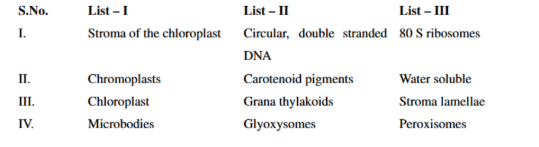
Study the following table and identify the correct combination
1
I, II
2
II, III
3
III, IV
4
IV, I
10
PYQ 2025
medium
botany ID: ap-eapce
Attraction of water molecules to polar surfaces in tracheary elements:
1
Inhibition
2
Adhesion
3
Cohesion
4
Diffusion
11
PYQ 2025
medium
botany ID: ap-eapce
Assertion (A): Due to water stress the bulliform cells in grasses make the leaf curl outward to minimise water loss.
Reason (R): Bulliform cells are large, empty and colourless cells.
Identify the correct option from the following:
Reason (R): Bulliform cells are large, empty and colourless cells.
Identify the correct option from the following:
1
Both (A) and (R) are true, and (R) is correct explanation of (A)
2
Both (A) and (R) are true, but (R) is not the correct explanation of (A)
3
(A) is true, but (R) is false
4
(A) is false, but (R) is true
About Plant Physiology - AP-EAPCET
Plant Physiology is a vital chapter for AP-EAPCET aspirants. Mastering the concepts covered in this chapter is essential for securing a top rank.
By rigorously practicing the previous year questions associated with this chapter, you can identify high-yield topics, understand the examiner's perspective, and boost your confidence during the actual exam.
Frequently Asked Questions
Why focus on Plant Physiology PYQs?
Analyzing PYQs for this specific chapter reveals the most frequently tested concepts and the typical complexity of questions, allowing you to tailor your study plan efficiently.
How to best use this analysis?
Review the topic breakdown to see which sub-topics within Plant Physiology carry the most weight. Then, tackle the questions iteratively to solidify your understanding.