Ancient Civilization
8 previous year questions.
High-Yield Trend
Chapter Questions 8 MCQs
The History of Pataliputra
Each city had a history of its own. Pataliputra, for instance, began as a village known as Pataligrama. Then, in the fifth century BCE, the Magadhan rulers decided to shift their capital from Rajagaha to this settlement and renamed it. By the fourth century BCE, it was the capital of the Mauryan Empire and one of the largest cities in Asia. Subsequently, its importance apparently declined. When the Chinese pilgrim Xuan Zang visited the city in the seventh century CE, he found it in ruins, and with a very small population.
What role did Pataliputra play in the history of the Magadhan empire?
The History of Pataliputra
Each city had a history of its own. Pataliputra, for instance, began as a village known as Pataligrama. Then, in the fifth century BCE, the Magadhan rulers decided to shift their capital from Rajagaha to this settlement and renamed it. By the fourth century BCE, it was the capital of the Mauryan Empire and one of the largest cities in Asia. Subsequently, its importance apparently declined. When the Chinese pilgrim Xuan Zang visited the city in the seventh century CE, he found it in ruins, and with a very small population.
What message did Xuan Zang wish to convey about Pataliputra?
The History of Pataliputra
Each city had a history of its own. Pataliputra, for instance, began as a village known as Pataligrama. Then, in the fifth century BCE, the Magadhan rulers decided to shift their capital from Rajagaha to this settlement and renamed it. By the fourth century BCE, it was the capital of the Mauryan Empire and one of the largest cities in Asia. Subsequently, its importance apparently declined. When the Chinese pilgrim Xuan Zang visited the city in the seventh century CE, he found it in ruins, and with a very small population.
Examine the main impact of the shift from Rajagaha to Pataliputra, on the Magadhan empire.
- Was the best known ruler of the Satavahana dynasty.
- Claimed to be a unique Brahmana.
- Was the son of Rishi Vashishtha.
- [I.] Ancient Parthian gold coins showed extensive trade in north India.
- [II.] Ancient Roman coins in South India indicated trade beyond borders.
- [III.] Ancient Yaudheyas issued copper coins that highlighted their economic activity.
- [IV.] Ancient Gupta rulers issued silver coins that facilitated trade.
Assertion (A): Shahjehan Begum was a patron of art and architecture in the 19th century, known for her contribution for Sanchi’s preservation.
Reason (R): Sanchi Stupa is a classical example of early Buddhist architecture.
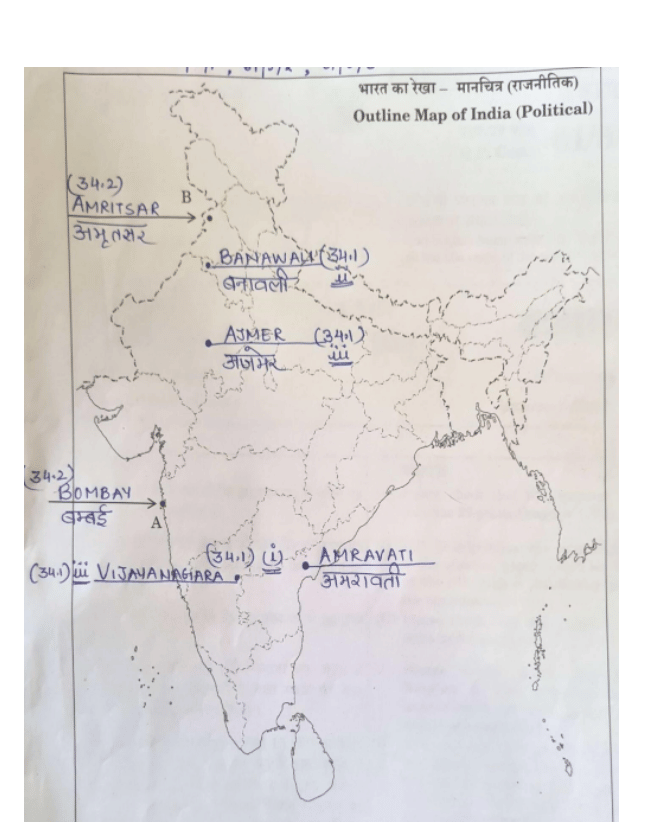
On the given political outline map of India, locate and label the following with appropriate symbols:
- [(i)] Amravati – Stupa
- [(ii)] Banawali – Indus Valley Site
- [(iii)] (a) Ajmer – Territory under the control of the Mughals
- [OR] (b) Vijayanagara – Capital of Vijayanagara Empire
On the same outline map of India, two places have been marked as ‘A’ and ‘B’, as the centres of the Indian National Movement. Identify them and write their correct names on the lines drawn near them. 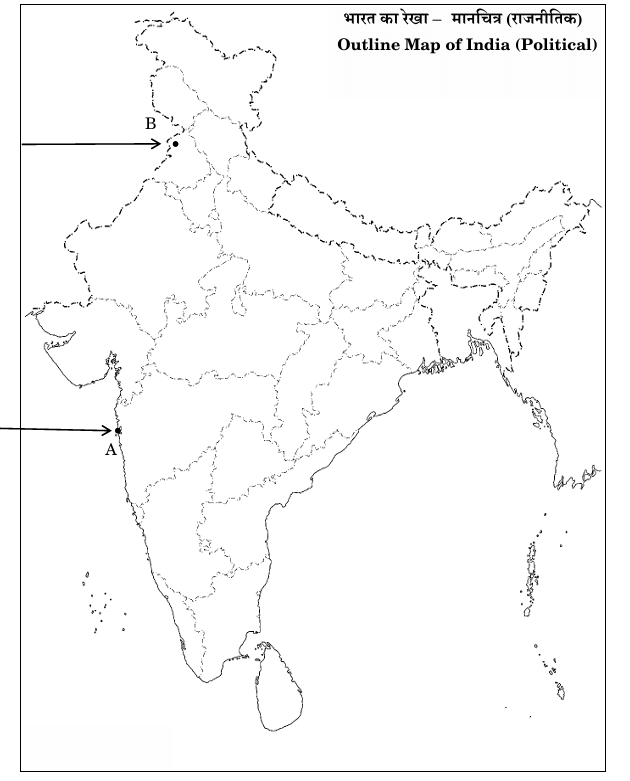
About Ancient Civilization - CBSE-CLASS-XII
Ancient Civilization is a vital chapter for CBSE-CLASS-XII aspirants. Mastering the concepts covered in this chapter is essential for securing a top rank.
By rigorously practicing the previous year questions associated with this chapter, you can identify high-yield topics, understand the examiner's perspective, and boost your confidence during the actual exam.
Frequently Asked Questions
Why focus on Ancient Civilization PYQs?
Analyzing PYQs for this specific chapter reveals the most frequently tested concepts and the typical complexity of questions, allowing you to tailor your study plan efficiently.
How to best use this analysis?
Review the topic breakdown to see which sub-topics within Ancient Civilization carry the most weight. Then, tackle the questions iteratively to solidify your understanding.