The Great Revolt Of 1857
8 previous year questions.
High-Yield Trend
Chapter Questions 8 MCQs
Arrah (Bihar) : Kunwar Singh; _______ : Birjis Qadr
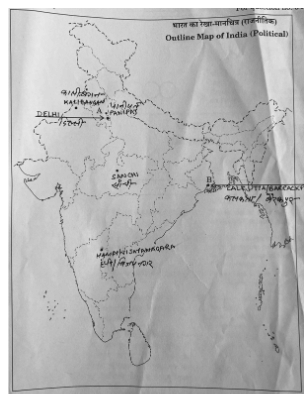
On the given political outline map of India, locate and label the following with appropriate symbols:
- [(i)] Sanchi – A Stupa (Located in Madhya Pradesh)
- [(ii)] Kalibanga – Harappan site (Located in northern Rajasthan, near the Ghaggar river)
- [(iii)] (a) Panipat – Territory under the control of British (Located in Haryana)
- [OR] (b) Vijayanagara – Capital of Vijayanagara empire (Located in Karnataka)
On the same outline map, two places have been marked as ‘A’ and ‘B’, as the centres of the Revolt of 1857. Identify them and write their correct names on the lines drawn near them. 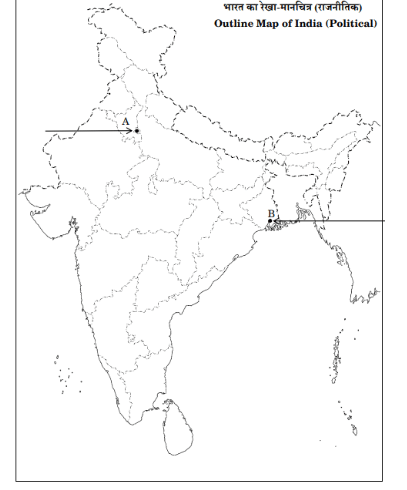
Nana Saheb : Kanpur; Kunwar Singh : __
Maulvi Ahmadullah Shah was one of the many maulvis who played an important part in the revolt of 1857. Educated in Hyderabad, he became a preacher when young. In 1856, he was seen moving from village to village preaching jehad (religious war) against the British and urging people to rebel. He moved in a palanquin, with drumbeaters in front and followers at the rear. He was therefore popularly called Danka Shah – the maulvi with the drum danka. British officials panicked as thousands began following the maulwi and many Muslims began seeing him as an inspired prophet. When he reached Lucknow in 1856, he was stopped by the police from preaching in the city. Subsequently, in 1857, he was jailed in Faizabad. When released, he was elected by the mutinous 22nd Native Infantry as their leader. He fought in the famous Battle of Chinhat in which the British forces under Henry Lawrence were defeated. He came to be known for his courage and power. Many people in fact believed that he was invincible, had magical powers, and could not be killed by the British. It was this belief that partly formed the basis of his authority.
Read the given source carefully and answer the questions that follow:
Two rebels of 1857
Shah Mal
Shah Mal lived in a large village in pargana Barout in Uttar Pradesh. He belonged to a clan of Jat cultivators whose kinship ties extended over chaurasee des (eighty-four villages). The lands in the region were irrigated and fertile, with rich dark loam soil. Many of the villagers were prosperous and saw the British land revenue system as oppressive: the revenue demand was high and its collection inflexible. Consequently cultivators were losing land to outsiders, to traders and moneylenders who were coming into the area.
Shah Mal mobilised the headmen and cultivators of chaurasee des, moving at night from village to village, urging people to rebel against the British. As in many other places, the revolt against the British turned into a general rebellion against all signs of oppression and injustice. Cultivators left their fields and plundered the houses of moneylenders and traders. Displaced proprietors took possession of the lands they had lost. Shah Mal’s men attacked government buildings, destroyed the bridge over the river, and dug up metalled roads – partly to prevent government forces from coming into the area, and partly because bridges and roads were seen as symbols of British rule. They sent supplies to the sepoys who had mutinied in Delhi and stopped all official communication between British headquarters and Meerut. Locally acknowledged as the Raja, Shah Mal took over the bungalow of an English officer, turned it into a “hall of justice”, settling disputes and dispensing judgments. He also set up an amazingly effective network of intelligence. For a period the people of the area felt that firangi raj was over, and their raj had come.
Shah Mal was killed in battle in July 1857.
How did the rebellion led by Shah Mal challenge the authority of the British?
Read the given source carefully and answer the questions that follow:
Two rebels of 1857
Shah Mal
Shah Mal lived in a large village in pargana Barout in Uttar Pradesh. He belonged to a clan of Jat cultivators whose kinship ties extended over chaurasee des (eighty-four villages). The lands in the region were irrigated and fertile, with rich dark loam soil. Many of the villagers were prosperous and saw the British land revenue system as oppressive: the revenue demand was high and its collection inflexible. Consequently cultivators were losing land to outsiders, to traders and moneylenders who were coming into the area.
Shah Mal mobilised the headmen and cultivators of chaurasee des, moving at night from village to village, urging people to rebel against the British. As in many other places, the revolt against the British turned into a general rebellion against all signs of oppression and injustice. Cultivators left their fields and plundered the houses of moneylenders and traders. Displaced proprietors took possession of the lands they had lost. Shah Mal’s men attacked government buildings, destroyed the bridge over the river, and dug up metalled roads – partly to prevent government forces from coming into the area, and partly because bridges and roads were seen as symbols of British rule. They sent supplies to the sepoys who had mutinied in Delhi and stopped all official communication between British headquarters and Meerut. Locally acknowledged as the Raja, Shah Mal took over the bungalow of an English officer, turned it into a “hall of justice”, settling disputes and dispensing judgments. He also set up an amazingly effective network of intelligence. For a period the people of the area felt that firangi raj was over, and their raj had come.
Shah Mal was killed in battle in July 1857.
How did Shah Mal’s leadership contribute to the spread of the rebellion?
About The Great Revolt Of 1857 - CBSE-CLASS-XII
The Great Revolt Of 1857 is a vital chapter for CBSE-CLASS-XII aspirants. Mastering the concepts covered in this chapter is essential for securing a top rank.
By rigorously practicing the previous year questions associated with this chapter, you can identify high-yield topics, understand the examiner's perspective, and boost your confidence during the actual exam.
Frequently Asked Questions
Why focus on The Great Revolt Of 1857 PYQs?
Analyzing PYQs for this specific chapter reveals the most frequently tested concepts and the typical complexity of questions, allowing you to tailor your study plan efficiently.
How to best use this analysis?
Review the topic breakdown to see which sub-topics within The Great Revolt Of 1857 carry the most weight. Then, tackle the questions iteratively to solidify your understanding.