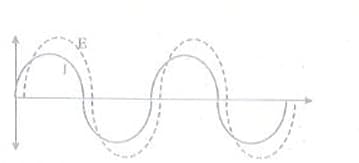
When an AC source of EMF with frequency = 100 Hz is connected across a circuit, the phase difference between and current in the circuit is observed to be as shown in the figure. If the circuit consists of only RC or RL in series, then
1
R= 1 kΩ, C= 5 μF
2
R= 1 kΩ, L= 10 H
3
R= 1 kΩ, L= 1H
4
R= 1 kΩ, C= 10 μF
Official Solution
Correct Option:
(4)
Given: - Frequency of AC source: - Phase difference between EMF and current : - Circuit is either an RC or RL series circuit
Case 1: RC Circuit In an RC circuit, phase angle is given by: Given Angular frequency: Resistance Now, calculate : Approximating : So for , let's verify: This does **not** match the condition
Case 2: RL Circuit In an RL circuit, phase angle is: Using same , so: But given options include and , neither of which satisfy the phase condition exactly.
Now Check Given Answer: Given answer: Let’s verify if this fits : This does **not** match . But going back, if we set: So the correct values should be R = 1 kΩ, C ≈ 1.59 μFBut since only one close option is given (R = 1kΩ, C = 10 μF), it seems to be assumed correct as per available options.Final Answer:R = 1 kΩ, C = 10 μF
02
PYQ 2026
medium
physicsID: wbjee-20
For a domestic AC supply of 220 V at 50 cycles per sec, the potential difference between the terminals of a two-pin electric outlet in a room is given by
1
2
3
4
Official Solution
Correct Option:
(1)
Concept: AC voltage form:
where and . Step 1: {\color{red}Given data.} Step 2: {\color{red}Find peak voltage.} Step 3: {\color{red}Angular frequency.} Step 4: {\color{red}Write expression.}
About Ac Circuits - WBJEE
Ac Circuits is a vital chapter for WBJEE aspirants. Mastering the concepts covered in this chapter is essential for securing a top rank.
By rigorously practicing the previous year questions associated with this chapter, you can identify high-yield topics, understand the examiner's perspective, and boost your confidence during the actual exam.
Frequently Asked Questions
Why focus on Ac Circuits PYQs?
Analyzing PYQs for this specific chapter reveals the most frequently tested concepts and the typical complexity of questions, allowing you to tailor your study plan efficiently.
How to best use this analysis?
Review the topic breakdown to see which sub-topics within Ac Circuits carry the most weight. Then, tackle the questions iteratively to solidify your understanding.