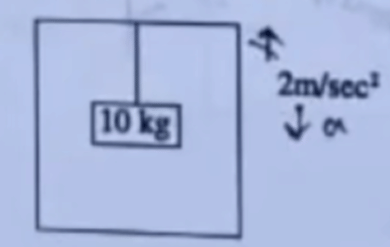
One end of a steel wire is fixed to the ceiling of an elevator moving up with an acceleration and a load of 10 kg hangs from the other end. If the cross-section of the wire is , then the longitudinal strain in the wire will be (Take and ).
1
2
3
4
Official Solution
Correct Option:
(4)
Step 1: Understanding the Problem
We need to calculate the longitudinal strain in the wire when the elevator is accelerating upwards with an acceleration . The strain is related to the stress applied to the wire, and the stress is related to the force acting on the wire. Step 2: Force Acting on the Wire
The force acting on the wire consists of two parts:
1. The weight of the 10 kg load.
2. The additional force due to the acceleration of the elevator. The total force acting on the wire is given by: Where:
- (mass of the load),
- (acceleration due to gravity),
- (acceleration of the elevator). Substituting the values: Step 3: Stress in the Wire
The stress in the wire is the force per unit area: Where:
- (cross-sectional area of the wire). Thus: Step 4: Longitudinal Strain
The longitudinal strain in the wire is related to the stress and the Young's modulus by: Where:
- (Young's modulus of the wire). Substituting the values: Step 5: Conclusion
The longitudinal strain in the wire is . Thus, the correct answer is:
About Stress And Strain - WBJEE
Stress And Strain is a vital chapter for WBJEE aspirants. Mastering the concepts covered in this chapter is essential for securing a top rank.
By rigorously practicing the previous year questions associated with this chapter, you can identify high-yield topics, understand the examiner's perspective, and boost your confidence during the actual exam.
Frequently Asked Questions
Why focus on Stress And Strain PYQs?
Analyzing PYQs for this specific chapter reveals the most frequently tested concepts and the typical complexity of questions, allowing you to tailor your study plan efficiently.
How to best use this analysis?
Review the topic breakdown to see which sub-topics within Stress And Strain carry the most weight. Then, tackle the questions iteratively to solidify your understanding.