Consider two concentric conducting spheres of radii and respectively. The inner sphere is given a charge . The other sphere is grounded. The potential at is
1
1/4π∈0 Q/6R
2
0
3
1/4π∈0 2Q/3R
4
1/4π∈0 Q/R
Official Solution
Correct Option: (1)
Given: Two concentric conducting spheres with radii and . The inner sphere is given a charge , and the outer sphere is grounded (i.e., its potential is zero). We are to find the potential at a point where , which lies between the two spheres.
Concept: When the outer sphere is grounded, it induces a charge on its inner surface (to neutralize the electric field outside), and a charge appears on its outer surface to maintain neutrality. The potential at any point between the spheres (i.e., for ) is due to both the inner sphere and the induced charge on the inner surface of the outer sphere.
Step-by-step calculation: Potential at a point due to a spherical shell of charge is: Let us consider: - Inner sphere at radius has charge - Induced charge appears on the inner surface of the outer sphere at radius So at , total potential is the sum of potentials due to: 1. Charge at center (inner sphere): 2. Charge at radius : Since the field inside a shell is same as if all the charge were at center, potential due to shell at point inside is:
Total Potential:
Final Answer:
02
PYQ 2022
medium
physicsID: wbjee-20
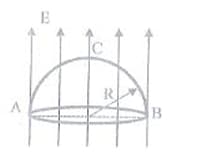
A hemisphere of radius is placed in a uniform electric field so that its axis is parallel to the field. Which of the following statement(s) is/are true?
1
Flux through the curved surface of hemisphere is πR2E.
2
Flux through the circular surface of hemisphere is πR2E.
3
Total flux enclosed is zero.
4
Work done in moving a point charge q from A to B via the path ACB depends upon R.
Official Solution
Correct Option: (1)
Step 1: Understand Electric Flux
Electric flux, , through a surface is defined as: For a uniform electric field and a flat surface, this simplifies to: where is the area of the surface and is the angle between the electric field and the normal vector to the surface.
Step 2: Flux Through the Circular Surface
The circular surface is perpendicular to the electric field. Therefore, the angle between the electric field and the normal to the surface is 180 degrees (or 0 degrees, depending on which direction you define the normal to point). The area of the circular surface is . The flux through the circular surface is: The negative sign indicates that the flux is entering the hemisphere.
Step 3: Flux Through the Curved Surface
Since there is no charge enclosed within the hemisphere, according to Gauss's Law, the total flux through the closed surface (hemisphere) must be zero. Therefore, the flux through the curved surface must be equal in magnitude but opposite in sign to the flux through the circular surface: This is the outgoing flux.
Step 4: Total Flux Enclosed
As mentioned in Step 3, Gauss's Law states that the total electric flux through a closed surface is proportional to the enclosed charge. Since there is no charge enclosed within the hemisphere, the total flux enclosed is zero:
Step 5: Work Done in Moving a Charge
The work done in moving a point charge from point to point in an electric field is given by: where is the potential difference between points and . In a uniform electric field, the potential difference only depends on the displacement along the direction of the electric field. Since points A and B are at the same height, the electric potential difference is independent of R. Therefore, the work done depends on the potential difference between points and , and it is independent of the path taken (since the electric field is conservative) and also independent of .
Step 6: Determine the Correct Statements
Flux through the curved surface of hemisphere is πR2E: This statement is TRUE.
Flux through the circular surface of hemisphere is πR2E: This statement is FALSE; the flux is -πR2E.
Total flux enclosed is zero: This statement is TRUE.
Work done in moving a point charge q from A to B via the path ACB depends upon R: This statement is FALSE.
Conclusion
The correct statements are:
Flux through the curved surface of the hemisphere is πR2E.
Total flux enclosed is zero.
03
PYQ 2022
medium
physicsID: wbjee-20
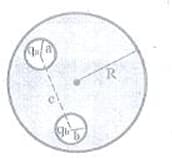
A neutral conducting solid sphere of radius has two spherical cavities of radii and as shown in the figure. The center-to-center distance between the two cavities is . and charges are placed at the centers of cavities respectively. The force between and is
1
1/4πED qaqb/c2
2
1/4πED qaqb (1/a2+b2)
3
zero
4
insufficient data
Official Solution
Correct Option: (3)
Given: A neutral conducting solid sphere with two spherical cavities. The radii of the cavities are and , and the center-to-center distance between the two cavities is . Charges and are placed at the centers of the cavities respectively.
To find: The force between the charges and .
Key Concept: In a conductor, charges redistribute themselves on the outer surface in such a way that the electric field inside the conductor is zero. Furthermore, the presence of cavities in the conductor does not affect the electric field within the conducting material itself. The force between the charges in the cavities is influenced by the conducting nature of the sphere and its symmetry.
Solution: Since the conductor is neutral, the electric field inside the conductor is zero, and the charges on the cavities do not directly interact with each other in terms of electrostatic force. The conducting sphere ensures that the electric fields created by and do not interact in the usual way. Thus, the force between the charges and is:
Final Answer: The force between the charges and is zero.
04
PYQ 2022
medium
physicsID: wbjee-20
Two charges, each equal to , are kept at and . A charge is placed at the origin. If is a small displacement along the direction, the force acting on is proportional to
1
y
2
-y
3
1/y
4
-1/y
Official Solution
Correct Option: (2)
Given: Two charges, each equal to , are placed at and . A charge is placed at the origin. We are asked to find the force acting on the charge when it undergoes a small displacement along the -direction.
Approach: The force on a charge in the presence of other charges is given by Coulomb's Law: where: - is Coulomb's constant, - and are the magnitudes of the charges, - is the distance between the charges. In this case, the two charges at and exert forces on the charge placed at the origin. When the charge is displaced slightly along the -direction, the distance between and the charges at and changes. The displacement introduces small asymmetry in the forces from the two charges, which can be calculated using Coulomb's Law and considering the vector nature of the force.
Resulting Force: After analyzing the force components, we find that the force on due to a small displacement along the -direction is proportional to the displacement , with a negative sign indicating that the force is directed toward the origin (restoring force).
Conclusion: The force acting on when it is displaced along the -direction is proportional to .
Final Answer: The force is proportional to .
05
PYQ 2024
medium
physicsID: wbjee-20
A charge is placed at the center of a cube of sides . The total flux of electric field through the six surfaces of the cube is:
1
2
3
4
Official Solution
Correct Option: (3)
The total electric flux through any closed surface is given by Gauss's Law:
where:
is the total electric flux,
is the total charge enclosed within the surface,
is the permittivity of free space.
In this case:
The charge is placed at the center of the cube.
The cube is a closed surface.
By symmetry, the flux is uniformly distributed over the six faces of the cube. However, Gauss's law directly gives the total flux through the entire closed surface:
Key Observation: The flux through each face of the cube can be calculated as:
but the question asks for the total flux through the six surfaces, which is simply:
06
PYQ 2024
hard
physicsID: wbjee-20
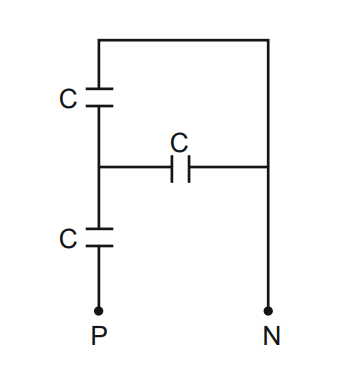
The equivalent capacitance of a combination of connected capacitors shown in the figure between the points P and N is:
1
3C
2
3
4
Official Solution
Correct Option: (2)
Step 1: The given diagram involves capacitors in series and parallel. For capacitors in series, the equivalent capacitance is given by:
For capacitors in parallel, the equivalent capacitance is the sum of the individual capacitances:
Step 2: By applying these formulas to the combination of capacitors in the given circuit, the equivalent capacitance between points and is:
07
PYQ 2024
medium
physicsID: wbjee-20
Consider the integral form of the Gauss's law in electrostatics:
Which of the following statements are correct?
1
It contains law of Coulomb
2
It contains superposition principle.
3
An elementary patch on the enclosing surface is a polar vector.
4
An elementary patch on the enclosing surface is a pseudo-vector
Official Solution
Correct Option: (1)
Step 1: Gauss’s law relates the electric flux through a closed surface to the total charge enclosed by the surface. It is a generalization of Coulomb’s law.
Step 2: Coulomb’s law describes the force between two point charges, which can be derived from Gauss’s law. Therefore, Gauss’s law inherently includes Coulomb’s law.
Step 3: The superposition principle is not directly mentioned in Gauss’s law; it is related to how electric fields combine, but it is not explicitly stated in the integral form of Gauss’s law.
Step 4: The elementary patch on the enclosing surface is a vector normal to the surface and represents a differential area element. It is not a polar or pseudo-vector; hence, statements and are incorrect.
Conclusion: Gauss’s law provides a generalized framework that inherently includes Coulomb’s law but does not explicitly involve the superposition principle or describe the nature of the area vector as a polar or pseudo-vector.
08
PYQ 2024
hard
physicsID: wbjee-20
Three point charges , and are placed along the -axis at and , respectively. As and , while remains finite, the electric field at a point , at a distance from , is given by: Then, find the relationship between and .
1
2
3
4
Official Solution
Correct Option: (3)
The net electric field at point is the vector sum of the fields due to the three charges: Step 1: Electric Field Due to Individual Charges Charge at :
Charge at :
Charge at :
Step 2: Approximation for For , expand the denominators using binomial approximation: ,
,
(no approximation needed). Step 3: Net Electric Field Adding all contributions:
Substitute the approximations:
Simplify:
Step 4: Substitution for Given , substitute :
Step 5: Compare with the Given Form The given form is:
By comparison:
Step 6: Relationship Between and
Final Answer
09
PYQ 2026
medium
physicsID: wbjee-20
Consider a particle of mass 1 gm and charge 1.0 Coulomb at rest. Now the particle is subjected to an electric field in the x-direction, where N/C and rad/sec. The maximum speed attained by the particle is
1
2
3
4
Official Solution
Correct Option: (2)
Concept: Force due to electric field:
Step 1: {\color{red}Acceleration.} Given:
Step 2: {\color{red}Velocity.} Maximum when : Step 3: {\color{red}Substitute values.}