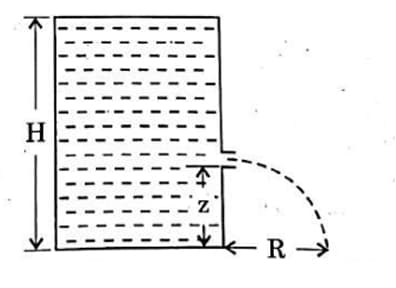
Water is filled in a cylindrical vessel of height H. A hole is made at height z from the bottom, as shown in the figure. The value of z for which the range R of the emerging water through the hole will be maximum for:
1
2
3
4
Official Solution
Correct Option:
(4)
Step 1: When water is flowing out of a hole at a certain height from the bottom, it follows the principles of fluid dynamics. The velocity of the water emerging from the hole can be determined using Torricelli’s law: where is the acceleration due to gravity and is the height from which the water is emerging.
Step 2: The horizontal range of the water emerging from the hole depends on the velocity of the water and the height . The time of flight for the water to reach the ground is given by: The horizontal range can be found by multiplying the horizontal velocity by the time of flight :
Step 3: To maximize the range , we analyze . Differentiating with respect to : Setting does not apply here directly since the relationship is linear. However, the maximum range is achieved when the height is proportional to the total height . From the geometry of the problem, the water has the most time to travel horizontally when is one-third of .
Step 4: Therefore, the maximum range occurs when:
Correct Answer:
02
PYQ 2025
medium
physicsID: wbjee-20
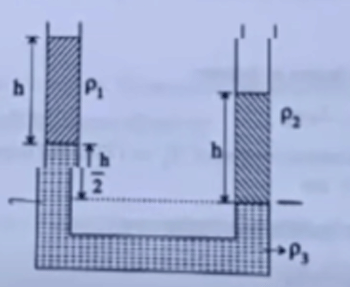
Three different liquids are filled in a U-tube as shown in the figure. Their densities are , , and , respectively. From the figure, we may conclude that:
1
2
3
4
Official Solution
Correct Option:
(3)
Step 1: Understanding the Problem
We have three different liquids in a U-tube, and the columns of these liquids are at different heights. The pressures exerted by the columns of liquids at the bottom of the U-tube must balance because the system is in equilibrium. Step 2: Pressure Equilibrium For the U-tube to be in equilibrium, the pressure at the same level on both sides must be equal. The pressure at the bottom of each liquid column is given by the formula: Where:
- is the density of the liquid,
- is the acceleration due to gravity,
- is the height of the liquid column. Step 3: Applying the Pressure Balance On the left side of the U-tube, the pressure due to the column of liquid with density and height is: On the right side of the U-tube, we have two columns: one with liquid of density and height , and the other with liquid of density and height . The total pressure on the right side is: For equilibrium: Substituting the expressions for and : Step 4: Simplifying the Equation We can cancel out from both sides: Multiplying both sides by 2: Rearranging the equation: Step 5: Conclusion Thus, the correct relationship is:
About Fluid Mechanics - WBJEE
Fluid Mechanics is a vital chapter for WBJEE aspirants. Mastering the concepts covered in this chapter is essential for securing a top rank.
By rigorously practicing the previous year questions associated with this chapter, you can identify high-yield topics, understand the examiner's perspective, and boost your confidence during the actual exam.
Frequently Asked Questions
Why focus on Fluid Mechanics PYQs?
Analyzing PYQs for this specific chapter reveals the most frequently tested concepts and the typical complexity of questions, allowing you to tailor your study plan efficiently.
How to best use this analysis?
Review the topic breakdown to see which sub-topics within Fluid Mechanics carry the most weight. Then, tackle the questions iteratively to solidify your understanding.