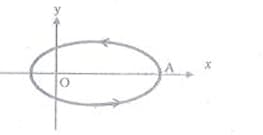
A particle is moving in an elliptical orbit as shown in the figure. If , , and denote the linear momentum, angular momentum, and position vector of the particle (from focus ) respectively at a point , then the direction of is along
1
+ve x axis
2
-ve x axis
3
+ve y axis
4
-ve y axis
Official Solution
Correct Option: (1)
We are given that a particle is moving in an elliptical orbit, and we need to determine the direction of , where is the linear momentum, is the angular momentum, and is the position vector of the particle from the focus at a point .
Step 1: Understanding the quantities - The linear momentum is given by: where is the mass of the particle and is its velocity. - The angular momentum is given by: where is the position vector of the particle from the focus , and is the linear momentum vector.
Step 2: Direction of We are asked to determine the direction of . The cross product of two vectors and gives a vector that is perpendicular to the plane formed by and . The direction of this vector follows the right-hand rule.
Step 3: Applying the right-hand rule - The velocity vector is tangential to the elliptical orbit, and the position vector points from the focus to the position of the particle at point . - The angular momentum is directed along the axis perpendicular to the plane of the orbit. - The cross product will be directed along the axis that is perpendicular to both the velocity and angular momentum vectors.
Step 4: Conclusion From the figure and the application of the right-hand rule, we find that the direction of is along the **+ve x axis**.
Answer:
02
PYQ 2023
hard
physicsID: wbjee-20
A mouse of mass m jumps on the outside edge of a rotating ceiling fan of the moment of inertia l and radius R. The frictionless loss of angular velocity of the fan as a result is,
1
2
3
4
Official Solution
Correct Option: (1)
As we know from Newton's first law of motion, an object in motion will retain its state of motion (velocity to be precise) unless an external force is applied on the object. We can use the same sense of the law in rotation, i.e. to the state of rotational motion, or precisely, rotational velocity. However, since it is rotational motion we are talking about, we have to always keep in mind the momentary position vector of any particle constituting the rotational motion. If we take into account all the momentary position vectors, they will constitute a disc of which the axis is along Z axis.
Now, for a particle in linear motion, a force along the direction of velocity cannot change the direction of velocity. In the same analogy, any force along the direction of the axis of the disc cannot change the direction of the axis of the disc. Only a force that has a component perpendicular to the Z axis will change the direction of the axis of the disc, thus changing the plane of rotation.
The correct answer is option (A):
03
PYQ 2024
hard
physicsID: wbjee-20
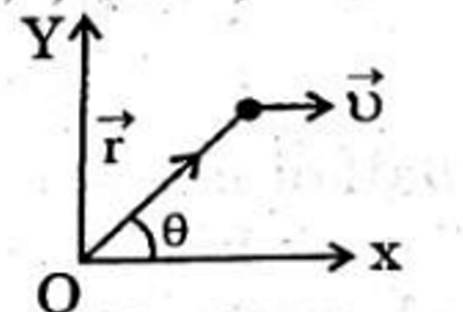
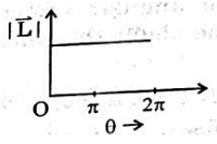
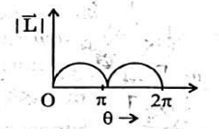
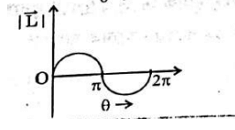
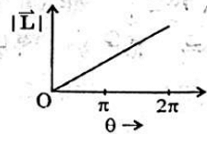
The position vector of a particle of mass moving with a constant velocity is given by , where is a constant. At an instant, makes an angle with the x-axis as shown in the figure. The variation of the angular momentum of the particle about the origin with will be:
1
2
3
4
Official Solution
Correct Option: (1)
Step 1: The angular momentum of a particle about the origin is given by the cross product:
where is the position vector and is the velocity vector.
Step 2: The magnitude of the angular momentum is given by:
where is the angle between and .
Step 3: Since is constant and the particle moves in a straight line, the angular momentum varies with , and the correct expression is:
04
PYQ 2024
hard
physicsID: wbjee-20
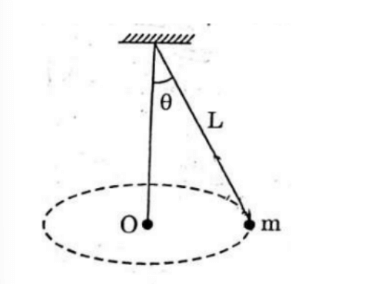
A small ball of mass m is suspended from the ceiling of a floor by a string of length L. The ball moves along a horizontal circle with constant angular velocity ω, as shown in the figure. The torque about the center (O) of the horizontal circle is:
1
mgL sin θ
2
mgL cos θ
3
0
4
mgl cos θ
Official Solution
Correct Option: (3)
1. Step 1: The ball is moving in a horizontal circle, which means that the forces acting on it in the vertical direction (the gravitational force mg) are balanced by the vertical component of the tension in the string. The ball is subject to two forces: Gravitational force: mg and Tension in the string: T 2. Step 2: Since the ball is in circular motion, the horizontal component of the tension T sin θ provides the centripetal force required for the circular motion. The vertical component T cos θ balances the weight of the ball. 3. Step 3: The torque about the center O of the horizontal circle is given by the cross product of the force and the radius vector. The torque τ due to the forces acting on the ball is calculated as: τ = r × F where r is the radius vector (the length L) and F is the force (in this case, the tension). However, since the tension is acting along the string, there is no torque about the center of the horizontal circle. 4. Step 4: Therefore, the total torque about the center is zero, because the force creating the circular motion (tension in the string) does not create any rotational effect about the center of the horizontal circle.
05
PYQ 2024
medium
physicsID: wbjee-20
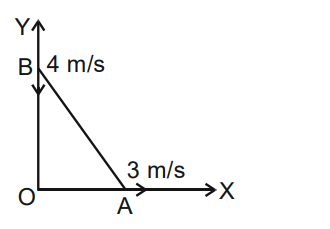
A uniform rod AB of length 1 m and mass 4 kg is sliding along two mutually perpendicular frictionless walls OX and OY. The velocity of the two ends of the rod A and Bare 3 m/s and 4 m/s respectively, as shown in the figure. Then which of the following statement(s) is/are correct?
1
The velocity of the centre of mass of the rod is 2.5 m/s.
2
Rotational kinetic energy of the rod is joule.
3
The angular velocity of the rod is 5 rad/s clockwise.
4
The angular velocity of the rod is 5 rad/s anticlockwise.
Official Solution
Correct Option: (1)
Step 1: To find the velocity of the centre of mass, we use the formula:
Where and are the velocities of the two ends of the rod, and and are their masses. Since the mass of the rod is uniform, .
Step 2: Given that the velocities of the ends of the rod are and , we can substitute these into the formula:
Therefore, the velocity of the centre of mass is .
Step 3: The rotational kinetic energy and angular velocity can be found using the rotational dynamics of the rod. However, the key result from the question is the velocity of the centre of mass.
Conclusion: The velocity of the centre of mass is .