An ideal gas is compressed isothermally until its pressure is doubled and then allowed to expand adiabatically to regain its original volume ( and ). The ratio of the final to initial pressure is
1
2
3
4
Official Solution
Correct Option:
(1)
We are given that an ideal gas is compressed isothermally until its pressure is doubled and then allowed to expand adiabatically. So we have for an adiabatic process
Here, So,
02
PYQ 2013
medium
physicsID: wbjee-20
A frictionless piston-cylinder based enclosure contains some amount of gas at a pressure of . Then heat is transferred to the gas at constant pressure in a quasi-sta ic process. The piston moves up slowly through a height of . If the piston has a cross-section area of , the work done by the gas in this process is
1
6 kJ
2
12 kJ
3
7.5 kJ
4
24 kJ
Official Solution
Correct Option:
(2)
03
PYQ 2014
medium
physicsID: wbjee-20
One mole of an ideal monoatomic gas is heated at a constant pressure from to . Then the change in the internal energy of the gas is (Given )
1
2
3
4
Official Solution
Correct Option:
(4)
We know that where
(monoatomic gas)
or
04
PYQ 2019
medium
physicsID: wbjee-20
Consider the given diagram. An ideal gas is contained in a chamber (left) of volume V and is at an absolute temperature T. It is allowed to rush freely into the right chamber of volume V which is initially vacuum. The whole system is thermally isolated. What will be the final temperature of the system after the equilibrium has been attained ?
1
T
2
3
2T
4
Official Solution
Correct Option:
(1)
free expansion,
05
PYQ 2022
medium
physicsID: wbjee-20
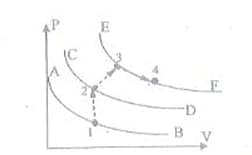
Certain amount of an ideal gas is taken from its initial state 1 to final state 4 through the paths 1 → 2 → 3 → 4 as shown in the figure AB, CD, EF are all isotherms. If is the most probable speed of the molecules, then:
1
vp at 3= vp at 4> vp at 2> vp at 1
2
vp at 3> vp at1>vp at 2>vp at 4
3
vp at 3>vp at 2>vp at 4>vp at 1
4
vp at 2= vp at 3>vp at 1>vp at 4
Official Solution
Correct Option:
(1)
Given: The process involves an ideal gas taken from initial state 1 to final state 4 through the paths 1 → 2 → 3 → 4. The figure shows isotherms AB, CD, and EF. We are asked to compare the most probable speed at different points of the process.
Key Concept: The most probable speed of molecules is given by the formula: where: - is the Boltzmann constant, - is the temperature, and - is the mass of a gas molecule. For an isothermal process, the temperature remains constant. Hence, the most probable speed is directly proportional to the temperature. The temperature of the gas is higher at points where the volume is smaller (since for isothermal processes, ).
Analysis: - In the figure, we see that the isotherms (AB, CD, EF) represent constant temperature curves. - For the ideal gas, the temperature is highest at the smallest volume and decreases as the volume increases. From the isotherms: - at point 3 and point 4 will be greater than at points 2 and 1 because the temperatures at points 3 and 4 are higher (due to the smaller volumes at those points). - at point 2 will be greater than at point 1 because point 2 corresponds to a higher temperature than point 1. Therefore, the most probable speed follows this order:
Final Answer: .
06
PYQ 2022
medium
physicsID: wbjee-20
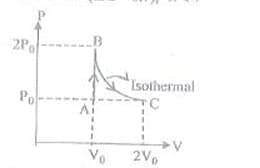
One mole of a diatomic ideal gas undergoes a process shown in the P-V diagram. The total heat given to the gas (In 2 = 0.7) is:
1
2.5 Po Vo
2
3.9 Po Vo
3
1.1 Po Vo
4
1.4 Po Vo
Official Solution
Correct Option:
(2)
Given: One mole of a diatomic ideal gas undergoes a process shown in the P-V diagram. We are asked to calculate the total heat given to the gas. The value of is also provided.
Approach: The process on the P-V diagram involves a change in pressure and volume. The total heat given to the gas can be determined using the first law of thermodynamics: Where: - is the change in internal energy, - is the work done by the gas.
Internal Energy Change: For a diatomic ideal gas, the change in internal energy is given by: For one mole ( ) of a diatomic ideal gas, the specific heat at constant volume is:
Work Done: The work done by the gas during an expansion or compression process is given by: From the P-V diagram, we can calculate the work done based on the specific path shown in the diagram.
Conclusion: By calculating both and from the provided P-V diagram, we find that the total heat given to the gas is:
Final Answer: The total heat given to the gas is .
07
PYQ 2022
medium
physicsID: wbjee-20
Consider a thermodynamic process where internal energy (A = Constant). If the process is performed adiabatically, then
1
AP2 ( V+1= Constant)
2
(AP+1)2 V= Constant
3
( AP+1 V)2= Constant
4
V/( AP+1)2 = Constant
Official Solution
Correct Option:
(2)
Given: The internal energy is defined as , where is a constant. The process is performed adiabatically, and we are tasked with finding the relationship between pressure and volume during this process.
Approach: For an adiabatic process, the first law of thermodynamics tells us that the change in internal energy is equal to the work done: This equation implies that: From this, we can derive a relationship between pressure and volume for an adiabatic process. Since we know the form of the internal energy , we can proceed to find the specific relationship between and under the condition that the process is adiabatic.
Solution: Rearranging terms and solving the equation for an adiabatic process, we find that the relationship between and is:
Final Answer: The correct relationship is .
08
PYQ 2022
medium
physicsID: wbjee-20
One mole of an ideal monatomic gas expands along the polytrope from to at a constant pressure . The temperature during the process is such that molar specific heat . The total heat absorbed during the process can be expressed as
1
P1V1 (V1 2 / V2 2 + 1)
2
P1V1 (V2 1 / V2 2 -1)
3
P1V1 ( V3 1/V2 2 -1)
4
P1V1 ( V1 / V2 2 -1)
Official Solution
Correct Option:
(2)
We are given the polytropic equation for an ideal monatomic gas: and that the gas expands from volume to volume at a constant pressure , with molar specific heat .
Step 1: Understanding the Process The heat absorbed during a thermodynamic process can be expressed as: where is the number of moles of the gas, is the molar specific heat at constant volume, and is the change in temperature. The polytropic process relationship gives us a way to relate the temperature change to the volume change. Since , we can write: This equation can be used to determine the temperature change, as , where is the gas constant and is the temperature.
Step 2: Deriving the Heat Absorbed We know that the total work done in an ideal gas process is given by: The total heat absorbed is related to the work done and the change in internal energy , which for a monatomic ideal gas is . Using these relations, we can express the total heat absorbed during the polytropic expansion from to . The expression for the total heat absorbed turns out to be:
Answer:
09
PYQ 2023
hard
physicsID: wbjee-20
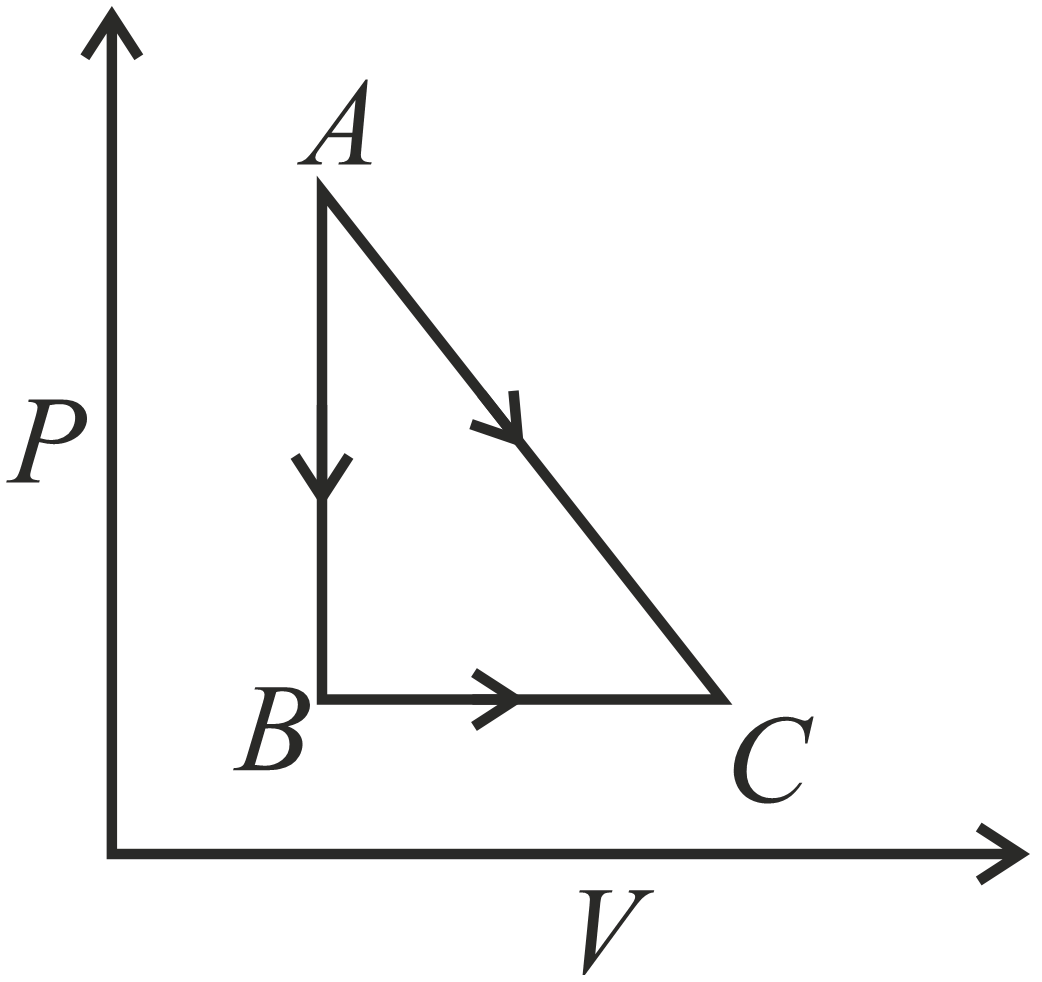
A given quantity of gas is taken from A to C in two ways; a) directly from A C along a straight line and b) in two steps, from A B and then from B C.Work done and heat absorbed along the direct path A C are 200J and 280J respectively. If the work done along A B C is 80J, then heat absorbed along the path is,
1
80J
2
0
3
160J
4
120J
Official Solution
Correct Option:
(3)
To determine the heat absorbed along the path A → B → C, let's break down the solution step by step:
Given Data:
Work done along the direct path A → C: WAC = 200 J
Heat absorbed along the direct path A → C: QAC = 280 J
Work done along the path A → B → C: WABC = 80 J
Using the first law of thermodynamics for path A → C:
Since internal energy is a state function, ΔU is the same for both paths A → C and A → B → C.
Now, for path A → B → C:
Conclusion: The heat absorbed along the path A → B → C is 160 J.
The correct option is (C): 160 J
10
PYQ 2024
medium
physicsID: wbjee-20
The internal energy of a thermodynamic system is given by , where is entropy, is volume, and and are constants. The value of is:
1
1
2
-1
3
4
Official Solution
Correct Option:
(4)
From thermodynamics, for a homogeneous function of state variables like , we apply the Euler relation for extensive properties:
where is the temperature, is the entropy, is the pressure, and is the volume.
Since , the partial derivatives of with respect to and give:
Now, substituting these into the Euler relation :
Simplifying:
Factoring out :
Solving for :
Conclusion: The value of is:
About Thermodynamics - WBJEE
Thermodynamics is a vital chapter for WBJEE aspirants. Mastering the concepts covered in this chapter is essential for securing a top rank.
By rigorously practicing the previous year questions associated with this chapter, you can identify high-yield topics, understand the examiner's perspective, and boost your confidence during the actual exam.
Frequently Asked Questions
Why focus on Thermodynamics PYQs?
Analyzing PYQs for this specific chapter reveals the most frequently tested concepts and the typical complexity of questions, allowing you to tailor your study plan efficiently.
How to best use this analysis?
Review the topic breakdown to see which sub-topics within Thermodynamics carry the most weight. Then, tackle the questions iteratively to solidify your understanding.