Which of the following materials is the best conductor of electricity?
1
Platinum
2
Gold
3
Silicon
4
Copper
Official Solution
Correct Option:
(4)
Answer (d) Copper
02
PYQ 2012
hard
physicsID: wbjee-20
The magnetic flux linked with a coil satisfies the relation , where is the time in second. The e.m.f. induced in the coil at second is
1
22 V
2
18 V
3
16 V
4
40 V
Official Solution
Correct Option:
(1)
Given and We know that Here,
03
PYQ 2022
medium
physicsID: wbjee-20
In a closed circuit there is only a coil of inductance and resistance . The coil is situated in a uniform magnetic field. All of a sudden, the magnetic flux linked with the circuit changes by Weber. What amount of charge will flow in the circuit as a result?
1
500 C
2
0.05 C
3
20 C
4
Value of L is to be known to find the charge flown
Official Solution
Correct Option:
(2)
Given: - Resistance, - Change in magnetic flux, - The circuit has only resistance and inductance (no external source). - To find: Charge flown,
Key concept: According to Faraday's law and Ohm’s law, the total charge that flows due to a change in magnetic flux is given by:
Substitute values:
Final Answer:0.05 C
04
PYQ 2022
medium
physicsID: wbjee-20
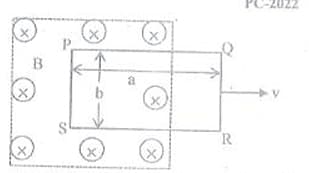
As shown in the figure, a rectangular loop of length and width and made of a conducting material of uniform cross-section is kept in a horizontal plane where a uniform magnetic field of intensity is acting vertically downward. The resistance per unit length of the loop is . If the loop is pulled with uniform velocity in a horizontal direction, which of the following statement(s) is/are true?
1
Current in the loop I= Bbw / (2b=2a)
2
Current will be in clockwise direction, looking from the top.
3
Vp - Vs = VQ - V R' where V is the potential
4
There cannot be any induction in part SR.
Official Solution
Correct Option:
(1)
We need to analyze the induced electromotive force (EMF), the induced current, the direction of the current, and the potential differences in the loop.
Step 1: Calculate the Induced EMF
As the loop is pulled through the magnetic field, an EMF is induced in the wires perpendicular to the velocity and magnetic field. The motional EMF induced in a wire of length moving with velocity perpendicular to a magnetic field is given by:
In this case, the wires and are the ones experiencing the induced EMF. Both wires have length , so the total induced EMF is:
Step 2: Calculate the Resistance of the Loop
The loop has a total length of . The resistance per unit length is . Therefore, the total resistance of the loop is:
Step 3: Calculate the Induced Current
Using Ohm's Law, the induced current in the loop is:
Step 4: Determine the Direction of the Current
Using the right-hand rule (or Lenz's Law), as the loop moves to the right, the magnetic flux through the loop decreases (since the area within the field decreases). To oppose this change in flux, the induced current will create a magnetic field pointing downwards (in the same direction as the external field). This requires a clockwise current when viewed from above.
Step 5: Analyze the Potential Differences
Consider the potential difference and . Since PQ and RS are the source of the emf then however due to the resistance, some of the potential will be lost hence is wrong.
There is definitely induction in part SR, since it is also moving through the magnetic field.
Step 6: Determine the Correct Statements
Current in the loop I= Bbv / (2b+2a): This statement is TRUE. Assuming the typo is instead of the number 1, and that the total length of the wire is and thus total resistance is . The formula matches what we derived:
Current will be in clockwise direction, looking from the top: This statement is TRUE.
VP - VS = VQ - VR, where V is the potential: This statement is FALSE.
There cannot be any induction in part SR: This statement is FALSE.
Conclusion
The correct statements are:
Current in the loop I= Bbv / (2b+2a)
Current will be in clockwise direction, looking from the top.
05
PYQ 2023
hard
physicsID: wbjee-20
An amount of charge Q passes through a coil of resistance R.If the current in the coil decreases to zero at a uniform rate during time T, then the amount of heat generated in the coil will be,
1
2
3
4
Official Solution
Correct Option:
(1)
Step 1: Expression for Current as a Function of Time
The current in the coil decreases uniformly from an initial value to zero over time . This implies that the current decreases linearly with time:
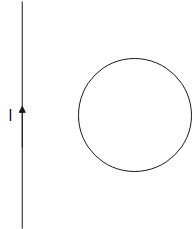
A circular coil is placed near a current-carrying conductor, both lying on the plane of the paper. The current is flowing through the conductor in such a way that the induced current in the loop is clockwise as shown in the figure. The current in the wire
1
time-dependent and downward
2
steady and upward
3
time-dependent and upward
4
An alternating current
Official Solution
Correct Option:
(1)
To analyze the given problem, we use Faraday's Law of Induction and Lenz's Law. The setup involves a circular coil placed near a current-carrying conductor, both lying on the plane of the paper. The induced current in the loop is clockwise.
Analyzing the Induced Current
Direction of the Induced Current: The induced current is clockwise. By Lenz's Law, it must oppose the change in magnetic flux.
Change in Magnetic Flux: A clockwise induced current means the magnetic flux through the loop is increasing out of the plane. To oppose this, the induced magnetic field is into the plane.
Current in the Wire: For the magnetic flux to be increasing out of the plane, the magnetic field at the loop’s location must be increasing and directed out of the plane. According to the right-hand rule, this happens if the current in the wire is downward.
Time Dependence: Since the flux is changing, the current in the wire must be increasing with time — i.e., time-dependent.
Conclusion
The current in the wire is time-dependent and downward.
Final Answer: (A): time-dependent and downward
About Electromagnetic Induction - WBJEE
Electromagnetic Induction is a vital chapter for WBJEE aspirants. Mastering the concepts covered in this chapter is essential for securing a top rank.
By rigorously practicing the previous year questions associated with this chapter, you can identify high-yield topics, understand the examiner's perspective, and boost your confidence during the actual exam.
Frequently Asked Questions
Why focus on Electromagnetic Induction PYQs?
Analyzing PYQs for this specific chapter reveals the most frequently tested concepts and the typical complexity of questions, allowing you to tailor your study plan efficiently.
How to best use this analysis?
Review the topic breakdown to see which sub-topics within Electromagnetic Induction carry the most weight. Then, tackle the questions iteratively to solidify your understanding.