BITSAT SERIES
Chemistry

Collision Theory Of Chemical Reactions

25 previous year questions.

Volume: 25 Ques
Yield: High

High-Yield Trend

3
2026
1
2023
2
2021
2
2020
2
2019
2
2018
2
2017
2
2016
2
2015
2
2014
1
2013
1
2012
1
2011
2
2010

Chapter Questions
25 MCQs

01
PYQ 2010
medium
chemistry ID: bitsat-2
The activation energy for a simple chemical reaction A → B is Eₐ in the forward direction. The activation energy for reverse reaction
1
is always less than Eₐ
2
can be less than or more than Eₐ
3
is always double of Eₐ
4
is negative of Eₐ
02
PYQ 2010
medium
chemistry ID: bitsat-2
The following data are for the decomposition of ammonium nitrite in aqueous solution: arrayc c Vol. of N₂ in cc & Time (min)
6.25 & 10
9.00 & 15
11.40 & 20
13.65 & 25
35.65 & ∞ array The order of reaction is:
1
Zero
2
One
3
Two
4
Three
03
PYQ 2011
medium
chemistry ID: bitsat-2
During the kinetic study of the reaction 2A + B → C + D, the following results were obtained. Based on the data, which rate law is correct?
1
rate = k[A]²[B]
2
rate = k[A][B]²
3
rate = k[A]²[B]²
4
rate = k[A][B]
04
PYQ 2012
medium
chemistry ID: bitsat-2
If rate and rate constant for above reaction are and , respectively, then calculate the concentration of :
1
14
2
1.2
3
0.04
4
0.8
05
PYQ 2013
medium
chemistry ID: bitsat-2
Velocity constant of a reaction at 290 K was found to be . At 300 K it will be:
1

2

3

4

06
PYQ 2014
medium
chemistry ID: bitsat-2
The reduction of peroxodisulphate ion by I ion is expressed by . If rate of disappearance of I is , what is the rate of formation of during same time?
1

2

3

4
07
PYQ 2014
medium
chemistry ID: bitsat-2
A gaseous reaction . There is an increase in pressure from 100 mm to 120 mm in 5 minutes. The rate of disappearance of is:
1

2

3

4
08
PYQ 2015
medium
chemistry ID: bitsat-2
The unit of rate constant for reactions of second order is:
1
mol L s
2
L mol s
3
L mol s
4
s
09
PYQ 2015
medium
chemistry ID: bitsat-2
In a first order reaction with time the concentration of the reactant decreases:
1
linearly
2
exponentially
3
no change
4
none of these
10
PYQ 2016
medium
chemistry ID: bitsat-2

In the reaction P+Q→ 2R+S, the time taken for 75% reaction of P is twice the time taken for 50% reaction of P. The concentration of Q varies with time as shown. The overall order of the reaction is:
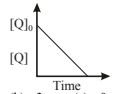
1
2
2
3
3
0
4
1
11
PYQ 2016
medium
chemistry ID: bitsat-2
Consider the reaction:

The rate equation is .
Which of the following mechanisms is/are consistent with this rate equation?
1
Only A
2
Only B
3
Both A and B
4
Neither A nor B
12
PYQ 2017
medium
chemistry ID: bitsat-2

For the reaction
,

the experimental data suggest the rate law
.
The molecularity and order of the reaction are respectively

1
2, (3)/(2)
2

3
1, 1
4
1, (1)/(2)
13
PYQ 2017
medium
chemistry ID: bitsat-2
The rate of reaction between two reactants A and B decreases by a factor of 4 if the concentration of reactant B is doubled. The order of this reaction with respect to reactant B is
1
2
2
–2
3
1
4
–1
14
PYQ 2018
medium
chemistry ID: bitsat-2

The rate constant of a reaction is 1.5×10⁻³ at 25°C and 2.1×10⁻² at 60°C. The activation energy is:

1

2

3

4
(298)/(35)Rlogₑ((1.5)/(2.1))
15
PYQ 2018
medium
chemistry ID: bitsat-2

The accompanying figure depicts a change in concentration of species A and B of the reaction A → B, as a function of time. The point of intersection of the two curves represents:
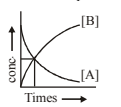
1

2

3

4
Data insufficient to predict
16
PYQ 2019
medium
chemistry ID: bitsat-2
The unit of rate constant for reactions of second order is
1
L mol⁻1 s⁻1
2
L⁻1 mol s⁻1
3
L mol s⁻1
4
s⁻1
17
PYQ 2019
medium
chemistry ID: bitsat-2
In a first order reaction with time the concentration of the reactant decreases
1
linearly
2
exponentially
3
no change
4
None of these
18
PYQ 2020
easy
chemistry ID: bitsat-2

In the reaction: P + Q longrightarrow ?R + S The time taken for 75% reaction of P is twice the time taken for 50% reaction of P. The concentration of Q varies with time as shown in the figure. The overall order of the reaction is:
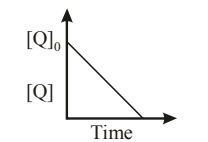
19
PYQ 2020
medium
chemistry ID: bitsat-2
Consider the reaction: Cl₂(aq) + H₂S(aq) → S(s) + 2H⁺(aq) + 2Cl⁻(aq) The rate equation for this reaction is: rate = k[Cl₂][H₂S] Which of these mechanisms is/are consistent with the rate equation? A. Cl₂ + H₂S → H⁺ + Cl⁻ + Cl⁺ + HS⁻ (slow) Cl⁺ + HS⁻ → H⁺ + Cl⁻ + S (fast) B. H₂S rightleftharpoons H⁺ + HS⁻ (fast equilibrium) Cl₂ + HS⁻ → 2Cl⁻ + H⁺ + S (slow)
1
B only
2
Both A and B
3
Neither A nor B
4
A only
20
PYQ 2021
medium
chemistry ID: bitsat-2
The rate of reaction between two reactants A and B decreases by a factor of 4 if the concentration of reactant B is doubled. The order of reaction with respect to reactant B is:
1
2
2
-2
3
1
4
-1
21
PYQ 2021
medium
chemistry ID: bitsat-2
For the reaction H₂(g) + Br₂(g) → 2HBr(g), the experimental data suggest, rate = k[H₂][Br₂]¹/2. The molecularity and order of the reaction are respectively
1
2,(3)/(2)
2
(3)/(2),2
3
1,1
4
1,(1)/(2)
22
PYQ 2023
medium
chemistry ID: bitsat-2
Among the ligands , the correct order of their increasing field strength is:
1

2

3

4
23
PYQ 2026
medium
chemistry ID: bitsat-2
For a reaction, the initial concentrations and corresponding rates are given. Which method is used to calculate the rate constant?
1
Integration method
2
Differential method
3
Initial rate method
4
Half-life method
24
PYQ 2026
medium
chemistry ID: bitsat-2
A first-order reaction is 25% complete in 30 minutes. How much time will it take for the reaction to be 75% complete?
1
90 min
2
60 min
3
120 min
4
150 min
25
PYQ 2026
easy
chemistry ID: bitsat-2
Half-life of zero order reaction product is 1 hour, when initial concentration of reactant is 2.0 mol L . The time required to decrease concentration of A from 0.50 to 0.25 mol L is:
1
0.5 hour
2
4 hour
3
15 min
4
60 min