The unsaturated hydrocarbon which on ozonolysis gives one mole each of formaldehyde, acetaldehyde and methyl glyoxal (CH₃COCHO) is
1
CH₃–CH=C(CH₃)–CH₃
2
CH₂=CH–CH₂–CH=CH₂
3
CH₂=CH–C(CH₃)=CH–CH₃
4
(CH₃)₂C=CH–CH₃
Official Solution
Correct Option: (2)
Step 1: Ozonolysis cleaves each double bond into carbonyl compounds. Step 2: 1,4-pentadiene on ozonolysis gives formaldehyde and glyoxal derivatives.
02
PYQ 2010
medium
chemistryID: bitsat-2
According to IUPAC system, the correct name of the compound having the formula CH₃-C(CH₂)-CH₂-CH₃
1
2-ethyl-3-methylbut-1-ene
2
2-methylpent-3-ene
3
2-methylbut-1-ene
4
None of these
Official Solution
Correct Option: (2)
Step 1: Longest chain contains five carbon atoms. Step 2: Double bond is at position 3 and methyl substituent at position 2.
03
PYQ 2010
medium
chemistryID: bitsat-2
Match List I (Reaction) with List II (Reagent) and select the correct answer. arrayl l
List I & List II
I. Etard reaction & A. Alcoholic KOH
II. Hydroxylation & B. Anhydrous AlCl₃
III. Dehydrohalogenation & C. Chromyl chloride
IV. Friedel–Crafts reaction & D. Dilute alkaline KMnO₄
array
What will be the product in the following reaction?
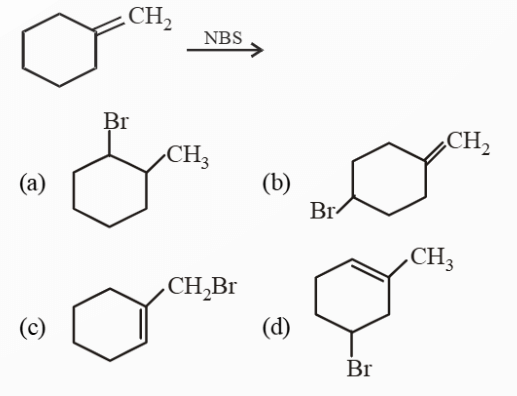
1
A
2
B
3
C
4
D
Official Solution
Correct Option: (3)
Step 1: Role of NBS.
NBS causes allylic bromination. Step 2: Reaction outcome.
Bromine substitutes allylic hydrogen.
05
PYQ 2012
medium
chemistryID: bitsat-2
Identify ‘C’ in the following reaction:
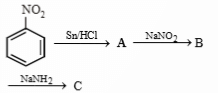
1
Benzamide
2
Benzoic acid
3
Chlorobenzene
4
Aniline
Official Solution
Correct Option: (4)
Step 1: Reaction steps.
This is a sequence of reactions involving the reduction of nitrobenzene to aniline via several intermediate steps. Thus, the final product, C, is aniline. Thus, the correct answer is (4).
06
PYQ 2012
medium
chemistryID: bitsat-2
Which alkene on ozonolysis gives and ?
1
2
3
4
Official Solution
Correct Option: (1)
Step 1: Ozonolysis reaction.
Ozonolysis of alkenes involves the cleavage of the double bond by ozone to form carbonyl compounds. The correct alkene that would give the products and is . Thus, the correct answer is (1).
07
PYQ 2013
medium
chemistryID: bitsat-2
What will be the correct structural formula of the product for the following reaction?
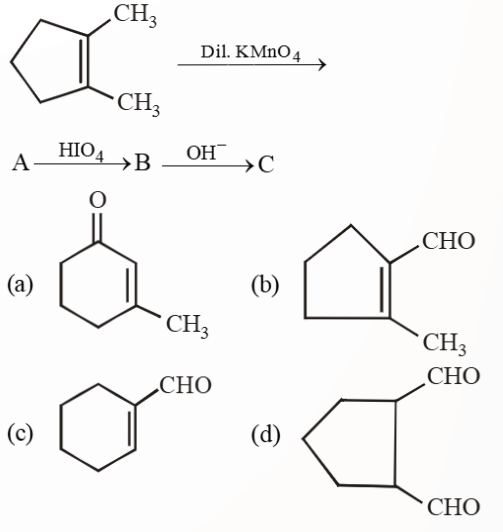
1
A
2
B
3
C
4
D
Official Solution
Correct Option: (1)
Step 1: Understand the reaction.
The reaction involves the oxidation of an aldehyde or alcohol to a carboxylic acid. Step 2: Conclusion.
The correct product is . Final Answer:
08
PYQ 2013
medium
chemistryID: bitsat-2
Which one of the following reactions is expected to readily give a hydrocarbon product in good yields?
1
2
3
4
Official Solution
Correct Option: (1)
Step 1: Understand the reaction type.
The reaction involves the reduction of a carboxylate anion to a hydrocarbon, a reaction that yields good results. Step 2: Conclusion.
This reaction will give a hydrocarbon product in good yield. Final Answer:
09
PYQ 2014
medium
chemistryID: bitsat-2
The number of double bonds in gammaxene is:
1
0
2
1
3
2
4
3
Official Solution
Correct Option: (2)
Step 1: Gammaxene is an unsaturated hydrocarbon insecticide. Step 2: It contains one C=C double bond.
10
PYQ 2016
medium
chemistryID: bitsat-2
Which of the following compound has all the four types (1°, 2°, 3° and 4°) of carbon atoms?
1
2,3,4-Trimethylpentane
2
neo-Pentane
3
2,2,4-Trimethylpentane
4
None of the three
Official Solution
Correct Option: (1)
Step 1: In 2,3,4-trimethylpentane:
- Terminal CH₃ groups → 1° carbons
- Chain CH₂ → 2° carbon
- Substituted CH → 3° carbon
- Central carbon attached to four carbons → 4° carbon Step 2: Hence all four types are present.
11
PYQ 2018
medium
chemistryID: bitsat-2
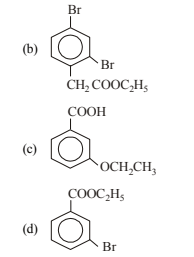
In a set of reactions, ethylbenzene yielded a product D. The reaction sequence is:
Ethylbenzene → [KOH] → KMnO₄ → B → [Br₂/FeCl₃] → C → [C₂H₅OH, H⁺] → D
The correct structure of product D is:
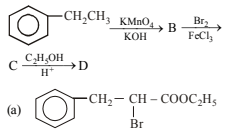
1
Benzyl bromide ethyl ester
2
Dibromobenzyl ethyl ester
3
Ethoxy benzoic acid
4
Ethyl m-bromobenzoate
Official Solution
Correct Option: (4)
Step 1:
Ethylbenzene on oxidation with alkaline KMnO₄ gives benzoic acid (-COOH). Step 2:
Benzoic acid undergoes electrophilic bromination.
The -COOH group is meta-directing, so bromination occurs at meta position. Step 3:
Treatment with ethanol in acidic medium gives esterification. Step 4:
Final product is ethyl meta-bromobenzoate.
12
PYQ 2020
easy
chemistryID: bitsat-2
Give the possible structure of X in the following reaction: C₆H₆ + D₂SO₄ xrightarrowD₂O X
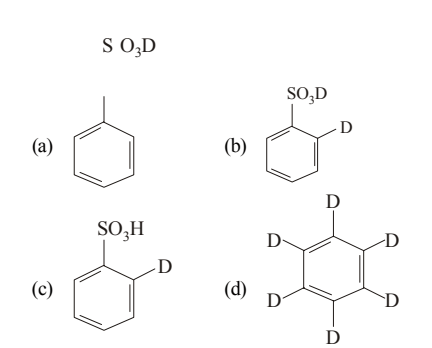
Official Solution
Correct Option: (1)
13
PYQ 2020
medium
chemistryID: bitsat-2
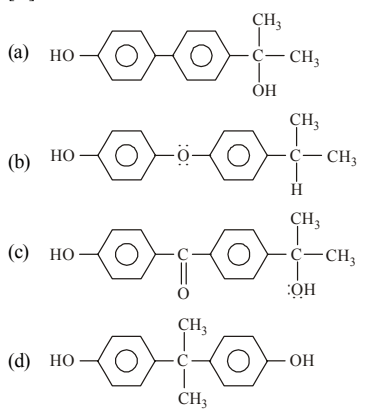
In the following reaction: Phenol + acetone xrightarrowH⁺ X The product [X] is:

1
Option a
2
Option b
3
Option c
4
Option d
Official Solution
Correct Option: (1)
Step 1: Phenol reacts with acetone in acidic medium to form bisphenol A. Step 2: The reaction involves electrophilic substitution followed by condensation. Step 3: The product contains two phenyl rings linked through a tertiary carbon bearing two methyl groups and one hydroxyl group.
14
PYQ 2020
medium
chemistryID: bitsat-2
An aromatic compound has molecular formula C₇H₇Br. Give the possible isomers and the appropriate method to distinguish them.
1
3 isomers; by heating with AgNO₃ solution
2
4 isomers; by treating with AgNO₃ solution
3
4 isomers; by oxidation
4
5 isomers; by oxidation
Official Solution
Correct Option: (2)
Step 1: Possible aromatic isomers of C₇H₇Br: • o-bromotoluene • m-bromotoluene • p-bromotoluene • benzyl bromide (C₆H₅CH₂Br) Step 2: Total isomers =4. Step 3: Distinction: • Benzyl bromide gives immediate precipitate with alcoholic AgNO₃ • Aryl bromides (o-, m-, p-) do not react
15
PYQ 2020
medium
chemistryID: bitsat-2
Which of the following methods gives better yield of p-nitrophenol?
1
Phenol [20^∘C]dil. HNO₃ p-Nitrophenol
2
Phenol (i) NaNO₂ + H₂SO₄ (ii) HNO₃ p-Nitrophenol
3
Phenol (i) NaOH (ii) conc. HNO₃
4
None of the three
Official Solution
Correct Option: (2)
Step 1: Direct nitration of phenol gives a mixture of o- and p-nitrophenols. Step 2: In method (b), phenol is first converted into phenyl nitrite which rearranges (via nitrosation–oxidation) to give predominantly p-nitrophenol. Step 3: Para product is favoured due to steric hindrance at ortho position.
16
PYQ 2020
medium
chemistryID: bitsat-2
Which of the following compounds has all the four types (1^∘, 2^∘, 3^∘ and 4^∘) of carbon atoms?
1
2,3,4-Trimethylpentane
2
neo-Pentane
3
2,2,4-Trimethylpentane
4
None of the three
Official Solution
Correct Option: (3)
Step 1: 2,2,4-Trimethylpentane (isooctane) contains: • Primary carbons (1^∘) in methyl groups • Secondary carbon (2^∘) in the chain • Tertiary carbon (3^∘) at C-4 • Quaternary carbon (4^∘) at C-2 Step 2: Other options lack at least one type of carbon.
17
PYQ 2025
easy
chemistryID: bitsat-2
Which of the following is an alkene?
1
C H
2
C H
3
C H
4
C H
Official Solution
Correct Option: (2)
To determine which compound is an alkene, we need to understand the characteristics of alkanes, alkenes, and alkynes:
Alkanes: Saturated hydrocarbons with single bonds only, following the general formula CnH2n+2.
Alkenes: Unsaturated hydrocarbons containing at least one carbon-carbon double bond, following the general formula CnH2n.
Alkynes: Unsaturated hydrocarbons with at least one carbon-carbon triple bond, following the general formula CnH2n-2.
Given the options:
C2H6: This follows the alkane formula (C2H2(2)+2) = C2H6. Therefore, it is an alkane.
C2H4: This fits the alkene formula (C2H2(2)) = C2H4. Thus, it is an alkene.
C3H8: This matches the alkane formula (C3H2(3)+2) = C3H8. Hence, it is an alkane.
C4H10: This conforms to the alkane formula (C4H2(4)+2) = C4H10. Therefore, it is an alkane.
From the options given, C2H4 is the only compound that satisfies the formula of an alkene, as it contains the double bond necessary for an unsaturated hydrocarbon.
18
PYQ 2026
medium
chemistryID: bitsat-2
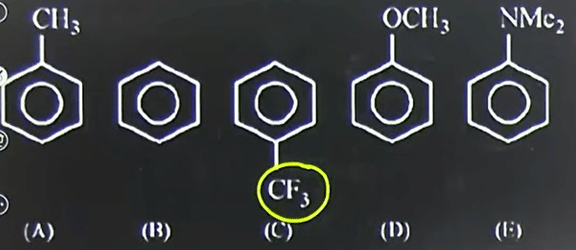
Decreasing order of reactivity towards electrophilic substitution for the following compounds is:
1
C > B > A > D > E
2
E > D > A > B > C
3
A > D > E > B > C
4
D > A > E > C > B
Official Solution
Correct Option: (2)
Step 1: Understanding the Concept:
The reactivity of a benzene ring towards electrophilic substitution depends on the nature of the substituent attached. Electron-donating groups (EDGs) activate the ring, while electron-withdrawing groups (EWGs) deactivate it. Step 2: Detailed Explanation:
- (E) : Strong EDG due to resonance (+R effect of Nitrogen). Highly activating.
- (D) : Strong EDG due to resonance (+R effect of Oxygen), but less so than Nitrogen.
- (A) : Weak EDG via inductive (+I) effect and hyperconjugation.
- (B) Benzene: The standard reference point.
- (C) : Strong EWG due to the high electronegativity of three fluorine atoms (-I effect). Highly deactivating. Step 3: Final Answer
The decreasing order of reactivity (most to least reactive) is E > D > A > B > C.
19
PYQ 2026
medium
chemistryID: bitsat-2
How many moles of oxygen are required to completely combust 1 mole of propane (C H )?
1
4 moles
2
5 moles
3
6 moles
4
3 moles
Official Solution
Correct Option: (2)
Step 1: Understanding the Concept
Complete combustion of a hydrocarbon involves reacting it with oxygen ( ) to produce carbon dioxide ( ) and water ( ). To find the molar ratio, we must write a balanced chemical equation. Step 2: Key Formula or Approach
The general formula for the combustion of a hydrocarbon is:
Step 3: Detailed Explanation
1. For Propane, and .
2. Carbon balancing: 3 atoms of C produce .
3. Hydrogen balancing: 8 atoms of H produce .
4. Oxygen balancing: - From : oxygen atoms.
- From : oxygen atoms.
- Total Oxygen atoms needed = .
- Since oxygen exists as , the number of moles of is .
5. Balanced Equation: Step 4: Final Answer
5 moles of oxygen are required to combust 1 mole of propane.
20
PYQ 2026
medium
chemistryID: bitsat-2
The one giving maximum number of isomeric alkenes on dehydrohalogenation reaction is (excluding rearrangement):
1
1-Bromo-2-methylbutane
2
2-Bromopropane
3
2-Bromopentane
4
2-Bromo-3,3-dimethylpentane
Official Solution
Correct Option: (3)
Step 1: Understanding the Concept:
Dehydrohalogenation follows Saytzeff's rule. The number of isomeric alkenes depends on the number of non-equivalent -hydrogens available and whether the resulting alkenes can show cis-trans (E/Z) isomerism. Step 2: Detailed Explanation:
1. 1-Bromo-2-methylbutane: Only one type of -H. Gives only 2-methylbut-1-ene. (1 product).
2. 2-Bromopropane: Two equivalent -carbons. Gives only propene. (1 product).
3. 2-Bromopentane: Two non-equivalent -carbons (C1 and C3).
- From C1: Pent-1-ene.
- From C3: Pent-2-ene. Pent-2-ene exists as cis and trans isomers.
- Total = 3 isomers.
4. 2-Bromo-3,3-dimethylpentane: C3 has no hydrogens. Only -H available is on C1. Gives 3,3-dimethylpent-1-ene. (1 product). Step 3: Final Answer
2-Bromopentane gives the maximum number of isomeric alkenes.