Current Electricity
104 previous year questions.
High-Yield Trend
Chapter Questions 104 MCQs
Two cables of copper are of equal lengths. One of them has a single wire of area of cross-section A, while other has 10 wires of cross-sectional area each. Give their suitability for transporting A.C. and D.C.
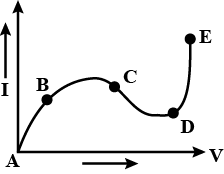
From the graph between current (I) and voltage (V) is shown below. Identify the portion corresponding to negative resistance
10 ohm
15 ohm
20 ohm
40 ohm
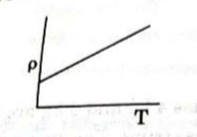
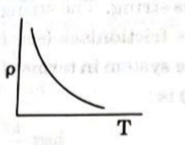
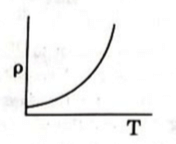
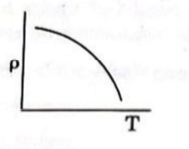
Specific resistance of a conductor increases with
Two 220-volt, 100-watt bulbs are connected first in series and then in parallel. Each time the combination is connected to a 220-volt a.c. supply line. The power drawn by the combination in each case respectively will be:
50 watt,100 watt
100 watt,50 watt
200 watt,150 watt
50 watt,200 watt
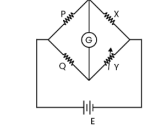
In a Wheatstone's bridge all the four arms have equal resistance R. If the resistance of the galvanometer arm is also R,the equivalent resistance of the combination as seen by the battery is:
R
2R
2R
R
7 V
21 V
14 V
28 V
A 5-A fuse wire can withstand a maximum power of 1W incircuit.The resistance of the fuse wire is:
0.02 Ω
0.2 Ω
0.4 Ω
0.04 Ω
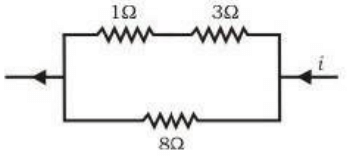
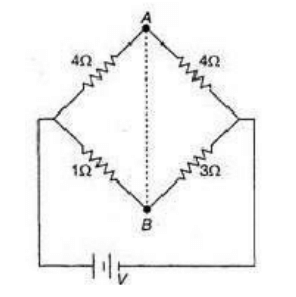
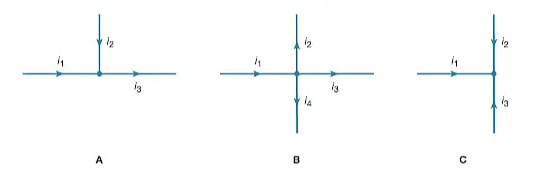
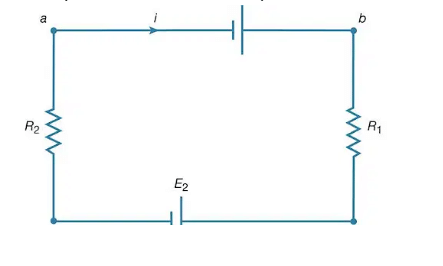
(i) infinity
(ii) 9.5 Ω,
the 'balancing lengths', on the potentiometer wire are found to be 3 m and 2.85 m, respectively. The value of internal resistance of the cell is:
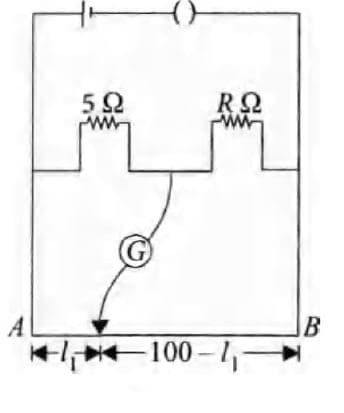
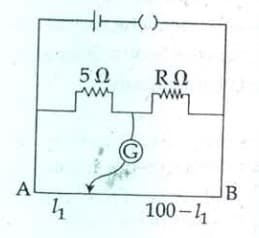
A set of ‘n’ equal resistors, of value each, are connected in series to a battery of emf ‘E’ and internal resistance ‘R' The current drawn is . Now, the ‘n’ resistors are connected in parallel to the same battery. Then the current drawn from the battery becomes . The value of ‘n’ is
Column - I gives certain physical terms associated with flow of current through a metallic conductor. Column - II gives some mathematical relations involving electrical quantities. Match Column - I and Column - II with appropriate relations.
| Column I | Column II | ||
|---|---|---|---|
| A | Drift Velocity | P | |
| B | Electrical Resistivity | Q | |
| C | Relaxation Period | R | |
| D | Current Density | S | |
| Column - I | Column - II | ||
| (A) | Drift Velocity | (P) | |
| (B) | Electrical Resistivity | (Q) | |
| (C) | Relaxation Period | (R) | |
| (D) | Current Density | (S) | |
(A)-(R), (B)-(Q), (C)-(S), (D)-(P)
(A)-(R), (B)-(S), (C)-(P), (D)-(Q)
(A)-(R), (B)-(S), (C)-(Q), (D)-(P)
(A)-(R), (B)-(P), (C)-(S), (D)-(Q)
62 cm
60 cm
21.6 cm
64 cm
Yellow
Red
Green
Orange
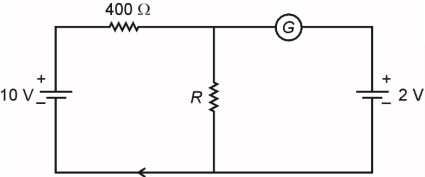
400Ω
200Ω
50Ω
100Ω
The effective resistance of a parallel connection that consists of four wires of equal length, equal area of cross-section, and same material is 0.25 Ω. What will be the effective resistance if they are connected in series?
4 Ω
0.25 Ω
0.5 Ω
1 Ω
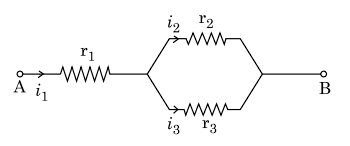
The magnitude and direction of the current in the following circuit is
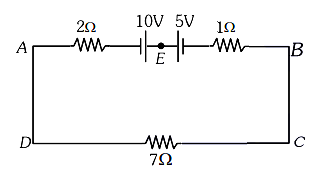
1.5 A from B to A through E
0.2 A from B to A through E
0.5 A from A to B through E
5/9 A from A to B through E
A constant voltage of 50 V is maintained between the points A and B of the circuit shown in the figure. The current through the branch CD of the circuit is :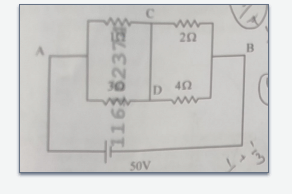
The current passing through the battery in the given circuit, is: 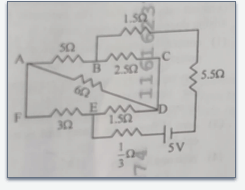
About Current Electricity - NEET-UG
Current Electricity is a vital chapter for NEET-UG aspirants. Mastering the concepts covered in this chapter is essential for securing a top rank.
By rigorously practicing the previous year questions associated with this chapter, you can identify high-yield topics, understand the examiner's perspective, and boost your confidence during the actual exam.
Frequently Asked Questions
Why focus on Current Electricity PYQs?
Analyzing PYQs for this specific chapter reveals the most frequently tested concepts and the typical complexity of questions, allowing you to tailor your study plan efficiently.
How to best use this analysis?
Review the topic breakdown to see which sub-topics within Current Electricity carry the most weight. Then, tackle the questions iteratively to solidify your understanding.