The coefficient of restitution , for a perfectly elastic collision is
1
1
2
0
3
4
-1
Official Solution
Correct Option: (1)
Coefficient of restitution or resilience of two bodies is defined as the constant ratio of relative velocity after impact to the relative velocity of the bodies before impact when the two bodies collide head on. There velocities are in the opposite directions. Thus constant The constant is known as coeff. of restitution or resilience of two bodies. For a perfectly elastic collision, and for a perfectly inelastic collision, . Thus .
02
PYQ 1989
easy
physicsID: neet-ug-
A bullet of mass 10 g leaves a rifle at an initial velocity of 1000 m/s and strikes the earth at the same level with a velocity of 500 m/s. The work done in joule overcoming the resistance of air will be
1
375
2
3750
3
5000
4
500
Official Solution
Correct Option: (2)
Work done = change in kinetic energy of the body
03
PYQ 1989
medium
physicsID: neet-ug-
A batsman hits back a ball straight in the direction of the bowler without changing its initial speed of . If the mass of the ball is 0.15 kg, the imparted to the ball is
How much water a pump of 2 kW can raise in one minute to a height of 10 m? (take g = 10 m/s )
1
1000 litres
2
1200 litres
3
100 litres
4
2000 litres
Official Solution
Correct Option: (2)
The correct option is(B): 1200 litres
Power= but W - mass gravity height
i.e. 1200 litres as one litre has a mass of 1 kg.
05
PYQ 1993
medium
physicsID: neet-ug-
Two masses of 1 g and 9 g are moving with equal kinetic energies. The ratio of the magnitudes of their respective linear momenta is
1
1 : 9
2
9 : 1
3
1 : 3
4
3 : 1
Official Solution
Correct Option: (3)
when
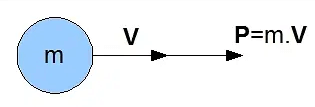
An object's mass times its velocity is said to have linear momentum. A vector quantity, that is. The letter "p" stands for it. A body's momentum and velocity both point in the same general direction. The overall momentum of an isolated system remains constant since momentum is a conserved quantity. Kg m/s is the SI unit for linear momentum.
Given by is the formula for a body's linear momentum.
p = m⋅v
Where,
m = the object's mass
v = the object's velocity
Now, linear momentum is calculated using the formula,
linear momentum = mass × velocity
So, the dimensional formula of linear momentum can be calculated using the above formula
Dimensional formula of mass = [M1L0T0]
Dimensional formula of velocity = [M0L1T-1]
Dimensional Formula of linear momentum = [M1L0T0] × [M0L1T-1] = [M1L1T-1]
Therefore, the dimensional formula of linear momentum is [M1L1T-1].
06
PYQ 1994
medium
physicsID: neet-ug-
A position dependent force, F = (7 - 2x + 3x ) N acts on a small body of mass 2 kg and displaces it from x = 0 to x = 5 m. The work done in joule is
1
135
2
270
3
35
4
70
Official Solution
Correct Option: (1)
Force (F) = 7 - 2x + 3x ; Mass (m) = 2 kg and displacement (d) = 5 m. Therefore work done
=
07
PYQ 1994
medium
physicsID: neet-ug-
A body, constrained to move in y-direction, is subjected to a force given by N The work done by this force in moving the body through a distance of 10 m along y-axis, is
1
150 J
2
20 J
3
190 J
4
160 J
Official Solution
Correct Option: (1)
The correct option is(A): 150 J.
N and distance (d) = 10 . Work done W= .
08
PYQ 1994
medium
physicsID: neet-ug-
When a body moves with a constant speed along a circle
1
no work is done on it
2
no acceleration is produced in it
3
its velocity remains constant
4
no force acts on it
Official Solution
Correct Option: (1)
If the speed is constant then no force is acting in tangential direction. Only force acting is perpendicular to direction of velocity. Hence, work done will be zero.
09
PYQ 1994
hard
physicsID: neet-ug-
The kinetic energy acquired by a mass m in travelling distance d, starting from rest, under the action of a constant force is directly proportional to
1
m
2
m
3
4
1
Official Solution
Correct Option: (2)
or or or and K.E = Thus K.E. is independent of m or directly proportional to m .
10
PYQ 1996
medium
physicsID: neet-ug-
A moving body of mass and velocity . Collides with a body at rest and of mass and then sticks to it. Now the combined mass starts to move, then the combined velocity will be :
1
4 km/hr
2
3 km/hr
3
2 km/hr
4
1 km/hr
Official Solution
Correct Option: (4)
Here : Mass of the body Velocity of the first body Mass of second body at rest Velocity of second body After combination total mass of the body
Now from the law of conservation of momentum
(where )
11
PYQ 1997
easy
physicsID: neet-ug-
A metal ball of mass 2 kg moving with speed of 36 km/h has a head on collision with a stationary ball of mass 3 kg. If after collision, both the balls move as a single mass, then the loss in K.E. due to collision is
1
100 J
2
140 J
3
40 J
4
60 J
Official Solution
Correct Option: (4)
Mass of metal ball = 2 kg; Speed of metal ball (v ) = 36 km/h = 10 m/s and mass of stationary ball = 3 kg. Applying law of conservation of momentum,
or, = 4 m/s Therefore loss of energy
= = 100 - 40 = 60 J.
12
PYQ 1997
easy
physicsID: neet-ug-
A body moves a distance of along a straight line under a action of force. If work done is , then angle between the force and direction of motion of the body will be
1
2
3
4
Official Solution
Correct Option: (2)
Component of force in the direction of displacement should be taken. Work is measured by the product of the applied force and the displacement of the body in the direction of the force
Work Force displacement
Given,
Hence, angle between force and direction of body is .
13
PYQ 1998
medium
physicsID: neet-ug-
A ball is dropped from a height of 5 m on a planet where the acceleration due to gravity is not known. On bouncing it rises to 1.8 m. The ball loses its velocity on bouncing by a factor of
1
16/25
2
44597
3
44625
4
44806
Official Solution
Correct Option: (2)
Using, , we get Loss in velocity =
14
PYQ 1998
medium
physicsID: neet-ug-
A force acts on a 3 g particle in such a way that the position of the particle as a function of time is given by x = 3t - 4t + t , where x is in metres and t is in seconds. The work done during the first 4 second is
1
490 mJ
2
450 mJ
3
576 mJ
4
530 mJ
Official Solution
Correct Option: (4)
The correct option is(D): 530 mJ.
We have, mass,
Now,
Now,
15
PYQ 1998
easy
physicsID: neet-ug-
Two bodies of masses m and 4m are moving with equal kinetic energies. The ratio of their linear momenta is
1
2
3
4
Official Solution
Correct Option: (1)
Mass of first body = m;
Mass of second body = 4m and KE = KE .
Linear momentum of a body
p=
Therefore
or
16
PYQ 1998
medium
physicsID: neet-ug-
A shell, in flight, explodes into four unequal parts. Which of the following is conserved?
1
Potential energy
2
Momentum
3
Kinetic energy
4
Both (a) and (c)
Official Solution
Correct Option: (2)
Answer (b) Momentum
17
PYQ 2000
medium
physicsID: neet-ug-
If =(60 +15 -3 )N and =(2 -4 +5 )m/s, then instantaneous power is:
A particle is projected making an angle of 45 with horizontal having kinetic energy K. The kinetic energy at highest point will be
1
2
3
2K
4
K
Official Solution
Correct Option: (2)
Kinetic energy of the ball = K and angle of projection ( ) = 45 . Velocity of the ball at the highest point = v cos . Therefore kinetic energy of the ball .
19
PYQ 2001
medium
physicsID: neet-ug-
A child is sitting on a swing. Its minimum and maximum heights from the ground 0.75 m and 2 m respectively, its maximum speed will be
1
10 m/s
2
5 m/s
3
8 m/s
4
15 m/s
Official Solution
Correct Option: (2)
Drop in P.E = maximum K.E. mg (2 - 0.75) = 1 mv .
20
PYQ 2001
medium
physicsID: neet-ug-
Two springs A and B having spring constant K and K (K = 2K ) are stretched by applying force of equal magnitude. If energy stored in spring A is E then energy stored in B will be
1
2
3
4
4
Official Solution
Correct Option: (1)
Energy =
. or .
21
PYQ 2002
medium
physicsID: neet-ug-
If kinetic energy of a body is increased by 300% than percentage change in momentum will be
1
100%
2
150%
3
265%
4
73.20%
Official Solution
Correct Option: (1)
The correct option is (A) : 100%
P1 = mE1 ; P2 = mE2
= m( ) =√2m(4E1)=2P1
∴ % change = = =100%
22
PYQ 2003
medium
physicsID: neet-ug-
A stationary particle explodes into two particles of masses m1 and m2 which move in opposite directions with velocities v1 and v2. The ratio of their kinetic energies is:
1
2
3
1
4
Official Solution
Correct Option: (1)
m1v1 = m2v2 (P1 = P2);
= =
23
PYQ 2003
medium
physicsID: neet-ug-
When a long spring is stretched by its potential energy is If the spring is stretched by the potential energy stored in it will be
1
U/5
2
5U
3
10U
4
25U
Official Solution
Correct Option: (4)
24
PYQ 2004
medium
physicsID: neet-ug-
A mass of moving with a speed of on a horizontal smooth surface, collides with a nearly weightless spring of force constant . The maximum compression of the spring would be
1
0.15 m
2
0.12 m
3
1.5 m
4
0.5 m
Official Solution
Correct Option: (1)
The kinetic energy of mass is converted into energy required to compress a spring which is given by
.
25
PYQ 2004
medium
physicsID: neet-ug-
A ball of mass and another of mass are dropped together from a feet tall building. After a fall of feet each towards earth, their respective kinetic energies will be in the ratio of
1
2
3
4
Official Solution
Correct Option: (3)
Here
26
PYQ 2005
medium
physicsID: neet-ug-
A force acting on an object varies with distance as shown in the figure. The force is in and in . The work done by the force in moving the obiect from to is
1
18.0 J
2
13.5 J
3
9.0 J
4
4.5 J
Official Solution
Correct Option: (2)
Work done by force = Area under force displacement graph.
27
PYQ 2005
medium
physicsID: neet-ug-
If a vector 2î+3ĵ+8 is perpendicular to the vector 4ĵ-4î+α,then the value of α is:
1
-2
2
3
4
2
Official Solution
Correct Option: (3)
A =2 +3 +8 B =4 −4 +a Given that A and B are parallel, A. B = 0 (2 +3 +8 )(4 −4 +a ) 8−12+8a=0 a= =
28
PYQ 2005
easy
physicsID: neet-ug-
A bomb of mass 30kg at rest explodes into two pieces of masses 18kg and 12kg. The velocity of 18kg mass is 6ms-1. The kinetic energy of the other mass is
1
243 J
2
486 J
3
564 J
4
388 J
Official Solution
Correct Option: (2)
The correct option is(B): 486 J.
The conservation of momentum states that the total momentum before the explosion is equal to the total momentum after the explosion.
Before the explosion, the bomb is at rest, so the total momentum is zero:
Total initial momentum (before explosion) = 0
After the explosion, we have two pieces with masses m1 = 18 kg and m2 = 12 kg. Let v1 be the velocity of the 18 kg mass after the explosion.
Total final momentum (after explosion) = m1 * v1 + m2 * v2
We know that m1 * v1 is the momentum of the 18 kg mass, and since v1 = 6 :
Total final momentum = (18 kg) * (6 ) + (12 kg) * v2
Now, according to the conservation of momentum, the total initial momentum is equal to the total final momentum:
0 = (18 kg) * (6 ) + (12 kg) * v2
Now, solve for v2:
(12 kg) * v2 = - (18 kg) * (6 )
v2 = - (18 kg) *
v2 = -9
Now that we have found the velocity of the 12 kg mass (v2 = -9 ), we can calculate its kinetic energy using the formula for kinetic energy:
Kinetic Energy (KE) = * mass * velocity2
KE = * (12 kg) *
KE = * (12 kg) *
KE = 486 J.
29
PYQ 2006
medium
physicsID: neet-ug-
300 J of work is done in sliding a 2 kg block up an inclined plane of height 10 m. Taking g =10 m/s2, work done against friction is :
1
50 J
2
100 J
3
zero
4
150 J
Official Solution
Correct Option: (2)
Work Done Against Friction: Work done against friction can be calculated using the formula W = F d, where F is the force of friction and d is the displacement. Given that 300 J of work is done to slide the block up an inclined plane, and taking g = 10 m/s2, the gravitational force component along the incline is mg = 2 kg 10 m/s2 = 20 N. Work done against gravity is Wgravity = m g h = 2 kg 10 m/s2 10 m = 200 J. Work done against friction is Wfriction = Total work - Work against gravity = 300 J - 200 J = 100 J.
30
PYQ 2006
easy
physicsID: neet-ug-
A body of mass 3 kg is under a constant force which causes a displacement s in meters in it, given by the relation s = ( ) t2, where t is in s. Work done by the force in 2 s is :
1
( )J
2
( )J
3
( )J
4
( )J
Official Solution
Correct Option: (3)
Work Done by Constant Force: The work done by a constant force is given by the formula W = F d, where F is the force and d is the displacement. In this case, s = ( )t2, so the force is F = m ( ) = . To find the work done in 2 seconds, integrate F with respect to t over the interval [0, 2]: W = ( ) dt = ( ) [ ] from 0 to 2 = ( ) ( ) = ( ) J. So, the correct option is ( ) J.
31
PYQ 2006
medium
physicsID: neet-ug-
The vectors and are such that: . The angle between the two vectors is:
1
90°
2
60°
3
30°
4
0°
Official Solution
Correct Option: (1)
Assume that the angle between A and B is θ The resultant of |A+B| is given by:
The resultant of |A-B| is given by:
According to question:
= ⇒ ⇒ , ⇒ So, the correct option is (A):
32
PYQ 2006
medium
physicsID: neet-ug-
The potential energy of a long spring when stretched by 2 cm is U. If the spring is stretched by 8 cm the potential energy stored in it is:
1
4U
2
3
16U
4
Official Solution
Correct Option: (3)
Now,
So, the correct option is (C): 16U
33
PYQ 2007
medium
physicsID: neet-ug-
vertical spring with force constant is fixed on a table. ball of mass m at a height h above the free upper end of the spring falls vertically on the spring so that the spring is compressed by a distance . The net work done in the process is
1
2
3
4
Official Solution
Correct Option: (1)
Net work done work done by gravitational force work done by spring force
34
PYQ 2008
easy
physicsID: neet-ug-
Water falls from a height of 60 m at the rate of 15 kg/s to operate a turbine. The losses due to frictional forces are 10% of energy. How much power is generated by the turbine ? (g = 10 m/s )
1
12.3 kW
2
7.0 kW
3
8.1 kW
4
10.2 kW
Official Solution
Correct Option: (3)
Mass of water falling/second = 15 kg/s h = 60 m g= 10 m/s , loss = 10%
i.e., 90% is used. Power generated = 15 10 60 0.9 = 8100 W = 8.1 kW.
35
PYQ 2008
medium
physicsID: neet-ug-
A shell of mass 200 gm is ejected from a gun of mass 4 kg by an explosion that generates 1.05 kJ of energy. The initial velocity of the shell is
1
40 ms
2
120 ms
3
100 ms
4
80 ms
Official Solution
Correct Option: (3)
mv = Mv' Total K.E. of the bullet and gun
Total K.E = Total K.E =
;
36
PYQ 2009
easy
physicsID: neet-ug-
A block of mass is attached to the lower end of a vertical spring. The spring is hung from a ceiling and has force constant value . The mass is released from rest with the spring initially unstretched. The maximum extension produced in the length of the spring will be
1
2Mg/k
2
4Mg/k
3
Mg/2k
4
Mg/k
Official Solution
Correct Option: (1)
Loss in grav. gain in spring At maximum elongation
37
PYQ 2009
medium
physicsID: neet-ug-
An explosion blows a rock into three parts Two parts go off at right angles to each other. These
two are, first part moving with a velocity of and second part moving with a velocity of . If the thirds part files off with a velocity of , its mass would be :
1
7 kg
2
17 kg
3
3 kg
4
5 kg
Official Solution
Correct Option: (4)
38
PYQ 2010
medium
physicsID: neet-ug-
A ball moving with velocity collides head on with another stationary ball of double the mass. If the coefficient of restitution is , then their velocities after collision will be
1
0, 1
2
44562
3
1, 0.5
4
0, 2
Official Solution
Correct Option: (1)
Here, m = w, m = 2m u = 2 m/s, u = 0 Coefficient of restitution, e = 0.5 Let v and v be their respective velocities after collision. Applying the law of conservation of linear momentum, we get
or or 2 = ( + 2 ...(i) By definition of coefficient of restitution,
or 0.5(2 - 0) = ...(ii)
Solving equations (i) and (ii), we get ,
39
PYQ 2010
easy
physicsID: neet-ug-
An engine pumps water through a hose pipe. Water passes through the pipe and leaves it with a velocity of . The mass per unit length of water in the pipe is . What is the power of the engine?
1
400 W
2
200 W
3
100 W
4
800 W
Official Solution
Correct Option: (4)
Here, Mass per unit length of water, Velocity of water, Power of the engine,
40
PYQ 2010
easy
physicsID: neet-ug-
A particle of mass , starting from rest, undergoes uniform acceleration. If the speed acquired in time is , the power delivered to the particle is
1
2
3
4
Official Solution
Correct Option: (4)
The correct option is(D): Power delivered in time T is
or P = MV or
41
PYQ 2011
medium
physicsID: neet-ug-
A mass moving horizontally (along the with velocity collides and sticks to a mass of moving vertically upward (along the -axis) with velocity . The final velocity of the combination is
1
2
3
4
Official Solution
Correct Option: (2)
From the law of conservation of linear momentum
42
PYQ 2011
medium
physicsID: neet-ug-
Force on a particle moving in a straight line varies with distance as shown in figure. The work done on the particle during its displacement of is
1
18 J
2
21 J
3
26 J
4
13 J
Official Solution
Correct Option: (4)
Work done area between force displacement curve and displacement axis
43
PYQ 2011
medium
physicsID: neet-ug-
The potential energy of a system increases if work is done
1
upon the system by a nonconservative force
2
by the system against a conservative force
3
by the system against a non conservative force
4
upon the system by a conservative force
Official Solution
Correct Option: (2)
The correct answer is Option B) by the system against a conservative force
Potential energy will increase when work is done by the system against a conservative force.
The potential energy of a particle in a force field is where A and B are positive constants and r is the distance of particle from the centre of the field. For stable equilibrium, the distance of the particle is
1
2
3
4
Official Solution
Correct Option: (2)
For Stable equilibrium, we get
45
PYQ 2012
medium
physicsID: neet-ug-
A car of mass m starts from rest and accelerates so that the instantaneous power delivered to the car has a constant magnitude . The instantaneous velocity of this car is proportional to
1
2
3
4
Official Solution
Correct Option: (2)
or Integrating both sides, we get
or
46
PYQ 2012
easy
physicsID: neet-ug-
Two spheres and of masses and respectively collide. is at rest initially and is moving with velocity along x-axis. After collision has a velocity in a direction perpendicular to the original direction. The mass moves after collision in the direction
1
same as that of B
2
opposite to that of B
3
to the x-axis
4
to the x-axis
Official Solution
Correct Option: (4)
There is no external force acting on the spheres. So linear momentum will be conserved. Before the collision, In direction , Linear momentum ....1 In direction , Linear momentum After the collision, spheres moves as shown in figure. Let velocity of sphere A is
In direction , Linear momentum In direction y, Linear momentum Linear momentum will be conserved, From equation 1 and From the equation 2, Dividing equation 5 by
47
PYQ 2013
easy
physicsID: neet-ug-
One coolie takes 1 minute to raise a suitcase through a height of 2 m but the second coolie takes 30 s to raise the same suitcase to the same height. The powers of two coolies are in the ratio
1
1 : 3
2
2 : 1
3
3 : 1
4
1 : 2
Official Solution
Correct Option: (4)
Power, P = Here work done (= mgh) is same in both cases. .
48
PYQ 2013
medium
physicsID: neet-ug-
A uniform force of newton acts on a particle of mass 2kg. Hence the particle is displaced from position meter to position meter. The work done by the force on the particle is :
1
15 J
2
9 J
3
6 J
4
13 J
Official Solution
Correct Option: (2)
The correct answer is B:9J
49
PYQ 2014
medium
physicsID: neet-ug-
A body of mass is lying in plane at rest. It suddenly explodes into three pieces. Two pieces, each of mass move perpendicular to each other with equal speeds . The total kinetic energy generated due to explosion is
1
2
3
4
Official Solution
Correct Option: (2)
Let be velocity of third piece of mass 2m. Initial momentum, (As the body is at rest) Final momentum According to law of conservation of momentum
0=mv
The magnitude of v' is
Total kinetic energy generated due to explosion
=
50
PYQ 2015
easy
physicsID: neet-ug-
A particle of mass m is driven by a machine that delivers a constant power k watts. If the particle starts from rest the force on the particle at time t is
1
2
3
4
Official Solution
Correct Option: (3)
Constant power acting on the particle of mass m is k watt. or P = k ; Integrating both sides
Using work energy theorem, W = [using equation (i)]
Acceleration of the particle,
Force on the particle, F = ma =
51
PYQ 2015
easy
physicsID: neet-ug-
On a frictionless surface, a block of mass moving at speed collides elastically with another block of same mass which is initially at rest. After collision the first block moves at an angle to its initial direction and has a speed . The second block's speed after the collision is
1
2
3
4
Official Solution
Correct Option: (3)
The situation is shown in the figure.
Using energy conservation, here, or or
52
PYQ 2015
easy
physicsID: neet-ug-
Two particles of masses m , m move with initial velocities u and u . On collision, one of the particles get excited to higher level, after absorbing energy . If final velocities of particles be v and v then we must have
1
2
3
4
Official Solution
Correct Option: (1)
Total initial energy of two particles
Total final energy of two particles
Using energy conservation principle,
53
PYQ 2015
medium
physicsID: neet-ug-
The heart of a man pumps litres of blood through the arteries per minute at a pressure of of mercury. If the density of mercury be and = then the power
1
3
2
1.5
3
1.7
4
2.35
Official Solution
Correct Option: (3)
Here , Volume of blood pumped by man's heart, V=5 litres= ( litre ) Time in which this volume of blood pumps, t = 1 min = 60 s Pressure at which the blood pumps , P = 150 mm of Hg = 0.15 m of Hg =(0.15 m) (13.6 )(10 m/s ) =20.4 Power of the heart =
54
PYQ 2016
hard
physicsID: neet-ug-
A particle of mass moves along a circle of radius with a constant tangential acceleration. What is the magnitude of this acceleration if the kinetic energy of the particle becomes equal to by the end of the second revolution after the beginning of the motion ?
1
2
3
4
Official Solution
Correct Option: (4)
Calculation of Tangential Acceleration
The correct option is (D): 0.1 m/s².
Step-by-Step Calculation:
We are given the following equation for kinetic energy:
Substituting values:
Simplifying further:
The initial velocity of the particle is:
Finding Tangential Acceleration
We are asked to find the tangential acceleration at the end of the 2nd revolution. First, we calculate the total distance covered:
Now, using the equation for motion:
Solving for acceleration :
Substituting known values:
Finally, simplifying:
Conclusion:
The tangential acceleration at the end of the 2nd revolution is approximately , so the correct option is (D).
55
PYQ 2016
medium
physicsID: neet-ug-
A body of mass 1 kg begins to move under the action of a time dependent force , where and are unit vectors along x and y axis. What power will be developed by the force at the time t ?
1
2
3
4
Official Solution
Correct Option: (3)
Force, Velocity, and Power Calculation
We are given the force as a function of time and need to calculate the velocity and power of the object:
Step 1: Given Force
The force acting on the object is given by:
Step 2: Using Newton's Second Law of Motion
According to Newton's second law, the force is related to the rate of change of velocity:
Where: - (mass of the object), - is the velocity of the object, - is time.
Step 3: Finding the Velocity
We now integrate the equation with respect to time to find the velocity. The equation becomes:
Performing the integration, we get:
This gives the velocity of the object as a function of time:
Step 4: Calculating the Power
The power delivered by the force is the dot product of the force and velocity vectors:
Substitute the expressions for and :
Now compute the dot product:
Conclusion:
The power delivered by the force as a function of time is:
56
PYQ 2016
medium
physicsID: neet-ug-
A particle moves from a point to when a force of is applied. How much work has been done by the force ?
1
8 J
2
11 J
3
5 J
4
2 J
Official Solution
Correct Option: (3)
Work Calculation Explanation
We are asked to calculate the work done by a force over a displacement . The formula for work is:
Step 1: Given Values
The force and displacement are given as:
Step 2: Simplify Displacement
Now, let's simplify the displacement vector :
First, distribute the negative sign:
Now, simplify the terms:
Step 3: Dot Product Calculation
Next, we calculate the dot product of the force and displacement vectors:
Step 4: Perform the Dot Product
To compute the dot product, we multiply corresponding components and sum them:
For the -component:
For the -component:
For the -component: (since there's no -component in )
So, the dot product is:
Conclusion:
The work done is 5 Joules (J).
57
PYQ 2017
medium
physicsID: neet-ug-
Consider a drop of rain water having mass falling from a height of . It hits the ground with a speed of . Take 'g' constant with a value . The work done by the (i) gravitational force and the (ii) resistive force of air is :-
1
(i) 1.25 J (ii) - 8.25 J
2
(i) 100 J (ii) 8.75 J
3
(i) 10 J (ii) - 8.75 J
4
(i) - 10 J (ii) - 8.25 J
Official Solution
Correct Option: (3)
Sol.
i.e. work done due to air resistance and work done due to gravity
58
PYQ 2017
medium
physicsID: neet-ug-
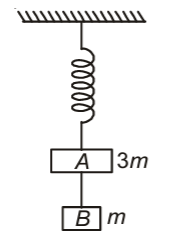
Two blocks A and B of masses 3m and m respectively are connected by a massless and inextensible string. The whole system is suspended by a massless spring as shown in figure. The magnitudes of acceleration of A and B immediately after the string is cut, are respectively
1
2
3
4
Official Solution
Correct Option: (2)
The correct option is (B): .
59
PYQ 2018
medium
physicsID: neet-ug-
A body initially at rest and sliding along a frictionless track from a height (as shown in the figure) just completes a vertical circle of diameter . The height h is equal to
1
2
3
4
Official Solution
Correct Option: (1)
As track is frictionless, so total mechanical energy will remain constant
For completing the vertical circle,
60
PYQ 2019
easy
physicsID: neet-ug-
A particle of mass 5 m at rest suddenly breaks on its own into three fragments. Two fragments of mass m each move along mutually perpendicular direction with speed v each. the energy released during the process is :
1
2
3
4
Official Solution
Correct Option: (4)
Energy released
61
PYQ 2019
easy
physicsID: neet-ug-
A mass is attached to a thin wire and whirled in a vertical circle. The wire is most likely to break when:
1
the mass is at the lowest point
2
inclined at an angle of from vertical
3
the mass is at the highest point
4
the wire is horizontal
Official Solution
Correct Option: (1)
The tension is maximum at the lowest position of mass, so the chance of breaking is maximum.
62
PYQ 2019
medium
physicsID: neet-ug-
Body A of mass 4m moving with speed u collides with another body B of mass 2m, at rest. The collision is head on and elastic in nature. After the collision the fraction of energy lost by the colliding body A is :
1
2
3
4
Official Solution
Correct Option: (4)
Fractional loss of KE of ccolliding body
63
PYQ 2019
medium
physicsID: neet-ug-
A force F = 20 + 10y action a particle in y-direction where F is in newton and y in meter. Work done by this force to move the particle from y = 0 to y = 1 m is :
1
25J
2
20J
3
30J
4
5J
Official Solution
Correct Option: (1)
Work done by variable force is
Here,
64
PYQ 2020
easy
physicsID: neet-ug-
Find the torque about the origin when a force of acts on a particle whose position vector is .
1
2
3
4
Official Solution
Correct Option: (3)
Given: ,
We know,
65
PYQ 2021
medium
physicsID: neet-ug-
Water falls from a height of 60 m at the rate of 15 kg/s to operate a turbine. The losses due to frictional force are 10% of the input energy. How much power is generated by the turbine (g=10 m/s2)
1
7.0 kW
2
10.2 kW
3
8.1 kW
4
12.3 kW
Official Solution
Correct Option: (3)
To solve the problem of calculating the power generated by the turbine, we will use the principle of conservation of energy. Here's a step-by-step breakdown:
First, determine the potential energy per second of the water falling from 60 m height. The potential energy (PE) gained by the water per second is given by the formula: where:
(mass flow rate)
(acceleration due to gravity)
(height)
Substitute the values into the potential energy formula:
Next, account for the energy losses due to friction. The problem states that 10% of the input energy is lost. Therefore, 90% of the potential energy is converted into useful energy:
Thus, the power generated by the turbine is .
This result matches the correct answer option: 8.1 kW.
In summary, despite the frictional losses, the system is capable of generating a significant amount of power, reaching 8.1 kW after accounting for efficiency losses. This solution involves understanding the conversion of gravitational potential energy to mechanical energy while incorporating efficiency factors that affect real-life applications.
66
PYQ 2021
medium
physicsID: neet-ug-
A particle is released from height S from the surface of the Earth. At a certain height, its kinetic energy is three times its potential energy. The height from the surface of the earth and the speed of the particle at that instant are respectively
1
2
3
4
Official Solution
Correct Option: (1)
To solve this problem, we need to find the height from the surface of the earth at which the kinetic energy (KE) of the particle is three times its potential energy (PE). We will also determine the speed of the particle at that height.
Initially, the particle is released from a height from the surface of the Earth with zero initial velocity. The total mechanical energy (TE) at the height is given by:
and .
Thus, .
At a certain height from the surface, we have:
According to the problem, . Therefore:
Simplifying, we get:
Since the total mechanical energy is conserved, we have:
Substitute into the above conservation equation:
Canceling the common terms and solving for , we get:
Now, substitute back into to find the speed:
Thus, the height from the surface of the Earth and the speed of the particle at that instant are respectively and , which matches the correct option:
67
PYQ 2023
easy
physicsID: neet-ug-
The potential energy of a long spring when stretched by 2 cm is U. If the spring is stretched by 8 cm, potential energy stored in it will be:
1
16U
2
2U
3
4U
4
8U
Official Solution
Correct Option: (1)
To determine the potential energy stored in a spring when stretched, we use the formula for potential energy of a spring: , where is the potential energy, is the spring constant, and is the displacement from the equilibrium position.
Initially, the spring is stretched by 2 cm, which is the displacement , and the potential energy is . Using the formula: .
Now, consider the spring stretched by 8 cm, which is the displacement . The potential energy stored is given by: .
To find the new potential energy in terms of , we set up the equation from earlier: , so . Substitute this back into the expression for :
Thus, if the spring is stretched by 8 cm, the potential energy stored in it is .
68
PYQ 2024
hard
physicsID: neet-ug-
Two heaters A and B have power rating of 1 kW and 2 kW, respectively. Those two are first connected in series and then in parallel to a fixed power source. The ratio of power outputs for these two cases is :
1
1 : 1
2
2 : 9
3
1 : 2
4
2 : 3
Official Solution
Correct Option: (2)
The problem involves calculating the ratio of power outputs when two heaters are connected in series and then in parallel to a fixed power source. We are given the power ratings of Heater A (1 kW) and Heater B (2 kW).
First, consider the case where heaters are connected in series. When connected in series, the voltage across each heater is different. The total power in series is given by the formula:
Where is the voltage of the power source, and and are the resistances of heaters A and B, calculated using the formula . Thus,
Solving for resistances,
In series:
Next, consider the parallel connection. In parallel, the voltage across each heater is the same, and the total power is:
The ratio of power outputs is:
Thus, the ratio of power outputs is 2:9, which is the correct answer.
69
PYQ 2024
medium
physicsID: neet-ug-
At any instant of time t, the displacement of any particle is given by 2t – 1 (SI unit) under the influence of force of 5N. The value of instantaneous power is (in SI unit):
1
10
2
5
3
7
4
6
Official Solution
Correct Option: (1)
To solve this problem, we need to determine the instantaneous power given the displacement function of a particle and the constant force applied.
Displacement Function:
Force:
1. Velocity Calculation: The instantaneous velocity is the derivative of the displacement function with respect to time .
2. Power Calculation: Instantaneous power is given by the product of force and instantaneous velocity.
Substituting the given values:
Thus, the value of instantaneous power is 10 W.
70
PYQ 2024
easy
physicsID: neet-ug-
An object falls from a height of 10 m above the ground. After striking the ground it loses of its kinetic energy. The height upto which the object can rebounce from the ground is:
1
7.5 m
2
10 m
3
2.5 m
4
5 m
Official Solution
Correct Option: (4)
1. Initial Potential Energy: Initial potential energy (PE) = mgh, where m is the mass, g is acceleration due to gravity, and h is the initial height (10 m).
2. Kinetic Energy Just Before Impact: By conservation of energy, the potential energy is converted to kinetic energy (KE) just before the object strikes the ground: KE = mgh.
3. Kinetic Energy After Impact: The object loses 50% of its KE after striking the ground, so the remaining KE is 0.5(mgh).
4. Rebound Height: The remaining KE is converted back to potential energy as the object rebounds. Let h’ be the rebound height. 0.5(mgh) = mgh’ h’ = 0.5h = 0.5(10 m) = 5 m
5. Conclusion: The rebound height is 5 m.
71
PYQ 2024
easy
physicsID: neet-ug-
An object moving along horizontal x-direction with kinetic energy is displaced through by the force . The kinetic energy of the object at the end of the displacement is: