The ratio for a carnot–engine is , Now the temperature of sink is reduced by , then this ratio becomes twice, therefore the initial temperature of the sink and source are respectively:
1
2
3
4
Official Solution
Correct Option: (2)
⇒
⇒
⇒
02
PYQ 2001
medium
physicsID: neet-ug-
A scientist says that the efficiency of his heat engine which work at source temperature and sink temperature is then
1
it is impossible
2
it is possible but less probable
3
it is quite probable
4
data are incomplete
Official Solution
Correct Option: (1)
Efficiency is maximum in Carnot engine which is an ideal engine.
efficiency is impossible for his heat engine.
03
PYQ 2003
medium
physicsID: neet-ug-
An ideal gas heat engine operates in a Carnot cycle between and It absorbs at the higher temperature. The amount of heat (in kcal) converted into work is equal to
1
4.8
2
3.5
3
1.6
4
1.2
Official Solution
Correct Option: (4)
Efficiency of Carnot engine
04
PYQ 2004
medium
physicsID: neet-ug-
One mole of an ideal gas at an initial temperature of T K does 6 R joules of work adiabatically. If the ratio of specific heats of this gas at constant pressure and at constant volume is 35 , the final temperature of gas will be
1
(T –2.4) K
2
(T + 4)K
3
(T – 4) K
4
(T + 2.4)K
Official Solution
Correct Option: (3)
The final temperature of the gas will be the same as the initial temperature, which is T Kelvin.
05
PYQ 2004
medium
physicsID: neet-ug-
The equation of state for 5g of oxygen at a pressure P and temperature T, when occupying a volume V, will be :-
1
PV = 5 RT
2
PV = ( ) RT
3
PV = ( ) RT
4
PV = ( ) RT
Official Solution
Correct Option: (4)
The equation of state for 5g of oxygen at a pressure P and temperature T, when occupying a volume V, is PV = 5 RT.
06
PYQ 2005
medium
physicsID: neet-ug-
Which of the following processes is reversible?
1
Transfer of heat by radiation
2
Electrical heating of a nichrome wire
3
Transfer of heat by conduction
4
Isothermal compression
Official Solution
Correct Option: (4)
While the other processes are irreversible in nature, slow isothermal expansion or compression of an ideal gas is a reversible process.
Therefore, the correct option is (D): Isothermal compression
07
PYQ 2005
medium
physicsID: neet-ug-
An ideal gas heat engine operates in Carnot cycle between 227°C and 127°C. It absorbs 6 x 10⁴ cal of heat at higher temperature. Amount of heat converted to work is:
1
2.4 x 10⁴ cal
2
3.6 x 10⁴ ca
3
1.2 x 10⁴ cal
4
6.4 x 10⁴ cal
Official Solution
Correct Option: (3)
Efficiency for a Carnot engine is e = 1 = = = = . e = is now equal to W=e 6 104 = 6 104 =1.2 104 cal.
Therefore, the correct option is (C): 1.2 x 10⁴ cal
08
PYQ 2006
easy
physicsID: neet-ug-
A Carnot engine whose sink is at 300 K has an efficiency of By how much should the temperature of source be increased so as to increase its efficiency by of original efficiency :-
1
380 K
2
275 K
3
325 K
4
250 K
Official Solution
Correct Option: (4)
now Therefore
09
PYQ 2006
medium
physicsID: neet-ug-
The molar specific heat at constant pressure of an ideal gas is (7/2)R. The ratio of specific heat at constant pressure to that at constant volume is :-
1
44811
2
44747
3
44780
4
44688
Official Solution
Correct Option: (2)
10
PYQ 2006
medium
physicsID: neet-ug-
A Carnot engine whose sink is at 300 K has an efficiency of 40%. By how much should the temperature of source be increased so as to increase its efficiency by 50% of original efficiency?
1
275 K
2
175 K
3
250 K
4
225 K
Official Solution
Correct Option: (3)
Temperature of sink TL = 300 K Original efficiency η = 40% = 0.4 Let the Initial temperature of the source be TH Using η = 1−THTL ∴ 0.4 = 1−TH x 300 ⟹ TH = 500 K Now the efficiency of the engine is increased by 50% of original efficiency, ∴ New efficiency η′=40% +20% =60% ∴ η′ = 1−TH'TL OR 0.6 = 1−TH′ x 300 OR TH′ x 300 = 0.4 ⟹TH′ = 750 K Increase in source temperature ΔTH = TH′ − TH = 750 − 500 = 250 K
so, the correct option is (C): 250 K
11
PYQ 2013
easy
physicsID: neet-ug-
A system is taken from state to state by two paths and as shown in the figure. The internal energy at is Along the path the amount of heat heat absorbed and the work obtained whereas along the path the heat absorbed The amount of work along the path is :
1
10 J
2
12 J
3
36 J
4
6 J
Official Solution
Correct Option: (4)
According to first law of thermodynamics,
Along the path adc Change in internal energy,
Along the path abc Change in internal energy,
As change in internal energy is path independent.
12
PYQ 2013
medium
physicsID: neet-ug-
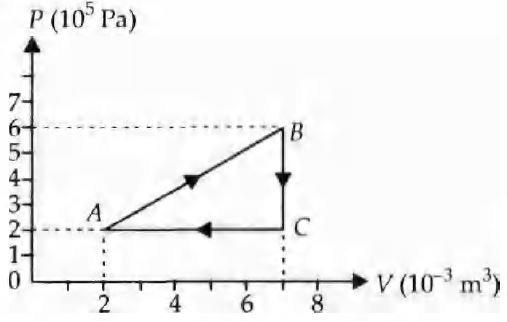
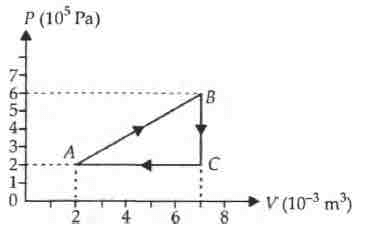
A gas is taken through the cycle as shown. What is the net work done by the gas?
1
Zero
2
-2000 J
3
2000 J
4
1000 J
Official Solution
Correct Option: (4)
In a cyclic process, work done is equal to the area under the cycle and is positive if the cycle is clockwise and negative if the cycle is anticlockwise.
The network done by the gas is W = Area of the cycle ABCA
13
PYQ 2014
medium
physicsID: neet-ug-
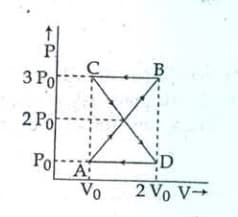
A thermodynamic system undergoes cyclic process ABCDA as shown in Fig. The work done by the system in the cycle is:
1
2P0V0
2
3
Zero
4
P0 V0
Official Solution
Correct Option: (3)
The correct option (C): Zero
14
PYQ 2014
medium
physicsID: neet-ug-
A monoatomic gas at a pressure P, having a volume V expands isothermally to a volume 2V and then adiabatically to a volume 16V. The final pressure of the gas is: (take \gamma = 5/3)
1
32P
2
3
16P
4
64P
Official Solution
Correct Option: (2)
The correct option (B):
15
PYQ 2014
hard
physicsID: neet-ug-
A monoatomic gas at a pressure , having a volume expands isothermally to a volume and then adiabatically to a volume . The final pressure of the gas is (Take
1
64P
2
32P
3
4
16P
Official Solution
Correct Option: (3)
First, isothermal expansion
(For isothermal process, PV=constant)
Then, adiabatic expansion
(For adiabatic process, constant)
16
PYQ 2015
medium
physicsID: neet-ug-
An ideal gas is compressed to half its initial volume by means of several processes. Which of the process results in the maximum work done on the gas?
1
Isochoric
2
Isothermal
3
Adiabatic
4
Isobaric
Official Solution
Correct Option: (3)
The P-V diagram of an ideal gas compressed from its initial volume by several processes is shown in the figure.
Work done on the gas = Area under P-V curve As area under the P-V curve is maximum for adiabatic process, so work done on the gas is maximum for adiabatic process.
17
PYQ 2016
medium
physicsID: neet-ug-
A refrigerator works between and . It is required to remove of heat every second in order to keep the temperature of the refrigerated space constant. The power required is :
1
23.65 W
2
236.5 W
3
2365 W
4
2.365 W
Official Solution
Correct Option: (2)
Power and Heat Removed Calculation
The equation for the coefficient of performance ( ) is given by:
Where: - is the heat removed, - is the work done, - and are the temperatures at the hot and cold reservoirs, respectively.
Step-by-Step Calculation:
Substitute the given values into the equation:
Simplifying the right-hand side:
Now, solve for :
Step 2: Calculate Power
Next, we calculate the power using the formula:
Conclusion:
The calculated power is .
18
PYQ 2016
medium
physicsID: neet-ug-
A gas is compressed isothermally to half its initial volume. The same gas is compressed separately through an adiabatic process until its volume is again reduced to half. Then :
1
Compressing the gas through adiabatic process will require more work to be done.
2
Compressing the gas isothermally or adiabatically will require the same amount of work.
3
Which of the case (whether compression through isothermal or through adiabatic process) requires more work will depend upon the atomicity of the gas.
4
Compressing the gas isothermally will require more work to be done.
Official Solution
Correct Option: (1)
Concept: When a gas is compressed, the work done depends on the nature of the thermodynamic process.
Isothermal Process: In an isothermal process, the temperature remains constant. The work done in compressing a gas from volume to is:
Adiabatic Process: In an adiabatic process, there is no heat exchange. The work done is:
or derived using:
Key Point: In adiabatic compression, temperature rises, so internal energy increases → more work is required.
Since both compressions reduce the volume to half, we compare them:
Isothermal: Temperature constant → some heat leaves → less work needed.
Adiabatic: No heat exchange → temperature increases → internal energy increases → more work required.
Correct Answer:
19
PYQ 2017
medium
physicsID: neet-ug-
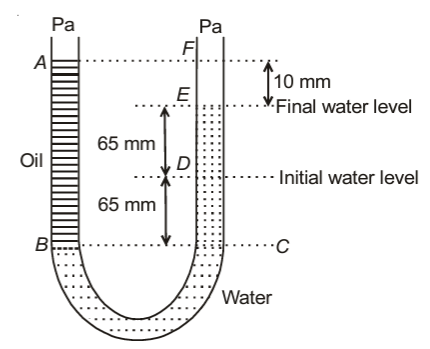
A U tube with both ends open to the atmosphere, is partially filled with water. Oil, which is immiscible with water, is poured into one side until it stands at a distance of 10 mm above the water level on the other side. Meanwhile the water rises by 65 mm from its original level (see diagram). The density of the oil is
1
650 kg m–3
2
425 kg m–3
3
800 kg m–3
4
928 kg m–3
Official Solution
Correct Option: (4)
The correct option is (D): 928 kg m–3.
20
PYQ 2017
medium
physicsID: neet-ug-
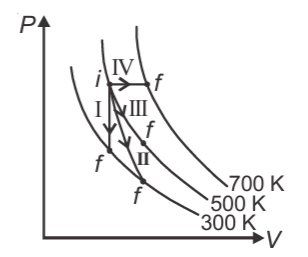
Thermodynamic processes are indicated in the following diagram.Match the following
Column-1
Column-2
P.
Process I
a.
Adiabatic
Q.
Process II
b.
Isobaric
R.
Process III
c.
Isochoric
S.
Process IV
d.
Isothermal
1
P→a, Q→c, R→d, S→b
2
P→c, Q→a, R→d, S→b
3
P→c, Q →d, R→b, S→a
4
P→d, Q→b, R→a, S→c
Official Solution
Correct Option: (2)
The correct option is (B): P→c, Q→a, R→d, S→b.
21
PYQ 2017
easy
physicsID: neet-ug-
A carnot engine having an efficiency of as heat engine, is used as a refrigerator. If the work done on the system is , the amount of energy absorbed from the reservoir at lower temperature is :
1
90 J
2
99 J
3
100 J
4
1 J
Official Solution
Correct Option: (1)
22
PYQ 2017
easy
physicsID: neet-ug-
Thermodynamic processes are indicated in the following diagram :
Column 1
Column 2
P.
Process I
a.
Adiabatic
Q.
Process II
b.
Isobaric
R.
Process III
c.
Isochoric
S.
Process IV
d.
Isothermal
1
P c, Q a, R d ,S b
2
P c, Q d, R b ,S a
3
P d, Q b, R a ,S c
4
P a, Q c, R d ,S b
Official Solution
Correct Option: (1)
Isochoric: It is a thermodynamic process that occurs at a constant volume. During this process the work done on or by the system is zero. Therefore it is path I Adiabatic: It is a thermodynamic process in which there is no exchange of heat between the system and its surrounding. Therefore it is path II Isothermal: It is a thermodynamic process that occurs at a constant temperature. Therefore it is path III Isobaric: It is a thermodynamic process that occurs at a constant pressure. Therefore it is path IV.
23
PYQ 2017
medium
physicsID: neet-ug-
A Carnot engine having an efficiency of as heat engine, is used as a refrigerator. If the work done on the system is 10 J, the amount of energy absorbed from the reservoir at lower temperature is
1
1 J
2
90 J
3
99 J
4
100 J
Official Solution
Correct Option: (2)
The correct option is (B): 90 J.
24
PYQ 2017
medium
physicsID: neet-ug-
A spherical black body with a radius of 12 cm radiates 450 watt power at 500 K. If the radius were halved and the temperature doubled, the power radiated in watt would be
1
225
2
450
3
1000
4
1800
Official Solution
Correct Option: (4)
The correct option is (D): 1800.
25
PYQ 2018
easy
physicsID: neet-ug-
A sample of of water at and normal pressure requires of heat energy to convert to steam at . If the volume of the steam produced is , the change in internal energy of the sample, is
1
84.5 J
2
104.3 J
3
42.2 J
4
208.7 J
Official Solution
Correct Option: (4)
26
PYQ 2019
medium
physicsID: neet-ug-
In which of the following processes, heat is neither absorbed nor released by a system?
1
isothermal
2
adiabatic
3
isobaric
4
isochoric
Official Solution
Correct Option: (2)
The correct option is (B) :adiabatic
27
PYQ 2020
medium
physicsID: neet-ug-
A cylinder contains hydrogen gas at pressure of 249 kPa and temperature . Its density is : )
1
2
3
4
Official Solution
Correct Option: (2)
We can express, an ideal gas equation as
28
PYQ 2020
medium
physicsID: neet-ug-
Two cylinders and of equal capacity are connected to each other via a stop clock. A contains an ideal gas at standard temperature and pressure. is completely evacuated. The entire system is thermally insulated. The stop clock is suddenly opened. The process is:
1
isothermal
2
adiabatic
3
isochoric
4
isobaric
Official Solution
Correct Option: (2)
The entire system is completely insulated and the free expansion of the gas will take place, the temperature of the gas will remain constant. So the process will be adiabatic.
29
PYQ 2022
medium
physicsID: neet-ug-
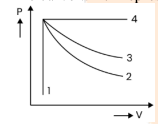
An ideal gas undergoes four different processes from the same initial state as shown in the figure below. Those processes are adiabatic, isothermal, isobaric and isochoric. The curve which represents the adiabatic process among 1, 2, 3 and 4 is:
1
1
2
2
3
3
4
4
Official Solution
Correct Option: (2)
In the context of thermodynamics, an ideal gas can undergo several types of processes, each defined by how certain parameters change:
Adiabatic Process: No heat exchange occurs (Q = 0). The process is characterized by a steeper curve on a PV diagram compared to an isothermal process.
Isothermal Process: Temperature remains constant (ΔT = 0). The PV curve follows a hyperbola, defined by PV = nRT.
Isobaric Process: Pressure remains constant (ΔP = 0). The PV curve is a horizontal line.
Isochoric Process: Volume remains constant (ΔV = 0). The PV curve is a vertical line.
In the provided figure (unavailable for reference here), we need to identify the curve representing the adiabatic process. Generally, an adiabatic process in an ideal gas follows the equation:
P*Vγ = constant
where γ (gamma) is the heat capacity ratio (Cp/Cv). The curve for the adiabatic process is steeper compared to the isothermal curve (because γ > 1 for ideal gases).
Given the provided options:
A: Typically less steep
B: The steepest curve
C: A likely candidate for isothermal (flatter curve)
D: A likely candidate for isobaric or isochoric
The process that appears to be the steepest, and thus corresponds to the adiabatic process, is option B.
Therefore, the adiabatic process is represented by curve 2.
30
PYQ 2023
easy
physicsID: neet-ug-
What is the correct expression for enthalpy?
Official Solution
Correct Option: (1)
The correct expression for enthalpy (H) is:
Where:
H is the enthalpy of the system.
U is the internal energy of the system.
P is the pressure of the system.
V is the volume of the system.
Enthalpy is a thermodynamic property that represents the total heat content of a system at constant pressure. It is often useful in chemical and physical processes, particularly when analyzing heat transfer and chemical reactions occurring at constant pressure.
31
PYQ 2023
easy
physicsID: neet-ug-
A carnot engine has an efficiency of 50% when its source is at a temperature 327°C. The temperature of the sink is:
1
200°C
2
27°C
3
15°C
4
100°C
Official Solution
Correct Option: (2)
The efficiency of a Carnot engine is given by the formula:
η=1−(Tc/Th)
where η is the efficiency, Tc is the temperature of the cold reservoir (sink), and Th is the temperature of the hot reservoir (source). All temperatures are in Kelvin. Given that the efficiency η is 50%, this can be represented as 0.5. The temperature of the hot reservoir Th is 327°C, which converts to Kelvin as follows:
Th=327+273=600 K
Substituting the values in the efficiency equation:
0.5=1−(Tc/600)
Simplifying the equation gives:
0.5=(Tc/600)
Solve for Tc:
Tc=0.5×600=300 K
Convert the temperature back to Celsius:
Tc=300−273=27°C
Thus, the temperature of the sink is 27°C.
32
PYQ 2024
medium
physicsID: neet-ug-
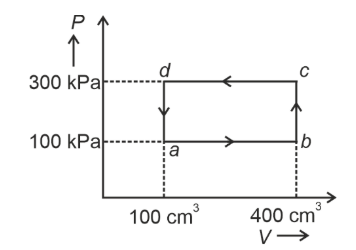
A thermodynamic system is taken through the cycle abcda. The work done by the gas along the path bc is :
1
Zero
2
30 J
3
–90 J
4
–60 J
Official Solution
Correct Option: (1)
Understanding the Concept
Work done by a gas in a thermodynamic process is given by the integral of pressure with respect to volume:
In simpler terms, on a P-V diagram, the work done is represented by the area under the curve for the given process.
Analyzing Path bc
Looking at the P-V diagram, path bc is a vertical line. This means the volume remains constant during this process. Such a process is called an isochoric or isovolumetric process.
Since the volume doesn't change (dV = 0), the work done along this path is:
Therefore, the work done by the gas along the path bc is 0.
33
PYQ 2024
medium
physicsID: neet-ug-
According to the law of equipartition of energy, the number of vibrational modes of a polyatomic gas of constant is ( where are the specific heat capacities of the gas at constant pressure and constant volume, respectively):
1
2
3
4
Official Solution
Correct Option: (3)
For a polyatomic gas with 3 translational, 3 rotational, and vibrational modes:
Internal energy (U)
34
PYQ 2024
medium
physicsID: neet-ug-
Water is used as a coolant in a nuclear reactor because of its
1
high thermal expansion coefficient
2
high specific heat capacity
3
low density
4
low boiling point
Official Solution
Correct Option: (2)
Water’s high specific heat capacity allows it to absorb a large amount of heat without a significant temperature change, making it an effective coolant.
35
PYQ 2024
medium
physicsID: neet-ug-
The value of electric potential at a distance of 9 cm from the point charge is
1
2
3
4
Official Solution
Correct Option: (4)
Electric potential (V) due to a point charge (q) at a distance (r) is given by:
Given: q = 4 × 10⁻⁷ C r = 9 cm = 0.09 m
36
PYQ 2024
medium
physicsID: neet-ug-
The equilibrium state of a thermodynamic system is described by: A. Pressure B. Total heat C. Temperature D. Volume E. Work done Choose the answer from the options given below.
1
A, B and E only
2
B, C and D only
3
A, B and C only
4
A, C and D only
Official Solution
Correct Option: (4)
The equilibrium state of a thermodynamic system is characterized by constant pressure, temperature, and volume.
37
PYQ 2025
medium
physicsID: neet-ug-
Two gases A and B are filled at the same pressure in separate cylinders with movable pistons of radii and respectively. On supplying an equal amount of heat to both the cylinders, their pressures remain constant and their pistons are displaced by 16 cm and 9 cm respectively. If the change in their internal energies is the same, then the ratio is:
1
2
3
4
Official Solution
Correct Option: (4)
To solve this problem, we need to analyze the relationship between the pistons' displacement and the volumes they encapsulate. Given that both cylinders are filled at the same pressure, we'll use the fact that the work done by the gas during piston displacement must be equal, due to the same change in internal energy. The work done by gas is given by , where is pressure, and is the change in volume. Given that the pressure is constant, for gas A and gas B: and . Since the change in internal energy is the same, , thus: . Canceling out the common factors and simplifying gives: . By dividing both sides by 9, we get: . Taking the square root of both sides results in: . Therefore, the ratio is , which matches the correct option.