A black body has maximum wavelength 1 m at 2000 K. Its corresponding wavelength at 3000 K will be
1
2
3
4
Official Solution
Correct Option:
(2)
According to Wein's law,
02
PYQ 1995
medium
physicsID: neet-ug-
Heat is flowing through two cylindrical rods of the same material. The diameters of the rods are in the ratio 1 : 2 and the lengths in the ratio 2 : 1. If the temperature difference between the ends is same, then ratio of the rate of flow of heat through them will be
1
2:1
2
8:1
3
1:1
4
1:8
Official Solution
Correct Option:
(4)
Ratio of diameters of rod = 1 : 2 and ratio of their lengths 2:1. The rate of flow of heat,
or Therefore, the correct option is (D) : 1:8
03
PYQ 2001
medium
physicsID: neet-ug-
A black body has wavelength corresponding to maximum energy at 2000 K. Its wavelength corresponding to maximum energy at 3000 K will be:
1
2
3
4
Official Solution
Correct Option:
(2)
The relation between the wavelength corresponding to maximum intensity of radiation at any temperature is given by Wien's displacement law. Wien's displacement law is given by
or
Here,
So, the correct option is (B):
04
PYQ 2009
medium
physicsID: neet-ug-
The two ends of a rod of length and a uniform cross-sectional area are kept at two temperatures and The rate of heat transfer, through the rod in a steady state is given by :
1
2
3
4
Official Solution
Correct Option:
(3)
For steady state
05
PYQ 2014
medium
physicsID: neet-ug-
Steam at 100°C is passed into 20 g of water at 10°C. When water acquires a temperature of 80°C, the mass of water present will be: [Take specific heat of water = 1 cal g-1°C-1 and latent heat of steam = 540 cal g-1]
1
31.5g
2
42.5g
3
22.5g
4
24g
Official Solution
Correct Option:
(3)
The correct option (C): 22.5g
06
PYQ 2015
medium
physicsID: neet-ug-
The two ends of a metal rod are maintained at temperatures 100 C and 110 C. The rate of heat flow in the rod is found to be 4.0 J/s. If the end are maintained at temperatures 200 C and 210 C, the rate of heat flow will be
1
8.0 J/s
2
4.0 J/s
3
44.0 J/s
4
16.8 J/s
Official Solution
Correct Option:
(2)
(b)
07
PYQ 2017
medium
physicsID: neet-ug-
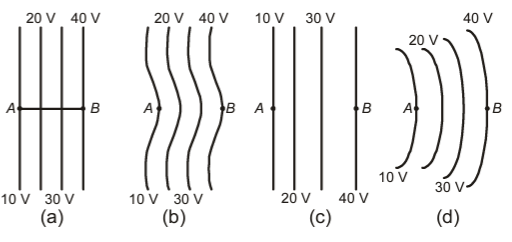
The diagrams below show regions of equipotentials.A positive charge is moved from A to B in each diagram.
1
Maximum work is required to move q in figure (c).
2
In all the four cases the work done is the same.
3
Minimum work is required to move q in figure (a).
4
Maximum work is required to move q in figure (b).
Official Solution
Correct Option:
(2)
The correct option is (B): In all the four cases the work done is the same..
08
PYQ 2019
hard
physicsID: neet-ug-
A deep rectangular pond of surface are A, containing water (density = r, specific heat capacity = s), is located in a region where the outside air temperature is at a steady value of -26°C. The thickness of the frozen ice layer in this pond, at a certain instant is x. Taking the thermal conductivity of ice as K, and its specific latent heat of fusion as L, the rate of increase of the thickness of ice layer, at this instant would be given by :-
1
2
3
4
Official Solution
Correct Option:
(3)
So, the correct option is (C): .
09
PYQ 2024
easy
physicsID: neet-ug-
Given below are two statements: One is labelled as Assertion A and the other is labelled as Reason R. Assertion A: Houses made of concrete roofs overlaid with foam keep the room hotter during summer. Reason R: The layer of foam insulation prohibits heat transfer, as it contains air pockets. In the light of the above statements, choose the correct answer from the options given below.
1
A is true but R is false.
2
A is false but R is true.
3
Both A and R are true and R is the correct explanation of A.
4
Both A and R true but R is NOT the correct explanation of A.
Official Solution
Correct Option:
(2)
Reason R is true: Foam insulation reduces heat transfer due to the presence of air pockets which are poor conductors of heat. However, Assertion A is false. Foam insulation is used to keep the room *cooler* during summer and warmer during winter by acting as a heat insulator.
About Heat Transfer - NEET-UG
Heat Transfer is a vital chapter for NEET-UG aspirants. Mastering the concepts covered in this chapter is essential for securing a top rank.
By rigorously practicing the previous year questions associated with this chapter, you can identify high-yield topics, understand the examiner's perspective, and boost your confidence during the actual exam.
Frequently Asked Questions
Why focus on Heat Transfer PYQs?
Analyzing PYQs for this specific chapter reveals the most frequently tested concepts and the typical complexity of questions, allowing you to tailor your study plan efficiently.
How to best use this analysis?
Review the topic breakdown to see which sub-topics within Heat Transfer carry the most weight. Then, tackle the questions iteratively to solidify your understanding.