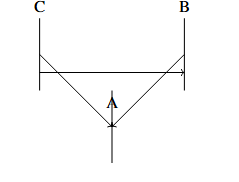
Energy level diagram of a certain atom is shown in the figure. The wavelength obtained in the emission transitions from level C to A is 1000 Å, and from C to B is 5000 Å. Calculate the wavelength emitted in the transition from B to A.
Official Solution
Correct Option:
(1)
Step 1: Use the energy level formula. The energy of the photon emitted during a transition is related to the change in energy levels, and the wavelength of the emitted photon is related to the energy difference by the formula:
where is Planck’s constant and is the speed of light. Step 2: Energy difference for the transition C to A. For the transition from level C to A, the wavelength is given as 1000 Å. Let be the energy difference between levels C and A. The energy of the photon emitted is:
where . Step 3: Energy difference for the transition C to B. Similarly, for the transition from C to B, the wavelength is 5000 Å, and the energy difference is: Step 4: Energy difference for the transition B to A. Now, the energy difference for the transition from B to A can be calculated by the relationship:
Substituting the expressions for and , we get: Step 5: Calculate the wavelength for the transition B to A. The wavelength for the transition from B to A is: Step 6: Conclusion. Thus, the wavelength emitted in the transition from B to A is .
02
PYQ 2023
medium
physicsID: up-board
Calculate the energy of a in its first excited state.
Official Solution
Correct Option:
(1)
Step 1: Energy formula for hydrogen-like ions. The energy of an electron in the -th orbit of a hydrogen-like atom is given by the formula:
where is the atomic number, is the principal quantum number, and is the energy of the ground state of hydrogen. Step 2: Apply the formula for . For (with ), the energy of the electron in the first excited state corresponds to . Substituting into the formula:
Step 3: Conclusion. The energy of the electron in the first excited state of is .
03
PYQ 2023
easy
physicsID: up-board
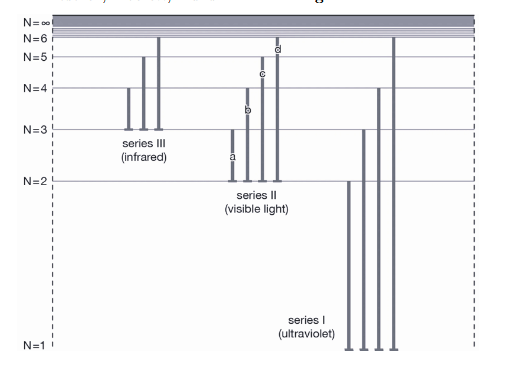
Draw the energy level diagram for hydrogen atom. Show the transitions of Lyman, Balmer, Paschen, Brackett and Pfund series in the diagram. In which region do these spectrum lie?
Official Solution
Correct Option:
(1)
Energy Level Diagram: The hydrogen atom has discrete energy levels given by the formula: The electron transitions from a higher energy level to a lower level result in the emission of photons of specific wavelengths. Different spectral series correspond to transitions ending at specific lower energy levels:
Lyman series: Transitions to Balmer series: Transitions to Paschen series: Transitions to Brackett series: Transitions to Pfund series: Transitions to
Regions of the Electromagnetic Spectrum:
Lyman series – Ultraviolet region Balmer series – Visible region Paschen, Brackett, Pfund – Infrared region
04
PYQ 2023
medium
physicsID: up-board
A light beam traveling in the X-direction is described by An electron is constrained to move along the Y-direction with speed . Find the maximum magnetic force acting on the electron.
Official Solution
Correct Option:
(1)
Step 1: Magnetic Force on Electron.
The magnetic force on the electron is given by:
Where:
- is the charge of the electron,
- is the speed of the electron,
- is the magnetic field, where is the electric field. Step 2: Maximum Magnetic Force.
The maximum magnetic force occurs when the electric field is at its peak:
Substitute the values:
Final Answer:
The maximum magnetic force acting on the electron is .
05
PYQ 2023
medium
physicsID: up-board
The kinetic energy of a charged particle decreases by 10 joules as it moves from a point at potential 200 volt to a point at potential 250 volt. Find the charge on the particle.
Official Solution
Correct Option:
(1)
Step 1: Formula for Work Done in Moving a Charge in an Electric Field.
The work done in moving a charge through a potential difference is given by:
Where:
- (since the kinetic energy decreases, the work done is negativ,
- . Step 2: Substituting Known Values.
Substitute the given values into the equation:
Step 3: Solving for the Charge.
Solving for :
Final Answer:
The charge on the particle is .
06
PYQ 2025
medium
physicsID: up-board
Describe the atomic model of Rutherford. How did Bohr model removed its drawbacks?
Official Solution
Correct Option:
(1)
Rutherford's Atomic Model (Nuclear Model):
Based on his famous alpha-particle scattering experiment, Ernest Rutherford proposed a model of the atom in 1911. Its main features are:
\begin{enumerate} \item Nucleus: Almost all the mass and the entire positive charge of an atom are concentrated in a very small, dense region at the center called the nucleus. \item Empty Space: Most of the atom is empty space. \item Electrons: The negatively charged electrons revolve around the nucleus in circular paths called orbits, much like planets orbiting the sun. The electrostatic force of attraction between the nucleus and electrons provides the necessary centripetal force for their revolution.
\end{enumerate} Drawbacks of Rutherford's Model:
Rutherford's model was inconsistent with classical physics and experimental observations in two key ways:
\begin{enumerate} \item Instability of the Atom: According to classical electromagnetic theory, an accelerating charged particle must radiate energy. An electron revolving in an orbit is constantly accelerating (due to the change in the direction of its velocity). Therefore, it should continuously lose energy and spiral into the nucleus, making the atom unstable. This contradicts the observed stability of atoms. \item Inability to Explain Line Spectra: As the electron spirals inwards, its frequency of revolution would increase continuously. This means it should emit a continuous spectrum of radiation. However, atoms (like hydrogen) are observed to emit a discrete line spectrum.
\end{enumerate} How Bohr's Model Removed the Drawbacks:
Niels Bohr, in 1913, modified Rutherford's model by introducing quantum concepts through three postulates:
\begin{enumerate} \item Postulate of Stationary Orbits: Bohr proposed that electrons can revolve only in certain specific, non-radiating orbits called stationary orbits. While in these orbits, electrons do not emit energy. This postulate directly contradicted classical theory and solved the problem of atomic instability. \item Postulate of Quantization of Angular Momentum: The allowed stationary orbits are those for which the angular momentum of the electron is an integral multiple of , where is Planck's constant. ( , where n=1, 2, 3...). \item Postulate of Frequency Condition: An atom emits radiation (a photon) only when an electron jumps from a higher energy stationary orbit ( ) to a lower energy one ( ). The frequency ( ) of the emitted photon is given by . Since only specific orbits and energy levels are allowed, only specific frequencies of light can be emitted, thus explaining the observed discrete line spectra.
\end{enumerate}
07
PYQ 2025
medium
physicsID: up-board
Describe in brief, the -scattering experiment. Write down about the atomic-structure from the observation obtained from the experiment.
Official Solution
Correct Option:
(1)
Step 1: Description of the -Scattering Experiment (Geiger-Marsden Experiment): The -scattering experiment was performed by Hans Geiger and Ernest Marsden under the direction of Ernest Rutherford around 1909. Setup: A narrow beam of high-energy alpha particles (which are doubly-ionized helium nuclei, He ) from a radioactive source (like Radium) was directed at a very thin gold foil (about m thick). Detection: The scattered alpha particles were detected using a movable detector consisting of a rotatable zinc sulfide (ZnS) screen and a microscope. When an alpha particle strikes the screen, it produces a tiny flash of light (scintillation) which can be observed. Objective: The experiment aimed to study the distribution of mass and charge within an atom by observing the deflection (scattering) of alpha particles as they passed through the gold foil. Step 2: Observations from the Experiment: The experiment yielded three key observations, which were contrary to the predictions of the then-prevalent Thomson's "plum pudding" model: Most particles passed undeviated: The vast majority of the alpha particles passed straight through the gold foil without any deflection. Small deflections: A small fraction of the alpha particles were deflected from their original path by small angles. Large deflections: A very small number of alpha particles (about 1 in 8000) were deflected by large angles (greater than 90 ), with some even bouncing back along their incident path (a deflection of nearly 180 ). Step 3: Conclusions about Atomic Structure: Based on these observations, Rutherford proposed his nuclear model of the atom with the following conclusions: Most of the atom is empty space: Since most alpha particles passed through undeflected, Rutherford concluded that the atom must be mostly empty. Existence of a Nucleus: The fact that some positively charged alpha particles were deflected means there must be a region of concentrated positive charge within the atom that repels them. Rutherford called this central region the nucleus. The nucleus is small and dense: The observation that only a very few alpha particles were deflected by large angles indicated that the nucleus must be extremely small in size compared to the atom, and that almost the entire mass of the atom is concentrated in this tiny nucleus. Electrons orbit the nucleus: To account for the overall neutrality of the atom, he concluded that negatively charged electrons must be revolving around the positively charged nucleus, much like planets orbiting the sun. This experiment was monumental as it disproved the Thomson model and established the modern concept of a nuclear atom.
08
PYQ 2025
medium
physicsID: up-board
What are the demerits of Rutherford model of an atom ?
Official Solution
Correct Option:
(1)
Step 1: Understanding the Concept:
Rutherford's nuclear model of the atom, proposed after the gold foil experiment, successfully described the atom as having a small, dense, positively charged nucleus with negatively charged electrons orbiting it. However, this model had significant shortcomings when analyzed with the principles of classical physics. Step 2: Detailed Explanation of Demerits:
The two main demerits (drawbacks) of the Rutherford model are as follows: 1. Instability of the Atom:
According to Maxwell's theory of classical electromagnetism, any charged particle undergoing acceleration must radiate energy continuously in the form of electromagnetic waves.
In Rutherford's model, the electrons are revolving around the nucleus. This circular motion is an accelerated motion.
Therefore, an orbiting electron should continuously lose energy by radiation.
This loss of energy would cause its orbit to shrink, and the electron would spiral into the nucleus in a very short time (calculated to be about seconds).
This would make the atom highly unstable. However, we know that atoms are stable. Rutherford's model could not explain this stability. 2. Inability to Explain the Line Spectrum:
As the electron spirals inwards towards the nucleus, its speed and frequency of revolution would increase continuously.
According to classical physics, the frequency of the emitted electromagnetic radiation should be equal to the frequency of revolution.
Since the electron's frequency is changing continuously, it should emit a continuous spectrum of radiation.
However, experimental observations show that atoms, like hydrogen, emit a discrete line spectrum, i.e., radiation of only specific frequencies or wavelengths.
Rutherford's model failed to explain the origin of these discrete spectral lines.
About Atoms - UP-BOARD-XII
Atoms is a vital chapter for UP-BOARD-XII aspirants. Mastering the concepts covered in this chapter is essential for securing a top rank.
By rigorously practicing the previous year questions associated with this chapter, you can identify high-yield topics, understand the examiner's perspective, and boost your confidence during the actual exam.
Frequently Asked Questions
Why focus on Atoms PYQs?
Analyzing PYQs for this specific chapter reveals the most frequently tested concepts and the typical complexity of questions, allowing you to tailor your study plan efficiently.
How to best use this analysis?
Review the topic breakdown to see which sub-topics within Atoms carry the most weight. Then, tackle the questions iteratively to solidify your understanding.