Semiconductor Electronics Materials Devices And Simple Circuits
25 previous year questions.
Volume: 25 Ques
Yield: High
High-Yield Trend
9
2025
16
2023
Chapter Questions
25 MCQs
01
PYQ 2023
medium
physicsID: up-board
What are light emitting diodes? Describe the principle and working of a light emitting diode. Why are they more useful than traditional filament lamps?
Official Solution
Correct Option: (1)
Step 1: Light Emitting Diodes (LEDs). A Light Emitting Diode (LED) is a semiconductor device that emits light when an electric current passes through it. LEDs are made of materials that allow current to flow in only one direction and produce light by electroluminescence. Step 2: Principle and Working of LED. When a forward voltage is applied to an LED, electrons recombine with holes in the semiconductor material. As the electrons drop to lower energy levels, they release energy in the form of photons, producing light. The color of the light depends on the energy band gap of the semiconductor material. Step 3: Advantages Over Traditional Filament Lamps. LEDs are more energy efficient than traditional filament lamps because they produce less heat and convert more electrical energy into light. They also have a longer lifespan and are more durable. Unlike filament lamps, LEDs do not burn out or break easily. Moreover, LEDs are smaller in size, which allows for more compact lighting solutions.
02
PYQ 2023
medium
physicsID: up-board
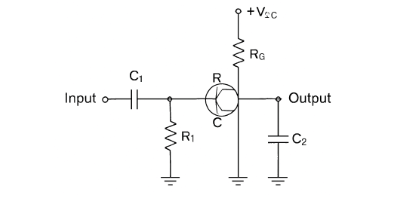
Draw a circuit diagram of a transistor amplifier in common emitter configuration
and explain its working in brief.
Official Solution
Correct Option: (1)
Step 1: Circuit Diagram of a Transistor Amplifier in Common Emitter Configuration.
Step 2: Working of Transistor Amplifier in Common Emitter Configuration. In the common emitter configuration, the input is applied to the base of the transistor, and the output is taken from the collector. The emitter is common to both the input and the output. The signal is amplified as follows: - The small input signal at the base modulates the base current. - This results in a large variation in the collector current due to the transistorβs current amplification factor Ξ². - The amplified output signal is taken across the collector resistor.
03
PYQ 2023
medium
physicsID: up-board
Write down the majority and minority charge carriers in n-type of semiconductor.
Official Solution
Correct Option: (1)
Step 1: N-type Semiconductor. In an n-type semiconductor, the material is doped with a group V element (such as phosphorus), which has five valence electrons. These extra electrons are free to move and contribute to electrical conduction.
Step 2: Majority Charge Carriers. The majority charge carriers in an n-type semiconductor are electrons. These are the free electrons provided by the donor atoms.
Step 3: Minority Charge Carriers. The minority charge carriers in an n-type semiconductor are holes. These are the absence of electrons in the valence band, which behave like positive charge carriers.
Step 4: Conclusion. Thus, in an n-type semiconductor, the majority charge carriers are electrons, and the minority charge carriers are holes.
04
PYQ 2023
medium
physicsID: up-board
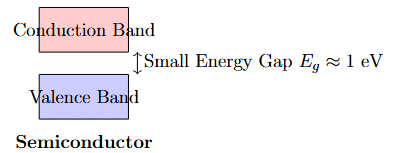
Explain the classification of conductors, insulators, and semiconductors on the basis of energy bands.
Official Solution
Correct Option: (1)
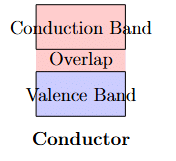
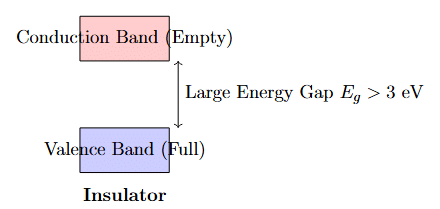
Step 1: Conductors. In conductors, the conduction band and valence band overlap or are very close. Electrons in the valence band can easily move to the conduction band when a small electric field is applied, allowing current to flow. Hence, conductors have free electrons and exhibit high electrical conductivity. Materials like copper, aluminum, and silver are examples of conductors. Step 2: Insulators. In insulators, the conduction band and valence band are separated by a large energy gap. This large gap makes it extremely difficult for electrons to move from the valence band to the conduction band. As a result, insulators have very low electrical conductivity. Materials like rubber, wood, and glass are examples of insulators. Step 3: Semiconductors. Semiconductors have a small energy gap between the conduction band and the valence band. At absolute zero temperature, they behave like insulators, but at higher temperatures, some electrons gain enough energy to jump into the conduction band. This allows semiconductors to conduct electricity, but not as well as conductors. Materials like silicon and germanium are examples of semiconductors. Step 4: Conclusion. The classification of materials into conductors, insulators, and semiconductors depends on the energy gap between the conduction band and the valence band.
05
PYQ 2023
medium
physicsID: up-board
In a transistor:
1
the emitter has the least concentration of impurity
2
the collector has the least concentration of impurity
3
the base has the least concentration of impurity
4
all three regions have equal concentration of impurity
Official Solution
Correct Option: (3)
Step 1: Understanding transistor structure. In a transistor, the base region is lightly doped compared to the emitter and collector. This is done to allow for efficient control of the current flowing between the emitter and collector.
Step 2: Conclusion. The correct answer is ( because the base of the transistor has the least concentration of impurity.
06
PYQ 2023
medium
physicsID: up-board
What is LED? Explain its principle, construction and working.
Official Solution
Correct Option: (1)
LED (Light Emitting Diode): An LED is a semiconductor device that emits light when an electric current flows through it. It is a - junction diode that emits photons during the process of electron-hole recombination. Principle: The working of an LED is based on the principle of electroluminescence, where light is emitted when a forward-biased - junction diode recombines electrons and holes near the junction. The energy released during this recombination is emitted in the form of photons (light). Construction:
LED is made using semiconductor materials like gallium arsenide (GaAs), gallium phosphide (GaP), etc.
It consists of a -type and an -type semiconductor.
The LED is housed in a transparent plastic casing to allow emitted light to escape.
The longer lead is the anode (+), and the shorter lead is the cathode (β).
Working:
When a forward voltage is applied, electrons from the -side and holes from the -side move toward the junction.
They recombine near the junction. The electrons lose energy.
This energy is released as photons (light).
The color of light depends on the bandgap energy of the material used.
07
PYQ 2023
medium
physicsID: up-board
As the temperature of a metal and of a semiconductor is increased, the:
1
conductivity of both increases
2
conductivity of both decreases
3
conductivity of metal increases and of semiconductor decreases
4
conductivity of metal decreases and of semiconductor increases
Official Solution
Correct Option: (3)
Step 1: Understanding the behavior of materials with temperature. As temperature increases, the conductivity of metals generally decreases because the increased thermal motion of atoms causes more resistance to electron flow. On the other hand, the conductivity of semiconductors increases with temperature due to the increased generation of charge carriers.
Step 2: Conclusion. The correct answer is ( because the conductivity of metals decreases and the conductivity of semiconductors increases with temperature.
08
PYQ 2023
medium
physicsID: up-board
Sensitivity of moving coil galvanometer can be increased by :
1
decreasing area of the coil
2
decreasing number of turns in the coil
3
increasing area of the coil
4
decreasing value of magnetic field
Official Solution
Correct Option: (3)
Step 1: Galvanometer Sensitivity. The sensitivity of a galvanometer is directly proportional to the number of turns of the coil and the area of the coil. Increasing the area of the coil or the number of turns increases the sensitivity.
Step 2: Conclusion. Thus, the sensitivity of the moving coil galvanometer can be increased by increasing the area of the coil. Therefore, the correct answer is option .
09
PYQ 2023
medium
physicsID: up-board
What are coherent sources? In a Youngβs double slit experiment, the distance between two coherent sources is 2 mm, and the distance of the screen is 1.5 m. If monochromatic light of wavelength 6000 is used, then find the fringe width and the distance of the third dark fringe from the centre.
Official Solution
Correct Option: (1)
Step 1: Formula for Fringe Width. In Youngβs double slit experiment, the fringe width ( ) is given by:
Where:
- is the wavelength of light,
- is the distance of the screen from the slits,
- is the distance between the two slits.
Substitute the values into the formula:
Step 2: Distance of the Third Dark Fringe. The position of the -th dark fringe is given by:
For the third dark fringe ( ):
Final Answer:
The fringe width is , and the distance of the third dark fringe from the centre is .
10
PYQ 2023
medium
physicsID: up-board
What is amplification? In a common emitter amplifier, collector current is increased by 1 milliampere by increasing base current by 5 ampere. Calculate current gain and .
Official Solution
Correct Option: (1)
Step 1: Definition of Amplification. Amplification refers to the process of increasing the amplitude of a signal. In the context of electronic circuits, it is the process by which the amplitude of an electrical signal (voltage or current) is increased without altering its other characteristics, such as frequency. Step 2: Given Data. - Increase in collector current, ,
- Increase in base current, . Step 3: Current Gain and . In a common emitter amplifier, the current gain and are related as:
Substitute the given values:
The current gain is related to by the formula:
Substitute the value of :
Final Answer:
The current gain is and .
11
PYQ 2023
medium
physicsID: up-board
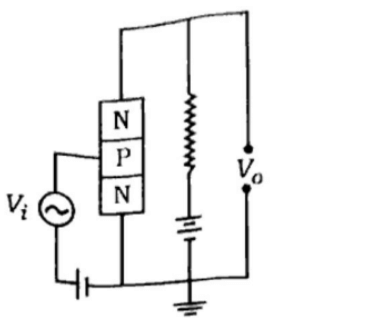
N-P-N transistor is arranged as in the following figure. This circuit is of
1
common-base amplifier
2
common-emitter amplifier
3
common-collector amplifier
4
none of these
Official Solution
Correct Option: (2)
Step 1: Identifying the Transistor Configuration. In a common-emitter amplifier configuration, the input signal is applied to the base of the N-P-N transistor, while the output voltage is taken from the collector. The emitter is typically connected to the ground.
Step 2: Analyzing the Circuit. From the given diagram, the input voltage is applied to the base of the N-P-N transistor, and the output voltage is taken from the collector, which matches the setup for a common-emitter amplifier.
Step 3: Conclusion. Therefore, the configuration shown in the figure corresponds to a common-emitter amplifier, making option (B) the correct answer.
12
PYQ 2023
medium
physicsID: up-board
What is a transistor? By drawing the circuit diagram of common emitter configuration, plot the output characteristics.
Official Solution
Correct Option: (1)
A **transistor** is a semiconductor device used to amplify or switch electronic signals and electrical power. It consists of three layers of semiconductor material, known as the emitter, base, and collector. The common emitter configuration is the most commonly used configuration in amplifiers. It has the following characteristics:
- The emitter is common to both the input and output.
- The base controls the current between the collector and emitter.
- It provides high voltage gain. ### Circuit Diagram of Common Emitter Configuration:
### Output Characteristics: In the common emitter configuration, the output characteristics are a plot of collector current ( ) versus collector-emitter voltage ( ) for different values of base current ( ). The graph typically shows three regions:
1. **Cutoff region**: Where .
2. **Active region**: Where increases linearly with .
3. **Saturation region**: Where the collector current becomes almost constant, irrespective of further increases in . The graph demonstrates the transistor's ability to amplify the input signal.
13
PYQ 2023
medium
physicsID: up-board
What is meant by the current gain ( ) of a transistor?
Official Solution
Correct Option: (1)
The current gain ( ) of a transistor is the ratio of the output current (collector current) to the input current (base current) in a transistor. It is a measure of how much the transistor amplifies the input current. Mathematically,
where: - is the collector current, - is the base current. The value of depends on the type of transistor (NPN or PNP) and its material properties. It is typically a large number, ranging from 20 to 1000, which means that a small input current can generate a large output current.
14
PYQ 2023
medium
physicsID: up-board
When an impurity is doped into intrinsic semiconductor, the conductivity of the semiconductor
1
becomes zero
2
increases
3
decreases
4
remains the same
Official Solution
Correct Option: (2)
Step 1: Effect of Impurity on Semiconductor. When an impurity is doped into an intrinsic semiconductor, the number of free charge carriers (electrons or holes) increases. This enhances the conductivity of the material.
Step 2: Conclusion. Thus, doping increases the conductivity of the semiconductor, and the correct answer is ( increases.
15
PYQ 2023
medium
physicsID: up-board
Let , , and represent the emitter current, the collector current, and the base current respectively in a transistor then
1
is slightly smaller than
2
is slightly greater than
3
is much greater than
4
is much greater than
Official Solution
Correct Option: (1)
Step 1: Current Relationships in a Transistor. In a transistor, the emitter current is the sum of the collector current and the base current . Hence, the collector current is slightly smaller than the emitter current due to the small fraction of current that goes into the base.
Step 2: Conclusion. The correct answer is ( is slightly smaller than .
16
PYQ 2023
medium
physicsID: up-board
Explain p-n-p transistor as a common emitter amplifier. What are the gains in it?
Official Solution
Correct Option: (1)
Step 1: p-n-p Transistor as a Common Emitter Amplifier. A p-n-p transistor consists of a layer of n-type semiconductor sandwiched between two p-type semiconductors. In a common emitter amplifier configuration, the emitter of the transistor is common to both the input and output. In this configuration:
- The input signal is applied to the base of the transistor, and the output is taken from the collector.
- The current flowing from the emitter to the collector is amplified by the transistor. Step 2: Working of Common Emitter Amplifier. In the common emitter amplifier:
- A small input current applied to the base controls a much larger current flowing from the emitter to the collector.
- The transistor operates in the active region, where the base-emitter junction is forward biased and the collector-base junction is reverse biased.
- The output signal is inverted, meaning that there is a phase shift of 180Β° between the input and output signals. Step 3: Gains in the Amplifier. The two main types of gains in the common emitter amplifier are:
1. **Current Gain**: The current gain of the transistor is the ratio of the collector current to the base current:
where:
- is the collector current,
- is the base current. 2. **Voltage Gain**: The voltage gain of the amplifier is the ratio of the change in output voltage to the change in input voltage:
The voltage gain depends on the load resistance and the transistor's characteristics. Step 4: Conclusion. A p-n-p transistor in a common emitter configuration is widely used for amplification purposes, and its performance is characterized by both current and voltage gains.
17
PYQ 2025
easy
physicsID: up-board
Explain the classification of conductors, insulators and semiconductors on the basis of energy bands.
Official Solution
Correct Option: (1)
Step 1: Understanding Energy Band Theory: In solids, due to the interaction between atoms, the discrete energy levels of isolated atoms broaden into continuous bands of allowed energy levels, separated by forbidden energy gaps. The highest energy band that is completely filled with electrons at absolute zero temperature (0 K) is called the Valence Band (VB). The next higher permitted energy band, which may be empty or partially filled, is called the Conduction Band (CB). The energy difference between the top of the valence band and the bottom of the conduction band is the Forbidden Energy Gap ( ). The electrical conductivity of a solid is determined by the size of this energy gap. Step 2: Classification and Energy Band Diagrams: 1. Conductors (Metals): In conductors, the valence band and the conduction band overlap. There is no forbidden energy gap between them ( ). Due to this overlap, a large number of free electrons are readily available in the conduction band to move freely throughout the material, even with a small applied electric field. This results in high electrical conductivity. 2. Insulators: In insulators, the valence band is completely filled with electrons, and the conduction band is completely empty. The forbidden energy gap ( ) between the valence and conduction bands is very large (typically eV). A very high amount of energy is required to excite an electron from the valence band to the conduction band. Therefore, at room temperature, there are virtually no free electrons in the conduction band, and the material has very low electrical conductivity. 3. Semiconductors: Semiconductors have an energy band structure similar to insulators, but with a much smaller forbidden energy gap (typically ). For example, eV for Silicon and eV for Germanium. At absolute zero (0 K), the valence band is full and the conduction band is empty, so they behave as insulators. However, at room temperature, some electrons gain enough thermal energy to jump across the small gap into the conduction band, leaving behind vacancies called "holes" in the valence band. Both the electrons in the CB and the holes in the VB contribute to electrical conductivity.
18
PYQ 2025
easy
physicsID: up-board
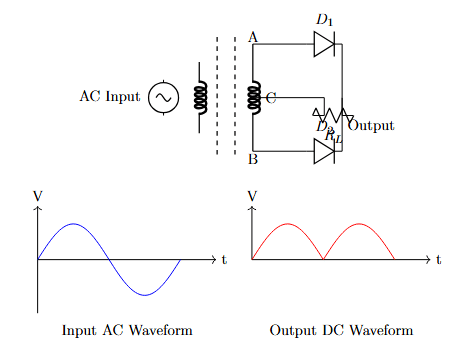
How is the p-n junction diode used as the full wave rectifier ? Explain its working by drawing simple circuit.
Official Solution
Correct Option: (1)
Step 1: Understanding the Concept: A full-wave rectifier is an electronic circuit that converts both halves (positive and negative) of an alternating current (AC) input into a pulsating direct current (DC) output. It uses two p-n junction diodes and a center-tapped transformer. The basic principle is that a p-n junction diode allows current to flow only when it is forward-biased. Step 2: Circuit Diagram and Waveforms: During the positive half-cycle of the AC input: The end A of the secondary coil is positive with respect to the center tap C, and the end B is negative. This makes the diode forward-biased and the diode reverse-biased. As a result, current flows through diode and the load resistor from top to bottom. No current flows through . During the negative half-cycle of the AC input: The polarity reverses. The end A becomes negative, and the end B becomes positive with respect to the center tap C. This makes diode forward-biased and diode reverse-biased. Current now flows through diode and the load resistor . Importantly, the direction of current through is again from top to bottom. \end{enumerate} In both half-cycles, the current flows through the load resistor in the same direction. Therefore, we get a continuous, pulsating DC voltage across the load, as shown in the output waveform diagram. Step 4: Final Answer: A full-wave rectifier uses a center-tapped transformer and two diodes to convert both halves of the AC cycle into a unidirectional (DC) output, making it more efficient than a half-wave rectifier.
19
PYQ 2025
medium
physicsID: up-board
Explain the meaning of rectification. Using a p-n junction diode, draw a circuit diagram of a full-wave rectifier and give a brief description of its working. Give a graphical representation of input and output voltage/current.
Official Solution
Correct Option: (1)
Rectification is the process of converting alternating current (AC) to direct current (DC). In a rectifier, a diode allows current to flow in one direction, blocking it in the opposite direction. The most common type of rectifier is the p-n junction diode. A full-wave rectifier uses both halves of the input signal to produce a continuous DC output. It uses two diodes in a bridge configuration, allowing current to flow in both halves of the AC input cycle. The circuit diagram for a full-wave rectifier is as follows:
In the positive half-cycle of the input AC, one diode conducts and allows current to pass through the load resistor. In the negative half-cycle, the other diode conducts, allowing current to flow in the same direction through the load. This results in a full-wave rectified output. The output waveform of a full-wave rectifier is a series of positive peaks, with the negative half of the AC signal flipped to the positive side. This gives a smoother DC output compared to a half-wave rectifier.
20
PYQ 2025
medium
physicsID: up-board
An a.c. voltage of peak value 20 V is connected in series with a silicon diode and a load resistance of 500 . The forward resistance of the diode is 10 and the resistive voltage is 0.7 V. Find the peak current through the diode and peak voltage across the load. \includegraphics[width=0.5\linewidth]{image4.png}
Official Solution
Correct Option: (1)
Given:
- Peak voltage of the a.c. source,
- Load resistance,
- Forward resistance of the diode,
- Resistive voltage across the diode, Step 1: Calculate the total resistance in the circuit.
The total resistance in the circuit is the sum of the forward resistance of the diode and the load resistance: Step 2: Calculate the peak current through the diode.
The peak current through the diode can be calculated using Ohm's law: Substituting the given values: Thus, the peak current through the diode is approximately . Step 3: Calculate the peak voltage across the load.
The peak voltage across the load can be calculated using Ohm's law: Substituting the values: Thus, the peak voltage across the load is approximately .
21
PYQ 2025
medium
physicsID: up-board
Temperature of a pure semiconductor is . Comment on its conductivity.}
Official Solution
Correct Option: (1)
Step 1: Intrinsic (pure) semiconductor at .}
A pure/intrinsic semiconductor has a completely filled valence band (VB) and an empty conduction band (CB) separated by an energy gap (e.g., for Si). At absolute zero, the FermiβDirac distribution becomes a step function:
For an intrinsic semiconductor, lies near the middle of the band gap; since and , all VB states are occupied and all CB states are empty.
Step 2: Carrier concentrations vanish at .}
The intrinsic carrier concentration
satisfies as (because the exponential ). Electron concentration in CB, ; hole concentration in VB, .
Step 3: Conductivity expression.
For a semiconductor,
where is the electronic charge and are mobilities. At , (mobilities are finite but irrelevant). .
Step 4: Physical interpretation.
With no thermally excited carriers, current cannot flow under an applied electric field. Hence the material behaves as an insulator at (formally ).
Final Answer: At , a pure (intrinsic) semiconductor has zero conductivity and acts like a perfect insulator.
22
PYQ 2025
medium
physicsID: up-board
What is meant by doping in semiconductors?
Official Solution
Correct Option: (1)
Doping in semiconductors refers to the process of intentionally adding impurity atoms to an intrinsic (pure) semiconductor to modify its electrical properties. This process is vital for controlling the electrical conductivity of semiconductors and making them suitable for use in various electronic devices such as diodes, transistors, and integrated circuits. Doping creates two types of charge carriers in the semiconductor: 1. N-type Doping: In N-type doping, semiconductor material (like silicon) is doped with elements that have more valence electrons than the semiconductor atoms, such as phosphorus. Phosphorus has five valence electrons, one more than silicon's four. The extra electron is loosely bound and can move freely in the crystal, resulting in the formation of free electrons (negative charge carriers). This increases the electrical conductivity by introducing more free electrons. 2. P-type Doping: In P-type doping, the semiconductor is doped with elements that have fewer valence electrons than the semiconductor atoms, such as boron. Boron has only three valence electrons, which creates "holes" (missing electrons) in the crystal lattice. These holes can move through the semiconductor, effectively behaving as positive charge carriers. As a result, the P-type semiconductor has an abundance of holes that carry positive charge and enhance conductivity. Doping is essential in forming P-N junctions, which are the basic building blocks of semiconductor devices such as diodes and transistors.
23
PYQ 2025
medium
physicsID: up-board
On the basis of energy band diagram in solids, explain the difference between conductor, semiconductor, and insulator. What is the need of doping in pure semiconductors? Write the value of current in the ideal diodes and in the given circuit. \includegraphics[width=0.5\linewidth]{image9.png}
Official Solution
Correct Option: (1)
Difference between Conductor, Semiconductor, and Insulator: In solids, the difference between conductors, semiconductors, and insulators can be explained based on their energy band diagrams. The energy band diagram represents the energy levels available for electrons in a solid. 1. Conductor: - In a conductor, the conduction band and valence band overlap, allowing electrons to freely move through the material. - There is no band gap between the conduction and valence bands. - Examples: Metals like copper, aluminum, etc. - Conductors have high electrical conductivity. 2. Semiconductor: - A semiconductor has a small energy gap (band gap) between the valence band and the conduction band. - At absolute zero, the conduction band is empty, and the valence band is full. At room temperature, some electrons gain enough energy to jump to the conduction band. - Examples: Silicon, germanium. - Semiconductors have moderate electrical conductivity, which increases with temperature. 3. Insulator: - In insulators, the band gap between the conduction band and the valence band is large. - The conduction band is empty, and the valence band is full, with no electrons able to move to the conduction band at room temperature. - Examples: Rubber, wood, glass. - Insulators have very low electrical conductivity. Need of Doping in Pure Semiconductors: Pure semiconductors, like silicon, have limited electrical conductivity. Doping introduces impurities into the semiconductor material to increase its conductivity. Doping creates either an excess of electrons (n-type doping) or a shortage of electrons (p-type doping), allowing current to flow more easily. Doping is crucial for creating practical semiconductors used in devices like diodes and transistors. Current in Ideal Diodes and : In the given circuit, we have two diodes and , with resistors and , respectively, connected in series with a battery. - For an ideal diode, the current flowing through the circuit is determined by Ohm's law. An ideal diode has zero resistance in the forward bias condition and infinite resistance in the reverse bias condition.
- For , if it is forward biased, it will conduct current.
- For , if it is reverse biased, it will not conduct any current. Assuming both diodes are ideal: - Current through the circuit, if is forward biased and is reverse biased.
24
PYQ 2025
medium
physicsID: up-board
The minority charge carriers in n type of semiconductors:
1
electrons
2
holes
3
both electrons and holes
4
none of them
Official Solution
Correct Option: (2)
In an n-type semiconductor, the majority charge carriers are electrons, while the minority charge carriers are holes. This is because n-type semiconductors are doped with donor atoms, which release extra electrons into the conduction band, making these electrons the majority charge carriers. The term "holes" refers to the absence of electrons in the lattice, and they behave like positive charge carriers in the semiconductor. The minority carriers are those which are less abundant in the material. In an n-type semiconductor, holes are the minority charge carriers because the material has more free electrons than holes. Hence, the correct answer is option (B) holes.
25
PYQ 2025
medium
physicsID: up-board
How does the p-n junction diode is used as the half wave rectifier ? Explain its working by drawing simple circuit.
Official Solution
Correct Option: (1)
Step 1: Understanding the Concept:
Rectification is the process of converting an alternating current (AC) into a direct current (DC). A half-wave rectifier uses a single p-n junction diode to achieve this. The basic principle is that a p-n diode allows current to flow in only one directionβwhen it is forward-biasedβand blocks current flow in the opposite directionβwhen it is reverse-biased.
Step 2: Simple Circuit Diagram:
The circuit consists of an AC input source (usually connected via a step-down transformer), a p-n junction diode (D), and a load resistor ( ) across which the DC output is obtained.
\begin{center}
Circuit Diagram: An AC voltage source is connected to the primary coil of a transformer. The secondary coil is connected in series with a p-n diode (D) and a load resistor ( ). The output voltage is measured across .
\end{center}
Step 3: Working:
The working can be explained by considering the two half-cycles of the input AC voltage.
\begin{enumerate} \item During the Positive Half-Cycle of AC Input: The upper end of the transformer's secondary coil becomes positive with respect to the lower end. This makes the p-side of the diode positive relative to the n-side, putting the diode in forward bias. The diode conducts current, and a current flows through the load resistor . Consequently, a voltage (output) is developed across , which follows the shape of the positive half-cycle of the input. \item During the Negative Half-Cycle of AC Input: The polarity of the secondary coil reverses. The upper end becomes negative with respect to the lower end. This makes the p-side of the diode negative relative to the n-side, putting the diode in reverse bias. In this state, the diode offers very high resistance and (ideally) does not conduct any current. Therefore, no current flows through , and the output voltage across it is zero.
\end{enumerate}
This process repeats for every cycle, resulting in an output voltage that consists only of the positive half-cycles of the original AC input. This output is a pulsating, unidirectional (DC) voltage.