What is optical path? A monochromatic light ray of 6000 Å is incident on a glass slab. Refractive index of the slab is 1.5. Find the velocity and wavelength of reflected and refracted rays from the slab.
Official Solution
Correct Option: (1)
Step 1: Definition of Optical Path. The optical path is the path length traveled by light in a medium, which is modified by the refractive index of the medium. It is given by the formula:
Step 2: Given Data. - Wavelength of the incident light ,
- Refractive index of the slab ,
- Speed of light in vacuum . Step 3: Wavelength of Light in the Slab. The wavelength of light inside a medium is related to the wavelength in vacuum by the formula:
Substituting the given values:
So, the wavelength of the refracted light inside the glass slab is . Step 4: Velocity of Light in the Slab. The velocity of light in a medium is given by:
Substituting the given values:
So, the velocity of light inside the glass slab is . Step 5: Reflected Ray. The reflected ray will have the same wavelength and speed as the incident ray because it does not enter the medium. The wavelength of the reflected ray remains , and its speed is . Step 6: Conclusion. - The wavelength of the refracted ray in the glass slab is ,
- The velocity of the refracted ray in the slab is ,
- The reflected ray has the same wavelength and speed as the incident ray: and .
02
PYQ 2023
medium
physicsID: up-board
Find the angle of minimum deviation for an equilateral prism made of refractive index . What is the angle of incidence for the deviation?
Official Solution
Correct Option: (1)
Step 1: Formula for minimum deviation. The angle of minimum deviation for a prism is given by:
where is the angle of incidence, and is the angle of the prism. Step 2: Formula for the refractive index. The refractive index of the material of the prism is related to the minimum deviation by the equation:
Substitute and :
Using the known values:
Solving for , we get:
Step 3: Conclusion. The angle of minimum deviation is . The angle of incidence for the deviation is .
03
PYQ 2023
medium
physicsID: up-board
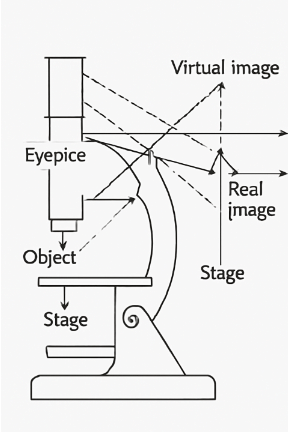
Draw a suitable ray diagram of a compound microscope, when the image is formed at the least distance of distinct vision. Find the expression of magnifying power in this case.
Official Solution
Correct Option: (1)
Step 1: Ray Diagram for Compound Microscope. The compound microscope consists of an objective lens (converging lens) and an eyepiece. The object is placed at a distance such that the image formed by the objective lens is at the focus of the eyepiece.
z Step 2: Magnifying Power. The magnifying power of a compound microscope is given by the product of the magnifying powers of the objective lens and the eyepiece:
where:
- is the magnification produced by the objective lens,
- is the magnification produced by the eyepiece, where is the least distance of distinct vision (usually taken as ) and is the focal length of the eyepiece. For the compound microscope, the total magnification is given by:
where is the focal length of the objective lens and is the focal length of the eyepiece. Step 3: Conclusion. The magnifying power of the compound microscope when the image is formed at the least distance of distinct vision is given by:
04
PYQ 2023
medium
physicsID: up-board
Define critical angle. Explain working of optical fibre.
Official Solution
Correct Option: (1)
Step 1: Critical Angle. The critical angle is defined as the angle of incidence in a denser medium for which the angle of refraction in the rarer medium is 90°. Beyond this angle, total internal reflection occurs. Mathematically, the critical angle is given by:
where is the refractive index of the denser medium, and is the refractive index of the rarer medium. Step 2: Working of Optical Fibre. Optical fibres work on the principle of total internal reflection. The core of the optical fibre has a higher refractive index, and the cladding surrounding it has a lower refractive index. Light is injected into the core, and it undergoes total internal reflection, keeping the light confined within the core, even when the fibre is bent. This allows the transmission of light over long distances with minimal loss. Step 3: Conclusion. The critical angle defines the condition for total internal reflection, which is essential for the working of optical fibres.
05
PYQ 2023
medium
physicsID: up-board
Define optical centre of a lens.
Official Solution
Correct Option: (1)
Step 1: Understanding optical centre. The optical centre of a lens is the point within the lens at which a ray of light passing through it does not undergo any deviation. In other words, light that passes through the optical centre of the lens does not get refracted, and it continues its path without bending. Step 2: Characteristics of the optical centre. The optical centre is usually located at the intersection of the two principal planes of the lens, and it is the point where the two surfaces of the lens are symmetrically aligned.
Step 3: Conclusion. In a convex or concave lens, the optical centre is the point where light passes through without deviation.
06
PYQ 2023
hard
physicsID: up-board
What will be the refractive index of a thin prism material if its refracting angle and angle of deviation are the same?
1
1.5
2
2.0
3
1.33
4
0 (zero)
Official Solution
Correct Option: (3)
Step 1: Understanding the Relationship Between Refracting Angle and Deviation. For a thin prism, the angle of deviation is related to the refracting angle and the refractive index by the formula:
In the case where the refracting angle and the angle of deviation are equal, we set , thus: Step 2: Solving for Refractive Index. Canceling from both sides (assuming ), we get:
Solving for , we get: Step 3: Conclusion. The refractive index of the thin prism material is , making option (B) the correct answer.
07
PYQ 2023
easy
physicsID: up-board
A diverging lens of focal length 20 cm and a converging lens of focal length 30 cm are placed 15 cm apart with their principal axes coinciding. Where should an object be placed on the principal axis so that its image is formed at infinity?
Official Solution
Correct Option: (1)
Step 1: Understanding the setup. Let the diverging lens be and the converging lens be . The focal lengths of and are (diverging lens) and (converging lens). The distance between the two lenses is . The object should be placed in such a way that the rays coming out of (diverging lens) and converging at form an image at infinity. Step 2: Using the lens formula. The lens formula for a single lens is given by:
where:
- is the focal length of the lens,
- is the image distance,
- is the object distance. For the diverging lens , the image formed will be virtual, and the rays will diverge, but the image formed by will act as a virtual object for . Let the object distance for be , and the image distance for be . Then, the object distance for is:
Now, applying the lens formula for and , we can calculate to find the position where the object should be placed. Step 3: Conclusion. After solving the lens equations, the object should be placed at from the diverging lens so that the image is formed at infinity.
08
PYQ 2023
medium
physicsID: up-board
Obtain the formula for refractive index of material of prism in terms of angle of minimum deviation and angle of prism.
Official Solution
Correct Option: (1)
Consider a prism with refracting angle , and let be the angle of minimum deviation. When light passes symmetrically through the prism at minimum deviation, the angle of incidence and the angle of emergence are equal, i.e.,
From the geometry of the prism, the relation between angle of incidence , angle of refraction , and prism angle is:
But under minimum deviation condition, the path of the ray inside the prism is symmetrical, so:
The total deviation is given by:
Now apply Snell's law at the first surface of the prism:
Substitute the values of and : Final Formula:
This is the required expression for the refractive index of the material of the prism in terms of the prism angle and angle of minimum deviation .
09
PYQ 2023
medium
physicsID: up-board
The magnifying power of a telescope is 9. When it is adjusted for parallel rays, the distance between the eye lens and objective is 20 cm. Determine the focal lengths of both the lenses.
Official Solution
Correct Option: (1)
The magnifying power of a telescope is given by the formula:
where is the focal length of the objective lens and is the focal length of the eye lens. We are given that the magnifying power and the distance between the eye lens and the objective lens . This distance is the sum of the focal lengths of the two lenses:
Thus, we have the system of equations:
1.
2. From the first equation, we can express in terms of :
Substitute this into the second equation:
Now substitute into :
Thus, the focal lengths of the lenses are:
10
PYQ 2023
medium
physicsID: up-board
Equiconcave lens of crown glass has to be made. How much radii of the surfaces of the lens should be kept so that its power would be -2.5 D? The refractive index of crown glass is 1.65.
Official Solution
Correct Option: (1)
The power of a lens is given by the formula:
Where is the focal length of the lens. The lens formula for a lens in air is given by:
Where:
- (refractive index of crown glass), - and are the radii of curvature of the two surfaces of the lens. For an equiconcave lens, both radii of curvature are equal in magnitude but opposite in sign. Thus, we have: Now, using the formula for power:
Thus,
Solving for : Thus, the radius of curvature of each surface of the lens should be .
11
PYQ 2023
medium
physicsID: up-board
What will be the effect on focal length and nature of convex lens of refractive index dipped in a liquid of refractive index ?
Official Solution
Correct Option: (1)
When a convex lens with a refractive index is immersed in a liquid with a refractive index , the refractive index difference between the lens and the surrounding medium becomes zero. The focal length of a lens is given by the formula:
where is the refractive index of the lens and is the refractive index of the surrounding medium. Since , the refractive index difference becomes zero. This implies that the lens loses its focusing power, and the focal length becomes infinite. The lens effectively behaves as if it is not present in the system, and no image will be formed. Therefore, the nature of the lens becomes neutral, and it no longer functions as a converging lens.
12
PYQ 2023
medium
physicsID: up-board
Derive the formula for the intensity of magnetic field produced at the centre of a current carrying circular loop.
Official Solution
Correct Option: (1)
Step 1: Formula for Magnetic Field at the Centre of a Circular Loop. The magnetic field at the centre of a current-carrying circular loop is given by Ampere’s Law:
Where:
- is the magnetic field,
- is the permeability of free space,
- is the current flowing through the loop,
- is the radius of the circular loop. Step 2: Derivation. Using the Biot-Savart law for a current-carrying element, the magnetic field produced by a small segment of current is integrated over the entire loop. The result of this integration gives the above formula for the magnetic field at the centre of the loop. Final Answer:
The formula for the magnetic field at the centre of a current-carrying circular loop is:
13
PYQ 2023
medium
physicsID: up-board
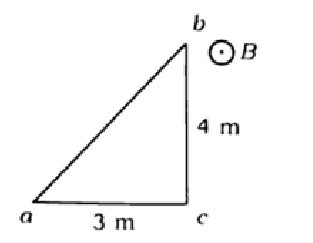
A right-angled triangle ABC, made from a metallic wire, moves at a uniform speed of 0 m/s in its plane as shown in the figure. A uniform magnetic field exists in the perpendicular direction to the plane. Find the induced emf in the segments BC, AC, and AB.
Official Solution
Correct Option: (1)
Step 1: Understanding the Problem. We are given a right-angled triangle with:
- ,
- ,
- The velocity of the wire is ,
- The magnetic field is ,
- The magnetic field is perpendicular to the plane of the wire. We need to find the induced emf in the three segments: , , and . Step 2: Formula for Induced EMF. The induced emf in a moving conductor of length moving with a velocity in a magnetic field is given by the formula:
Where:
- is the induced emf,
- is the magnetic field,
- is the length of the conductor,
- is the velocity of the conductor. Step 3: Calculating Induced EMF in Segment BC. For the segment , the length is . Substitute the given values into the formula:
Step 4: Calculating Induced EMF in Segment AC. For the segment , the length is (using the Pythagoras theorem, ). Substitute the given values into the formula:
Step 5: Calculating Induced EMF in Segment AB. For the segment , the length is . Substitute the given values into the formula:
Final Answer:
The induced emf in the segments are:
- ,
- ,
- .
14
PYQ 2023
medium
physicsID: up-board
A point object is placed at a distance of 15 cm from a convex lens. The image is formed on the other side of the lens at a distance of 30 cm from the lens. When a concave lens is placed in contact with the convex lens, the image shifts away further by 30 cm. Calculate the focal lengths of the two lenses.
Official Solution
Correct Option: (1)
Step 1: Use the lens formula for convex lens.
The lens formula is given by:
Where:
- is the focal length of the lens,
- is the image distance (30 cm),
- is the object distance (-15 cm, since the object is on the opposite side of the light sourc. For the convex lens:
So, . Step 2: Use the lens formula for concave lens.
When a concave lens is placed in contact with the convex lens, the total focal length of the system changes. The distance of the image shifts further by 30 cm. So the new image distance is 30 cm + 30 cm = 60 cm. The total effective focal length of two lenses in contact is given by:
Let the focal length of the concave lens be .
For the new image distance:
Thus, . Final Answer:
The focal length of the convex lens is , and the focal length of the concave lens is .
15
PYQ 2023
medium
physicsID: up-board
Define work function. Write its unit.
Official Solution
Correct Option: (1)
Step 1: Definition of Work Function. The work function ( ) is the minimum energy required to remove an electron from the surface of a material (usually a metal) to a point where the electron is free from the material. This is the energy needed to overcome the attractive forces binding the electron to the material. Step 2: Unit of Work Function. The work function is measured in joules (J). Since energy is expressed in joules, the unit of the work function is also joules. Final Answer:
The work function is the minimum energy required to free an electron from a material, and its unit is .
16
PYQ 2023
medium
physicsID: up-board
( If the energy of an atom in its ground state is -54.4 eV, then find its ionising potential.
Official Solution
Correct Option: (1)
Step 1: Understanding Ionising Potential. The ionising potential refers to the energy required to remove an electron from the atom and bring it to the zero energy level (ionised stat. It is equal to the magnitude of the energy of the atom in its ground state. Step 2: Formula. The ionising potential is given by:
Where is the energy of the atom in its ground state. Step 3: Given Data. It is given that the energy of the atom in its ground state is . Step 4: Calculation. Substituting the given value: Final Answer: The ionising potential of the atom is .