State Gauss's theorem of electrostatics. What is the meaning of equipotential surface? Two insulator plates having equal charge density are placed as shown in the figure. Find the electric field intensity at points P and Q.
Official Solution
Correct Option:
(1)
Step 1: Gauss's Theorem of Electrostatics. Gauss's theorem states that the electric flux through a closed surface is proportional to the charge enclosed within the surface. Mathematically, it is expressed as:
where:
- is the electric field, - is the differential area vector on the closed surface, - is the permittivity of free space. Step 2: Equipotential Surface. An equipotential surface is a surface on which the potential is constant at every point. No work is required to move a charge along an equipotential surface because the potential difference between any two points on the surface is zero. The electric field is always perpendicular to the equipotential surfaces. Step 3: Electric Field Intensity at Points P and Q. Given two insulator plates with equal charge density, the electric field between them is uniform. For an infinite plane sheet with charge density , the electric field at a distance from the plate is given by:
where is the surface charge density and is the permittivity of free space. For points and , if they lie between the two plates, the electric field at both points will be the same in magnitude and direction, assuming the plates are infinitely large. The field will be directed from the positive plate towards the negative plate.
02
PYQ 2023
medium
physicsID: up-board
Define electric dipole and dipole moment. An electric dipole of dipole moment is inclined at an angle of 30° from a uniform electric field of . Find the potential energy of the dipole and the moment of the couple acting on it.
Official Solution
Correct Option:
(1)
Step 1: Electric Dipole and Dipole Moment. An electric dipole consists of two equal and opposite charges separated by a small distance. The dipole moment is given by:
where:
- is the charge, - is the displacement vector between the charges. Step 2: Potential Energy of the Dipole. The potential energy of a dipole in a uniform electric field is given by:
where is the dipole moment and is the electric field. For ,
Substitute the values:
Step 3: Moment of the Couple. The moment of the couple acting on the dipole is given by:
Substitute the values:
03
PYQ 2023
medium
physicsID: up-board
Diameter of two spheres of metal are 6 cm and 4 cm. They are charged to the same
potential. Find out the ratio of the surface densities of charge on the sphere.
Official Solution
Correct Option:
(1)
Step 1: Formula for Surface Charge Density
The surface charge density on a sphere is given by:
where is the charge and is the surface area of the sphere.
For a sphere, the surface area is: Since both spheres are charged to the same potential, the charge is proportional to the radius.
Step 2: Ratio of Surface Charge Densities
The ratio of surface charge densities for the two spheres is:
Given the diameters are 6 cm and 4 cm, the radii are 3 cm and 2 cm respectively.
Therefore, the ratio of surface charge densities is:
04
PYQ 2023
medium
physicsID: up-board
How can the capacity of a conductor be increased? Radius of the plates of a parallel plate air capacitor is and the capacitance is equal to the capacitance of a charged sphere of radius 1 m. Find the distance between the plates of the capacitor.
Official Solution
Correct Option:
(1)
Step 1: Formula for the Capacitance of a Parallel Plate Capacitor. The capacitance of a parallel plate capacitor is given by the formula:
where:
- is the permittivity of free space ( ), - is the area of the plates, - is the distance between the plates. Step 2: Formula for the Capacitance of a Charged Sphere. The capacitance of a charged sphere of radius is given by:
where . Step 3: Setting Capacitances Equal. We are given that the capacitance of the parallel plate capacitor is equal to the capacitance of the charged sphere. So, we set the capacitance formulas equal: Step 4: Solving for Distance. The area of the plates of the parallel plate capacitor is given by , where is the radius of the plates. Substituting into the equation:
Simplifying and solving for :
Substituting the given values: Step 5: Conclusion. Thus, the distance between the plates of the capacitor is .
05
PYQ 2023
medium
physicsID: up-board
Obtain an expression for (i) potential difference and (ii) capacitance of a parallel plate capacitor filled partly with dielectric material between plates.
Official Solution
Correct Option:
(1)
Step 1: Consider parallel plate capacitor. Let distance between plates , where is filled with air (or vacuum, ), and is filled with dielectric of constant . Step 2: Electric field in each medium. - In air gap: - In dielectric: Step 3: Potential difference across capacitor.
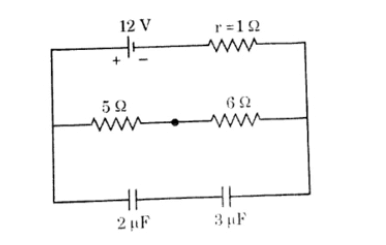
Calculate the stored charge and potential difference between the plates in steady state for both the capacitors as shown in the circuit:
Official Solution
Correct Option:
(1)
Step 1: Given Values. The circuit consists of two capacitors in parallel, with the following values:
- ,
- ,
- ,
- . Since the capacitors are in parallel, the total capacitance is the sum of the individual capacitances:
Step 2: Finding the Charge on the Capacitors. The charge stored on each capacitor in steady state is given by:
Step 3: Finding the Potential Difference Across Each Capacitor. Since the capacitors are in parallel, the potential difference across both capacitors is the same as the applied voltage:
Step 4: Conclusion. Thus, the stored charge on the capacitors is , and the potential difference across each capacitor is .
07
PYQ 2023
medium
physicsID: up-board
Derive the formula for the electric field due to a uniformly charged straight wire of infinite length by using Gauss' law.
Official Solution
Correct Option:
(1)
Step 1: Gauss' Law. Gauss' law states that the electric flux through a closed surface is proportional to the total charge enclosed within the surface:
where is the electric field, is the differential area vector, is the total charge enclosed, and is the permittivity of free space. Step 2: Symmetry of the Problem. Consider a uniformly charged straight wire of infinite length. The electric field produced by this wire is radially symmetric and points directly outward (or inward if the charge is negative). The field depends only on the distance from the wire. We will use a cylindrical Gaussian surface with radius and length centered on the wire. The total charge enclosed by the Gaussian surface is , where is the linear charge density (charge per unit length) of the wire. Step 3: Electric Flux Calculation. Since the electric field is radial and uniform over the surface of the cylinder, the flux through the curved surface of the cylinder is:
where is the magnitude of the electric field and is the surface area of the curved side of the cylindrical Gaussian surface. Step 4: Apply Gauss’ Law. Using Gauss' law, the total electric flux is also equal to the charge enclosed divided by :
Equating the two expressions for electric flux, we get:
Step 5: Solve for the Electric Field. Canceling from both sides, we get the electric field at distance from the wire:
Step 6: Conclusion. Thus, the electric field due to a uniformly charged straight wire of infinite length is:
08
PYQ 2023
medium
physicsID: up-board
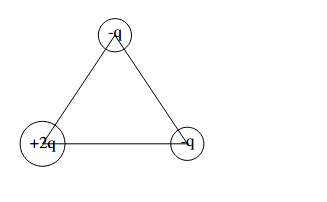
Find out total electric potential energy of the system of charges, shown in the figure:
Official Solution
Correct Option:
(1)
Step 1: Formula for Potential Energy
The total electric potential energy of a system of charges is given by the formula:
Between and :
Between and (again):
Step 3: Total Potential Energy
The total potential energy is the sum of all pairwise potential energies:
Step 4: Conclusion
Thus, the total electric potential energy of the system is .
09
PYQ 2023
medium
physicsID: up-board
The capacitance of a charged capacitor is farad and stored energy is joule. Write the expression for charge on the plates of the capacitor.
Official Solution
Correct Option:
(1)
Step 1: Formula for Energy Stored in a Capacitor. The energy stored in a capacitor is given by the formula:
where is the energy, is the capacitance, and is the potential difference across the plates.
Step 2: Relationship Between Charge and Voltage. The charge on the plates of the capacitor is related to the capacitance and the voltage by the equation: Step 3: Substituting Voltage Expression. From the energy formula , we can solve for : Step 4: Final Expression for Charge. Substituting this value of into the equation for charge:
10
PYQ 2023
medium
physicsID: up-board
Find the expression of the capacity of the parallel plate capacitor partly filled with dielectric substance. If the capacitor is charged by 100 μC and dielectric constant of the slab putting in it is 2.0, then find the induced charge on the dielectric slab in the capacitor.
Official Solution
Correct Option:
(1)
Step 1: Expression for the capacitance of a parallel plate capacitor. The capacitance of a parallel plate capacitor without a dielectric is given by:
where:
- is the permittivity of free space,
- is the area of each plate,
- is the separation between the plates. When a dielectric material with dielectric constant is inserted between the plates, the capacitance increases by a factor of , and the capacitance becomes:
Step 2: Induced charge on the dielectric slab. Let the total charge on the capacitor be . The electric field inside the capacitor is related to the charge and the capacitance by:
For the dielectric material inserted, the induced charge on the dielectric slab is given by:
Substituting the given values:
Step 3: Conclusion. The induced charge on the dielectric slab in the capacitor is .
11
PYQ 2023
medium
physicsID: up-board
Obtain the formula for the electric potential on the axial line of an electric dipole.
Official Solution
Correct Option:
(1)
Step 1: Electric potential of a dipole. The electric potential at a point on the axial line of an electric dipole is given by:
where:
- is the electric potential,
- is the dipole moment ( , where is the charge and is the separation between the charges),
- is the distance from the center of the dipole to the point where the potential is being calculated,
- is the angle between the dipole axis and the position vector of the point,
- is the permittivity of free space. Step 2: Electric potential along the axial line. For points along the axial line, , so , and the electric potential simplifies to:
Step 3: Conclusion. The electric potential at a point on the axial line of an electric dipole is:
12
PYQ 2023
medium
physicsID: up-board
The electric field of intensity passes through the plane of area . Find the electric flux.
Official Solution
Correct Option:
(1)
Step 1: Electric flux formula. The electric flux is given by the dot product of the electric field and the area vector :
Step 2: Substituting the values. We are given:
Now, calculate the dot product:
Since the component of the area vector is 0, we only consider the component:
Step 3: Conclusion. Therefore, the electric flux is .
13
PYQ 2023
medium
physicsID: up-board
What is an oscillator? Explain the working of a transistor as an oscillator with a suitable circuit diagram.
Official Solution
Correct Option:
(1)
Step 1: Definition of Oscillator. An oscillator is a circuit that generates a continuous periodic waveform (usually sine or squar without requiring an external input signal. The circuit generates its own signal, often referred to as the "oscillations." Step 2: Working of a Transistor as an Oscillator. In a transistor oscillator circuit, feedback is used to produce an oscillating signal. A common configuration for a transistor oscillator is the Colpitts oscillator. This type of oscillator uses an LC tank circuit for frequency determination. The feedback network controls the oscillation, ensuring that the transistor amplifies the signal continuously.
The general working of a transistor oscillator:
1. The transistor is used to amplify the signal. The LC network provides feedback from the output to the input.
3. The feedback loop sustains oscillations, and the circuit generates a stable waveform.
Step 3: Circuit Diagram. Here’s a simplified circuit diagram for a common emitter oscillator using a transistor: In this diagram, the transistor amplifies the signal, while the LC circuit (inductor and capacitor) sets the frequency of oscillation. Final Answer:
An oscillator is a circuit that generates a continuous periodic signal. A transistor oscillator uses feedback to sustain oscillations and typically uses an LC tank circuit to determine the frequency.
14
PYQ 2023
medium
physicsID: up-board
A hydrogen atom emits ultraviolet radiation of wavelength 1025 . What are the quantum numbers of energy states involved in the transition?
Official Solution
Correct Option:
(1)
Step 1: Energy of the Photon.
The energy of the emitted photon is given by:
Where:
- ,
- ,
- .
Substitute the values:
Step 2: Transition and Quantum Numbers.
The energy of the photon corresponds to the energy difference between two energy levels of the hydrogen atom. Using the Rydberg formula:
Solve for and (the quantum numbers). Final Answer:
The transition involves quantum numbers and .
15
PYQ 2023
medium
physicsID: up-board
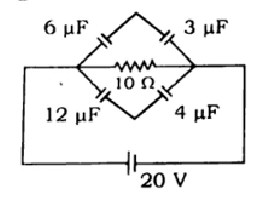
Define capacitance of a capacitor. Find the charge on each capacitor in the circuit shown in the figure.
Official Solution
Correct Option:
(1)
Step 1: Definition of Capacitance. The capacitance of a capacitor is the ratio of the charge stored on one plate to the potential difference between the plates. It is given by the formula:
Where:
- is the capacitance,
- is the charge on the capacitor,
- is the potential difference across the capacitor. Step 2: Analyze the Circuit. Given the circuit:
- The capacitors are in a combination of series and parallel.
- Capacitors in series have an equivalent capacitance .
- Capacitors in parallel have an equivalent capacitance .
The circuit consists of capacitors and a resistor connected to a power supply. Step 3: Find the Equivalent Capacitance of the Capacitors. - The capacitors and are in series:
- Now, the capacitor is in parallel with the capacitor:
- The capacitor is in series with the capacitor:
Step 4: Find the Total Charge in the Circuit. Using the formula , where , we can find the total charge:
Step 5: Find the Charge on Each Capacitor. - The charge on each capacitor is the same in series combination, so the charge on and capacitors will be the same, .
- The charge on the parallel combination of and will be the same, . Final Answer:
The charge on each capacitor is .
16
PYQ 2023
medium
physicsID: up-board
The dielectric constant (k) of silver is
1
2
3
4
(infinity)
Official Solution
Correct Option:
(1)
Step 1: Understanding Dielectric Constant. The dielectric constant (also called the relative permittivity) of a material is a measure of its ability to insulate charges from each other. In general, materials with high dielectric constants are better insulators. Metals, however, behave differently when it comes to dielectric constants. Step 2: Analysis of options. - (A) : The dielectric constant of metals like silver is 0 because metals have free electrons that screen electric fields, preventing the material from polarizing in response to an external electric field. - (B) : A dielectric constant of +1 is characteristic of vacuum or air, not silver. - (C) : The dielectric constant cannot be negative for a stable, passive material. A negative value is not realistic for silver or other materials in this context. - (D) (infinity): A dielectric constant of infinity is theoretical and typically used to describe idealized dielectric materials that can polarize perfectly in an electric field, which is not true for silver.
Step 3: Conclusion. The correct value of the dielectric constant for silver is , as it is a metal and does not polarize in response to an electric field. Therefore, option (A) is the correct answer.
17
PYQ 2023
medium
physicsID: up-board
The unit of electric flux is:
1
Volt Sec
2
Volt metre
3
Amp Sec
4
Amp metre
Official Solution
Correct Option:
(2)
Step 1: Formula of electric flux. Electric flux is defined as: where is electric field (unit: Volt/m) and is area ( ). Step 2: Unit calculation. So, unit = (Volt/m) ( ) = Volt metre. Step 3: Conclusion. Thus, the correct answer is Volt metre.
18
PYQ 2023
medium
physicsID: up-board
Diameters of two spheres of metal are and . They are charged to the same potential. Find out the ratio of the surface densities of charge on the sphere.
Official Solution
Correct Option:
(1)
Step 1: Relation of potential with charge. For a sphere of radius , If both spheres are at same potential: Step 2: Express in terms of surface density. So, Step 3: Substitution. , . Step 4: Conclusion. The ratio of surface charge densities is .
19
PYQ 2023
medium
physicsID: up-board
Find out the formula for the capacitance of the parallel plate capacitor shown in the figure. Area of the plates is and thicknesses of the dielectric slabs between the plates are and , and their dielectric constants are and respectively.
Official Solution
Correct Option:
(1)
Step 1: Recall formula for capacitance. For a parallel plate capacitor with dielectric of thickness and constant : Step 2: Observation of system. Here, the capacitor contains two dielectric slabs of thicknesses and constants , placed in series (stacked one after another between plates). Step 3: Equivalent capacitance for series connection. For series capacitors: Step 4: Individual capacitances.
Step 5: Substitute in series formula.
Step 6: Simplify.
Step 7: Conclusion. Thus, the capacitance of the system is:
20
PYQ 2023
medium
physicsID: up-board
Write down the formula for the electric potential on the axial line of an electric dipole.
Official Solution
Correct Option:
(1)
Step 1: Recall definition of dipole. A dipole consists of charges and separated by distance . Dipole moment . Step 2: Potential on axial line. At a point at distance from the center on the axial line: Step 3: Conclusion. Thus, the potential decreases as .
21
PYQ 2023
medium
physicsID: up-board
State, explain and compare features of (i) Gauss’s law in electrostatics and (ii) Ampere’s circuital law in magnetostatics.
Official Solution
Correct Option:
(1)
Step 1: Gauss’s law in electrostatics. Statement: The total electric flux through any closed surface is equal to times the total charge enclosed. - Useful for highly symmetric charge distributions (spherical, cylindrical, planar). - Provides relation between electric field and enclosed charge. Step 2: Ampere’s circuital law in magnetostatics. Statement: The line integral of magnetic field around a closed path is equal to times the net current enclosed by the path. - Useful for symmetric current distributions (solenoids, toroids, straight conductors). - Provides relation between magnetic field and enclosed current. Step 3: Comparison. - Gauss’s law electric field and charge (flux law). - Ampere’s law magnetic field and current (circulation law). - Both are integral laws, derived from Maxwell’s equations. - Gauss’s law uses closed surfaces, Ampere’s law uses closed loops. Step 4: Conclusion. Both laws are symmetry tools: Gauss’s law for , Ampere’s law for .
22
PYQ 2023
medium
physicsID: up-board
Derive the formula for the capacitance of a parallel plate capacitor, partially filled with a dielectric.
Official Solution
Correct Option:
(1)
Consider a parallel plate capacitor of plate area and separation . Let the space between the plates be partially filled with a dielectric of dielectric constant up to a thickness , and the remaining space is air (or vacuum). We can treat the system as two capacitors in series:
1. Capacitor with dielectric of thickness and dielectric constant ,
2. Capacitor with air gap of thickness and dielectric constant 1. Capacitance of each section:
- With dielectric:
- With air:
Since they are in series, the equivalent capacitance is given by: Final Result:
23
PYQ 2023
medium
physicsID: up-board
A particle of mass and charge traverses distance from rest in a uniform electric field . Prove that the velocity attained by the particle is .
Official Solution
Correct Option:
(1)
When a charged particle of charge and mass moves in a uniform electric field , the work done by the electric field is equal to the change in kinetic energy of the particle. The work done by the electric field is given by:
where is the force acting on the particle. Since the particle starts from rest, the work done is equal to the kinetic energy gained by the particle:
Equating the work done to the kinetic energy: Rearranging for , we get: Thus, the velocity attained by the particle is:
24
PYQ 2023
medium
physicsID: up-board
Show that N/C and V/m are the units of the same physical quantity. Name that physical quantity.
Official Solution
Correct Option:
(1)
Step 1: Understanding the Units of N/C.
The unit N/C is the unit of electric field intensity. In terms of base units:
Thus, the unit N/C is:
Step 2: Understanding the Units of V/m.
The unit V/m is also the unit of electric field intensity. Voltage (V) is defined as:
Thus, the unit V/m is:
Step 3: Comparison.
From both calculations, we can see that the units of N/C and V/m are the same. Hence, both N/C and V/m are the units of electric field intensity. Final Answer:
Both N/C and V/m are the units of electric field intensity.
25
PYQ 2023
medium
physicsID: up-board
Give an equation related to nuclear fusion.
Official Solution
Correct Option:
(1)
Step 1: Understanding Nuclear Fusion. Nuclear fusion is the process in which two light atomic nuclei combine to form a heavier nucleus, releasing a large amount of energy. The energy released in fusion is described by Einstein’s mass-energy equivalence principle. Step 2: Equation for Energy Released in Fusion. The equation for the energy released in fusion is:
Where:
- is the energy released,
- is the mass defect (the difference in mass before and after fusion),
- is the speed of light. Final Answer: The energy released in nuclear fusion is given by .
26
PYQ 2023
medium
physicsID: up-board
In a Boolean expression , if , , then find the value of Y.
Official Solution
Correct Option:
(1)
Step 1: Substitute the values of and into the Boolean expression. The Boolean expression is:
Substituting the values and : Final Answer: The value of is .
27
PYQ 2023
medium
physicsID: up-board
Write Gauss' law of electrostatics and obtain Coulomb's law with its help.
Official Solution
Correct Option:
(1)
Step 1: Gauss' Law of Electrostatics. Gauss' law states that the electric flux through any closed surface is proportional to the net charge enclosed within that surface. Mathematically, it is given by:
where:
- is the electric field,
- is the infinitesimal area vector on the closed surface,
- is the total charge enclosed within the surface,
- is the permittivity of free space. Step 2: Deriving Coulomb's Law from Gauss' Law. Consider a point charge at the center of a spherical Gaussian surface of radius . By symmetry, the electric field is radial and uniform over the surface, so the electric flux is:
According to Gauss' law:
Equating the two expressions for electric flux:
Solving for :
This is the electric field due to a point charge. The force on another charge due to this electric field is:
This is Coulomb's law, which gives the electrostatic force between two point charges and separated by a distance . Step 3: Conclusion. Gauss' law leads directly to Coulomb's law, which describes the force between two point charges.
28
PYQ 2024
medium
physicsID: up-board
Obtain the formula for the intensity of electric field on the equatorial point of an electric dipole.
Official Solution
Correct Option:
(1)
Step 1: Consider an electric dipole consisting of charges and separated by a distance . The dipole moment is: Step 2: The electric field at an equatorial point (perpendicular bisector) of the dipole at a distance from the center is given by the formula: Step 3: For large distances ( ):
29
PYQ 2024
medium
physicsID: up-board
What is Gauss' law? Find the formula for the intensity of electric field produced due to a point charge with the help of it.
Official Solution
Correct Option:
(1)
Step 1: Gauss' law states that the total electric flux through a closed surface is equal to the charge enclosed divided by the permittivity of free space: Step 2: Consider a point charge at the center of a spherical surface of radius : Step 3: Solving for the electric field:
30
PYQ 2025
medium
physicsID: up-board
Define electric dipole and give the formula for its dipole moment. Find the expression of torque acting on an electric dipole placed in a uniform electric field.
Official Solution
Correct Option:
(1)
An electric dipole consists of two opposite charges of equal magnitude and , separated by a distance . The electric dipole moment is defined as the product of the charge and the separation distance:
where:
- is the magnitude of the charge, - is the displacement vector pointing from the negative charge to the positive charge. Torque on an Electric Dipole in a Uniform Electric Field.
When an electric dipole is placed in a uniform electric field , it experiences a torque that tends to align the dipole moment with the electric field. The torque is given by:
where:
- is the dipole moment, - is the electric field.
Step 1: Magnitude of Torque. The magnitude of the torque is:
where:
- is the magnitude of the dipole moment, - is the magnitude of the electric field, - is the angle between the dipole moment and the electric field.
Final Answer: The formula for torque on an electric dipole in a uniform electric field is:
31
PYQ 2025
medium
physicsID: up-board
Derive the formula for the intensity of electric field on the bisector (equatorial line) of an electric dipole.
Official Solution
Correct Option:
(1)
Intensity of Electric Field on the Bisector of an Electric Dipole: Consider an electric dipole consisting of two charges and , separated by a distance . The dipole is placed along the -axis, with the charges located at and . The point where we need to calculate the electric field lies on the bisector (the equatorial line) of the dipole, which is at a distance from the center of the dipole. The angle between the line joining the charges and the point on the bisector is . To calculate the electric field at this point: 1. Electric field due to the positive charge : The electric field due to a point charge is given by: For the positive charge at a distance from the point, the electric field is directed radially away from the charge. Since the point lies on the bisector, the field due to the positive charge will have a component along the direction of the bisector. 2. Electric field due to the negative charge : Similarly, the electric field due to the negative charge at the same distance will also have a component along the bisector, but it will be directed towards the negative charge. 3. Net Electric Field on the Bisector: Since both electric fields are of equal magnitude but opposite directions, they add up along the bisector. The net electric field is: where is the dipole moment of the system. Thus, the intensity of the electric field on the bisector (equatorial line) of an electric dipole is:
32
PYQ 2025
medium
physicsID: up-board
Electric force of 80 N acts between two point charges. When these charges are placed in a dielectric medium, then electric force becomes 8 N. Dielectric constant of the medium will be
1
0.1
2
10
3
16
4
640
Official Solution
Correct Option:
(2)
Step 1: Understanding the Concept:
The electric force between two point charges changes when they are placed in a dielectric medium instead of a vacuum (or air). The dielectric constant (K), also known as relative permittivity ( ), is a measure of how much a dielectric material reduces the electric field strength. The force in the medium is inversely proportional to the dielectric constant.
Step 2: Key Formula or Approach:
The relationship between the electric force in a vacuum ( ) and the electric force in a dielectric medium ( ) is given by the formula:
where is the dielectric constant of the medium.
Step 3: Detailed Explanation:
We are given the following values:
The initial electric force in air (which is approximately a vacuum), .
The electric force when placed in the dielectric medium, .
Using the formula from Step 2, we can calculate the dielectric constant :
Step 4: Final Answer:
The dielectric constant of the medium is 10. Therefore, option (B) is correct.
33
PYQ 2025
medium
physicsID: up-board
Charge on a piece of metal is coulomb. Number of excess electrons in the metal is:
1
2
3
4
Official Solution
Correct Option:
(2)
Step 1 (Quantization of charge). Electric charge on any isolated body is an integer multiple of the elementary charge . If a body has an excess of electrons, its charge is . Step 2 (Use magnitude for counting). The negative sign in indicates extra electrons; the count is . Step 3 (Compute). .
(Using gives , which rounds to ).
34
PYQ 2025
medium
physicsID: up-board
State Gauss's law in electrostatics. On the basis of it, obtain the formula for the electric field produced due to a plane charged plate.
Official Solution
Correct Option:
(1)
Gauss's law in electrostatics states that the total electric flux through any closed surface is equal to the net charge enclosed within the surface divided by the permittivity of free space . Mathematically, Gauss's law is expressed as: where:
- is the electric field,
- is the differential area element on the closed surface,
- is the total charge enclosed within the surface,
- is the permittivity of free space, . Now, to find the electric field due to a plane charged plate, we consider a uniformly charged infinite plane with surface charge density . We will apply Gauss's law using a Gaussian surface in the form of a cylindrical pillbox that intersects the charged plane. The electric field produced by the charged plate is symmetric and uniform, and it points perpendicular to the surface of the plate. 1. Gauss's Law Application: The Gaussian surface consists of two faces, one above and one below the charged plane. The electric field is perpendicular to the surface of the plate and has the same magnitude on both sides of the plane. The flux through the curved surface of the pillbox is zero since the electric field is parallel to this surface. Therefore, the total flux is given by the flux through the two flat faces of the pillbox. 2. Flux Calculation: The flux through one face of the pillbox is , where is the area of the face. The total flux through the two faces is: 3. Charge Enclosed: The charge enclosed by the Gaussian surface is the surface charge density times the area of the pillbox: 4. Applying Gauss's Law: Using Gauss's law, we equate the flux to the charge enclosed divided by : 5. Solving for Electric Field: Simplifying the equation, we get the electric field due to the uniformly charged plane: Thus, the electric field produced by an infinite plane of charge with surface charge density is: Key Notes:
- The electric field is directed perpendicular to the surface of the charged plane.
- The electric field due to a uniformly charged plane is constant in magnitude and does not depend on the distance from the plane.
35
PYQ 2025
medium
physicsID: up-board
Electrostatic force between two point charges placed in a medium of dielectric constant is . On changing the medium, electrostatic force between the charges becomes . Dielectric constant of the medium will be:
1
2
3
4
Official Solution
Correct Option:
(3)
The electrostatic force between two point charges in a vacuum is given by Coulomb's Law:
where:
- is the electrostatic force in a vacuum,
- is Coulomb's constant,
- and are the magnitudes of the charges, and
- is the distance between the charges. When a dielectric medium with dielectric constant is introduced, the force between the charges decreases due to the presence of the medium. The force between the charges in the dielectric medium is:
This shows that the electrostatic force in the dielectric medium is reduced by a factor of . Now, if the initial force between the charges in the medium is and the new force is , the relationship between the two forces is:
Rearranging this equation to find , we get:
Thus, the dielectric constant of the medium is , and the correct answer is option (C).
36
PYQ 2025
medium
physicsID: up-board
Charge on a piece of metal is coulomb. Number of excess electrons in the metal is:
1
2
3
4
Official Solution
Correct Option:
(2)
Step 1 (Quantization of charge). Electric charge on any isolated body is an integer multiple of the elementary charge . If a body has an excess of electrons, its charge is . Step 2 (Use magnitude for counting). The negative sign in indicates extra electrons; the count is . Step 3 (Compute). .
(Using gives , which rounds to ).
37
PYQ 2025
medium
physicsID: up-board
Electrostatic force between two point charges placed in a medium of dielectric constant is . On changing the medium, electrostatic force between the charges becomes . Dielectric constant of the medium will be:
1
2
3
4
Official Solution
Correct Option:
(3)
The electrostatic force between two point charges in a vacuum is given by Coulomb's Law:
where:
- is the electrostatic force in a vacuum,
- is Coulomb's constant,
- and are the magnitudes of the charges, and
- is the distance between the charges. When a dielectric medium with dielectric constant is introduced, the force between the charges decreases due to the presence of the medium. The force between the charges in the dielectric medium is:
This shows that the electrostatic force in the dielectric medium is reduced by a factor of . Now, if the initial force between the charges in the medium is and the new force is , the relationship between the two forces is:
Rearranging this equation to find , we get:
Thus, the dielectric constant of the medium is , and the correct answer is option (C).
38
PYQ 2025
medium
physicsID: up-board
Obtain the formula for work done by an electric dipole in rotating from equilibrium in a uniform electric field.
Official Solution
Correct Option:
(1)
Step 1: Understanding the Concept:
When an electric dipole with dipole moment is placed in a uniform electric field , it experiences a torque that tries to align it with the field. To rotate the dipole from its equilibrium position, external work must be done against this restoring torque. This work is stored as potential energy in the dipole.
Step 2: Key Formula or Approach:
The torque ( ) experienced by the dipole is given by , where is the angle between and .
The work done ( ) in rotating the dipole through a small angle is .
To find the total work done, we must integrate this expression from the initial position to the final position.
Step 3: Detailed Explanation (Derivation):
The equilibrium position for a dipole is when it is aligned with the electric field, so the initial angle is . We want to find the work done in rotating it to a final angle .
The total work done is:
Substitute the expression for torque:
Since and are constant:
Performing the integration:
Since :
Step 4: Final Answer:
The formula for the work done in rotating an electric dipole by an angle from its equilibrium position is .
39
PYQ 2025
medium
physicsID: up-board
Define electric dipole and give the formula for its dipole moment. Find the expression of torque acting on an electric dipole placed in a uniform electric field.
Official Solution
Correct Option:
(1)
An electric dipole consists of two opposite charges of equal magnitude and , separated by a distance . The electric dipole moment is defined as the product of the charge and the separation distance:
where:
- is the magnitude of the charge, - is the displacement vector pointing from the negative charge to the positive charge. Torque on an Electric Dipole in a Uniform Electric Field.
When an electric dipole is placed in a uniform electric field , it experiences a torque that tends to align the dipole moment with the electric field. The torque is given by:
where:
- is the dipole moment, - is the electric field. Step 1: Magnitude of Torque. The magnitude of the torque is:
where:
- is the magnitude of the dipole moment, - is the magnitude of the electric field, - is the angle between the dipole moment and the electric field. Final Answer: The formula for torque on an electric dipole in a uniform electric field is:
40
PYQ 2025
medium
physicsID: up-board
Write the unit of electric flux.
Official Solution
Correct Option:
(1)
Step 1: Start from the definition.
Electric flux through a surface is
For a uniform field making an angle with the area vector, . Step 2: Analyze units using in N/C.
has unit newton per coulomb (N/C) and has unit m . Hence,
Step 3: Show the equivalent unit using in V/m.
Since , an equivalent unit is
Step 4: Express in SI base units (dimensional check).
and . Therefore
This confirms internal consistency. Answer (unit of electric flux): (equivalently, ).
About Electrostatics - UP-BOARD-XII
Electrostatics is a vital chapter for UP-BOARD-XII aspirants. Mastering the concepts covered in this chapter is essential for securing a top rank.
By rigorously practicing the previous year questions associated with this chapter, you can identify high-yield topics, understand the examiner's perspective, and boost your confidence during the actual exam.
Frequently Asked Questions
Why focus on Electrostatics PYQs?
Analyzing PYQs for this specific chapter reveals the most frequently tested concepts and the typical complexity of questions, allowing you to tailor your study plan efficiently.
How to best use this analysis?
Review the topic breakdown to see which sub-topics within Electrostatics carry the most weight. Then, tackle the questions iteratively to solidify your understanding.