On the basis of Ampere's circuital law, find the expression for the magnetic field produced by an infinitely long straight current-carrying conductor.
Official Solution
Correct Option: (1)
Step 1: Ampere's Circuital Law. Ampere's circuital law states that the line integral of the magnetic field around a closed loop is proportional to the total current passing through the loop. The law is given by:
where:
- is the permeability of free space, - is the enclosed current. Step 2: Magnetic Field due to a Straight Conductor. Consider a long straight conductor carrying a current . We choose a circular path of radius around the wire. Since the magnetic field due to a straight conductor is radially symmetric, the magnetic field at a distance from the wire is tangential to the circle. The line integral of the magnetic field around the circular path is: Solving for , we get the magnetic field at a distance from the conductor:
02
PYQ 2023
medium
physicsID: up-board
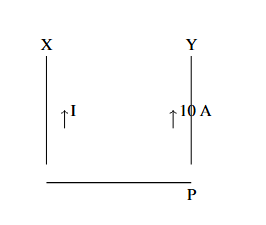
In the figure, currents are flowing in opposite directions in two parallel conductors. What should be the current in the conductor X, so that the resultant magnetic field at the point P is zero? Current in the conductor Y is 10 ampere.
Official Solution
Correct Option: (1)
Step 1: Magnetic Field Due to a Current-Carrying Conductor. The magnetic field at a point due to a current in a long straight conductor is given by Ampere's law:
where: - is the permeability of free space ( ), - is the current, - is the distance from the wire to the point where the field is being measured. Step 2: Magnetic Field at Point P Due to Conductor Y. The magnetic field at point P due to conductor Y, with current and distance , is:
Step 3: Magnetic Field at Point P Due to Conductor X. For the field to be zero at point P, the magnetic field due to conductor X must be equal and opposite in direction to the field due to conductor Y. Let the current in conductor X be , and the distance from point P to conductor X is . The magnetic field at point P due to conductor X is: Step 4: Setting the Fields Equal. For the magnetic fields to cancel each other out, we set :
Solving for :
Step 5: Conclusion. Thus, the current in conductor X must be in the opposite direction to cancel the magnetic field at point P.
03
PYQ 2023
medium
physicsID: up-board
Define 1 ampere on the basis of the force acting between two parallel current-carrying conductors.
Official Solution
Correct Option: (1)
Step 1: Definition of 1 Ampere. 1 ampere is defined as the current that, when flowing through each of two parallel conductors placed 1 meter apart in a vacuum, produces a force of per meter of length between the conductors. Step 2: Explanation. This definition is based on the force between two current-carrying conductors. The force per unit length between two parallel conductors is given by:
where:
- is the force per unit length,
- and are the currents in the two conductors,
- is the distance between the conductors,
- is the permeability of free space ( ). For two conductors with a current of 1 ampere each, placed 1 meter apart, the force between them is . This is the basis for the definition of 1 ampere.
04
PYQ 2023
medium
physicsID: up-board
A proton and an -particle enter perpendicularly in a uniform magnetic field with the same velocity. Find out the ratio of their period of revolutions.
Official Solution
Correct Option: (1)
Step 1: Formula for Period of Revolution. The period of revolution of a charged particle moving in a magnetic field is given by the formula:
where is the mass of the particle, is the charge of the particle, and is the magnetic field strength. Step 2: Mass and Charge of the Proton and -Particle. - For the proton, the charge (where is the elementary charge) and mass is the mass of a proton.
- For the -particle, the charge (twice the charge of a proton) and mass (four times the mass of a proton). Step 3: Ratio of Periods. The ratio of the periods for the proton and for the -particle is given by: Step 4: Conclusion. The ratio of the period of revolution of the -particle to the proton is 2:1.
05
PYQ 2023
medium
physicsID: up-board
State Biot-Savart law. Find the expression for the magnetic field due to a current carrying circular loop at its centre. Also, write down the formula for the magnetic moment of this current loop.
Official Solution
Correct Option: (1)
Step 1: Biot-Savart Law. The Biot-Savart law gives the expression for the magnetic field produced by a small current element. It is given by:
where:
- is the infinitesimal magnetic field produced by the current element, - is the current through the conductor, - is the infinitesimal length vector of the current element, - is the unit vector from the current element to the point of observation, - is the distance from the current element to the point of observation, - is the permeability of free space. Step 2: Magnetic Field Due to a Current Carrying Circular Loop. The magnetic field at the center of a circular loop of radius , carrying a current , is given by the formula:
This expression is derived using the Biot-Savart law by integrating over the entire loop. Step 3: Magnetic Moment of the Current Loop. The magnetic moment of a current loop is given by:
where:
- is the current, - is the area of the loop. For a circular loop, the area , so the magnetic moment becomes:
06
PYQ 2023
medium
physicsID: up-board
The radius of the circular path of a charged particle in a uniform magnetic field is directly proportional to the:
1
charge of the particle
2
momentum of the particle
3
intensity of the magnetic field
4
energy of the particle
Official Solution
Correct Option: (2)
Step 1: Formula for the Radius of the Circular Path. The radius of the circular path of a charged particle in a magnetic field is given by:
where is the mass of the particle, is the velocity, is the charge, and is the magnetic field strength. Step 2: Analyzing the Proportionality. We can express momentum as , so the radius becomes:
Therefore, the radius is directly proportional to the momentum of the particle. Step 3: Conclusion. Hence, the correct answer is (B) momentum of the particle.
07
PYQ 2023
medium
physicsID: up-board
State Gauss’ theorem. Obtain the expression for the intensity of the electric field at a point due to a thin charged wire of infinite length with its help.
Official Solution
Correct Option: (1)
Step 1: Gauss’ Theorem. Gauss’ theorem states that the total electric flux through a closed surface is equal to the charge enclosed divided by the permittivity of free space :
Step 2: Electric Field Due to a Thin Charged Wire. Consider an infinitely long, straight charged wire with linear charge density (charge per unit length). To find the electric field at a distance from the wire, we use a cylindrical Gaussian surface with radius and length . The electric flux through the surface is given by:
Since the charge enclosed is , applying Gauss' law:
Solving for :
Final Answer:
The intensity of the electric field at a distance from a thin charged wire of infinite length is:
08
PYQ 2023
medium
physicsID: up-board
Define magnetic moment and write its unit. An electron is moving with the velocity in a circular orbit of radius 0.3 \AA. Calculate its magnetic moment.
Official Solution
Correct Option: (1)
Step 1: Definition of Magnetic Moment. Magnetic moment ( ) is the measure of the strength and orientation of a magnetic source. For a moving charge, it is given by the formula:
Where:
- is the current,
- is the area enclosed by the moving charge. For an electron moving in a circular path, we can express the magnetic moment as:
Where:
- is the mass of the electron ( ),
- is the velocity of the electron ( ),
- is the radius of the circular orbit ( ). Step 2: Calculation of Magnetic Moment. Substitute the values into the formula for magnetic moment:
Step 3: Unit of Magnetic Moment. The SI unit of magnetic moment is (ampere square meter). Final Answer:
The magnetic moment of the electron is .
09
PYQ 2023
medium
physicsID: up-board
The work function of a photoelectric material is 4.0 eV. Find the wavelength of light for which the stopping potential is 5 volt.
Official Solution
Correct Option: (1)
Step 1: Use the Photoelectric Equation. The energy of the incident photons can be related to the work function and stopping potential using the photoelectric equation:
Where:
- is the energy of the photon,
- is the work function,
- is the stopping potential,
- is Planck's constant,
- is the speed of light,
- is the wavelength of light. Step 2: Rearranging the Equation. Substitute in the equation:
Step 3: Convert eV to Joules. 1 eV = , so:
Step 4: Solving for Wavelength . Now, solve for :
Substitute the values of and :
Final Answer:
The wavelength of light is .
10
PYQ 2023
easy
physicsID: up-board
Explain Biot-Savart law and find the unit of with the help of the Biot-Savart equation.
Official Solution
Correct Option: (1)
Step 1: Biot-Savart Law. The Biot-Savart law gives the magnetic field produced at a point by a small current element. The law is given by:
where:
- is the infinitesimal magnetic field,
- is the permeability of free space,
- is the current,
- is the infinitesimal length element of the wire,
- is the unit vector from the current element to the point of observation,
- is the distance from the current element to the point of observation. Step 2: Unit of . Rearranging the Biot-Savart law to isolate :
From this, we can see that the units of are derived as follows:
Thus, the unit of is , where is the tesla, is meters, and is amperes. Step 3: Conclusion. The unit of is .
11
PYQ 2023
medium
physicsID: up-board
An electron of energy 45 eV is revolving in a circular path in magnetic field of intensity weber/m². Find the radius of the circular path.
Official Solution
Correct Option: (1)
The kinetic energy of the electron is given as 45 eV. We can convert this into joules: The expression for the kinetic energy of an electron is also:
Where: - is the mass of the electron, - is the velocity of the electron. Rearranging for , we get: Now, using the formula for the radius of the circular path in a magnetic field:
Where: - is the radius, - is the mass of the electron, - is the velocity of the electron, - is the charge of the electron, - is the magnetic field strength. Substituting the known values: - , - , We get: Thus, the radius of the circular path is .
12
PYQ 2023
medium
physicsID: up-board
Write Fleming's left hand rule. A particle of having charge enters in a magnetic field of with velocity . Find the magnitude and direction of magnetic force exerting on the particle.
Official Solution
Correct Option: (1)
Step 1: Fleming's Left Hand Rule. Fleming's Left Hand Rule is used to find the direction of force exerted on a moving charged particle in a magnetic field. It states that if you stretch the thumb, index finger, and middle finger of your left hand at right angles to each other:
- The index finger points in the direction of the magnetic field ,
- The middle finger points in the direction of the velocity of the particle,
- The thumb will point in the direction of the force on the charged particle. Step 2: Formula for magnetic force. The force on a charged particle moving in a magnetic field is given by the Lorentz force law:
where:
- is the charge of the particle,
- is the velocity of the particle,
- is the magnetic field,
- denotes the vector cross product. Step 3: Cross product calculation. We are given:
To find the magnetic force, we calculate the cross product :
Expanding this determinant:
Thus:
Step 4: Force on the particle. Now, we use the formula for the force:
Step 5: Conclusion. The magnitude of the force is , and the direction is along the negative -axis (perpendicular to both and ).
13
PYQ 2023
medium
physicsID: up-board
Derive an expression of intensity of magnetic field at the centre of a current-carrying circular coil at its centre. Also, enunciate the law used in it.
Official Solution
Correct Option: (1)
Step 1: Biot-Savart Law. The magnetic field at the center of a current-carrying circular coil is derived using the Biot-Savart law. The Biot-Savart law states that the magnetic field at a point due to an infinitesimal current element is:
where:
- is the permeability of free space,
- is the current,
- is the infinitesimal length element of the wire,
- is the unit vector from the current element to the point where the magnetic field is being calculated,
- is the distance from the current element to the point. Step 2: Magnetic field at the center of the coil. For a circular loop of radius , the magnetic field at the center of the loop due to a current is given by:
where:
- is the magnetic field at the center of the coil,
- is the permeability of free space,
- is the current flowing through the coil,
- is the radius of the coil. Step 3: Conclusion. Thus, the intensity of the magnetic field at the center of a current-carrying circular coil is:
Step 4: Law used. The law used to derive this expression is the Biot-Savart law.