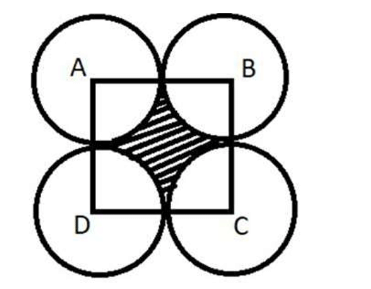
Four circles of equal radius are drawn with centers, A, B, C and D such that ABCD is a square of side 14 cm and the circles touch externally as in the figure. The area of the shaded region bounded by the 4 circles is: (Take )
1
24 cm
2
42 cm
3
96 cm
4
54 cm
Official Solution
Correct Option:
(2)
Step 1: Understanding the Concept:
The shaded area can be found by calculating the area of the square ABCD and subtracting the areas of the four circular sectors that are inside the square. Step 2: Key Formula or Approach:
1. Determine the radius of the circles.
2. Calculate the area of the square.
3. Calculate the area of the four sectors inside the square.
4. Area of Shaded Region = Area of Square - Area of 4 Sectors. Step 3: Detailed Explanation:
The side of the square ABCD is given as 14 cm. Since the circles with centers A and B (or A and D) touch externally, the side of the square is the sum of the radii of two circles.
Side of square = radius + radius = 2 radius.
cm.
The radius of each circle is 7 cm.
Area of the square ABCD = cm .
The four sectors inside the square are at the corners. Since ABCD is a square, the angle of each corner is 90 . So, each sector has a central angle of 90 .
The sum of the angles of the four sectors is , which is the angle of a complete circle.
Therefore, the combined area of the four sectors is equal to the area of one full circle with radius r = 7 cm.
Area of 4 sectors = Area of one circle = .
Area of 4 sectors = cm .
Now, calculate the area of the shaded region:
Area of Shaded Region = Area of Square - Area of 4 Sectors
Area of Shaded Region = cm . Step 4: Final Answer:
The area of the shaded region is 42 cm .
02
PYQ 2025
medium
general-aptitudeID: cuet-ug-
The base diameter of a cylinder is 21 cm and the height is 28 cm, then: (A) Radius of cylinder = 10.5 cm (B) Volume = 12936 cm (C) Curved Surface Area = 1848 cm (D) Total surface area = 2541 cm Which of the following is/ are correct? Choose the correct answer from the options given below:
1
(A), (B) and (D) only
2
(A), (C) and (D) only
3
(B), (C) and (D) only
4
(A), (B) and (C) only
Official Solution
Correct Option:
(2)
Step 1: Understanding the Concept:
This question requires calculating the radius, volume, curved surface area (CSA), and total surface area (TSA) of a cylinder and verifying the given statements. Step 2: Key Formula or Approach:
Given: Diameter (d) = 21 cm, Height (h) = 28 cm.
Radius (r) = d/2
Volume (V) =
Curved Surface Area (CSA) =
Total Surface Area (TSA) =
Use . Step 3: Detailed Explanation: (A) Radius of cylinder:
Radius r = cm. Statement (A) is correct. (B) Volume:
V =
V =
Simplify by cancelling terms: .
V = cm .
The statement says Volume = 12936 cm . Thus, statement (B) is incorrect. (C) Curved Surface Area:
CSA =
CSA =
Simplify: .
CSA = cm .
Statement (C) is correct. (D) Total surface area:
TSA = = CSA + 2( )
TSA =
TSA =
TSA = cm .
Statement (D) is correct. The correct statements are (A), (C), and (D). Step 4: Final Answer:
The correct option is (2) which includes statements (A), (C), and (D) only.
About Mensuration - CUET-UG
Mensuration is a vital chapter for CUET-UG aspirants. Mastering the concepts covered in this chapter is essential for securing a top rank.
By rigorously practicing the previous year questions associated with this chapter, you can identify high-yield topics, understand the examiner's perspective, and boost your confidence during the actual exam.
Frequently Asked Questions
Why focus on Mensuration PYQs?
Analyzing PYQs for this specific chapter reveals the most frequently tested concepts and the typical complexity of questions, allowing you to tailor your study plan efficiently.
How to best use this analysis?
Review the topic breakdown to see which sub-topics within Mensuration carry the most weight. Then, tackle the questions iteratively to solidify your understanding.