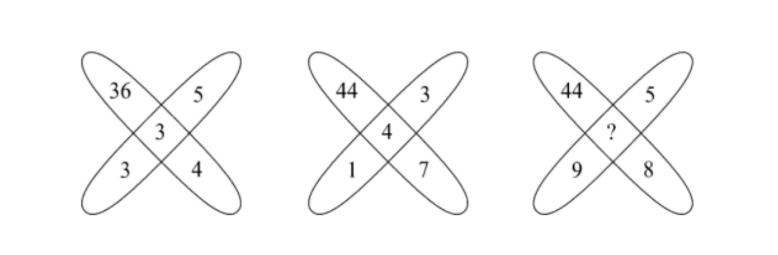
Find the missing number in the following sequence:
1
34
2
63
3
77
4
45
Official Solution
Correct Option: (3)
To find the pattern, observe the calculations in the first two figures. The central number is obtained by multiplying the two numbers on each diagonal and then adding the results.
• First Figure: - Surrounding numbers: 3, 3, 4, and 5 - Calculation: 3 × 4 = 12 and 3 × 5 = 15 - Adding these results: 12 + 15 = 36, which matches the central number.
• Second Figure: - Surrounding numbers: 4, 1, 7, and 3 - Calculation: 4 × 7 = 28 and 1 × 3 = 3 - Adding these results: 28 + 3 = 44, which matches the central number.
• Third Figure: - Surrounding numbers: 9, 8, and 5 - We need to find the missing central number, represented by ?. - Calculation: 9 × 8 = 72 and 5 × 1 = 5 - Adding these results: 72 + 5 = 77
So, the correct answer is (C): 77
02
PYQ 2024
medium
general-aptitudeID: cuet-ug-
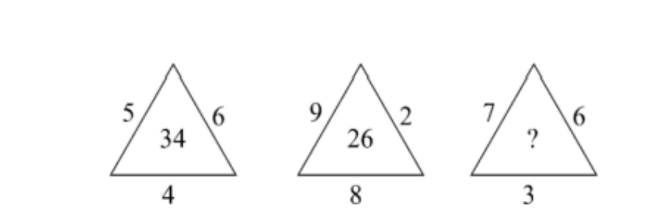
Which one will replace the question mark (?)?
1
2
3
4
Official Solution
Correct Option: (2)
Solution: Observing the pattern in the first two triangles, we can deduce a rule to find the central number based on the surrounding numbers. 1. In the first triangle: - Numbers: 5, 6, and 4 - The central number (34) can be calculated
2. In the second triangle: - Numbers: 9, 2, and 8 - The central number (26) can be calculated as:
Following the same pattern in the third triangle: - Numbers: 7, 6, and 3 - The missing central number (?) is calculated as:
Thus, the correct answer is 45.
03
PYQ 2025
medium
general-aptitudeID: cuet-ug-
Find the missing number from the given alternatives.
6
10
14
9
15
21
12
20
?
1
28
2
36
3
42
4
43
Official Solution
Correct Option: (1)
Step 1: Understanding the Concept:
This is a matrix puzzle where the numbers in the grid follow a certain logical pattern, either row-wise, column-wise, or diagonally. We need to find this pattern to determine the missing number. Step 2: Detailed Explanation:
Let's analyze the patterns in the matrix. Pattern 1: Row-wise Logic
Row 1: 6, 10, 14. The difference between consecutive numbers is +4. ( , ). This is an arithmetic progression. Row 2: 9, 15, 21. The difference between consecutive numbers is +6. ( , ). This is also an arithmetic progression. Row 3: 12, 20, ?. The difference between the first two numbers is +8. ( ). The common differences in the rows are increasing by 2 (4, 6, 8). Following this logic, the next number in the third row should also be found by adding 8. So, .
Pattern 2: Column-wise Logic
Column 1: 6, 9, 12. The difference is +3. ( , ). Column 2: 10, 15, 20. The difference is +5. ( , ). Column 3: 14, 21, ?. The difference is +7. ( ). The common differences in the columns are also increasing by 2 (3, 5, 7). Following this logic, the next number in the third column should be .
Both the row-wise and column-wise patterns lead to the same result. Step 3: Final Answer:
The missing number is 28.