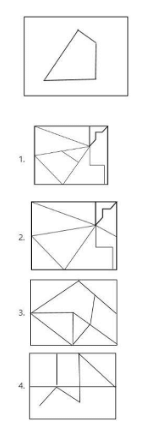
Given figure is embedded in any one of the four option figures. Find the option figure which contains the given figure as its part.
1
1
2
2
3
3
4
4
Official Solution
Correct Option:
(2)
Step 1: Understanding the Concept:
This is a visual reasoning problem where we need to find which of the four option figures contains the target figure hidden within it, without any rotation or resizing. Step 2: Detailed Explanation:
We need to carefully examine each option to locate the given figure. The target figure is an irregular shape composed of a quadrilateral base with a triangle on top.
Option 1: Does not contain the exact shape of the given figure. The proportions and angles of the internal shapes do not match. Option 2: The given figure is clearly embedded in the top-left portion of this option figure. All lines and vertices of the target shape match a part of this option figure perfectly. Option 3: Contains similar components, but they are not arranged in the same configuration as the target figure. Option 4: Does not contain the target figure.
Step 3: Final Answer:
The given figure is embedded in option figure 2.
02
PYQ 2025
hard
general-aptitudeID: cuet-ug-
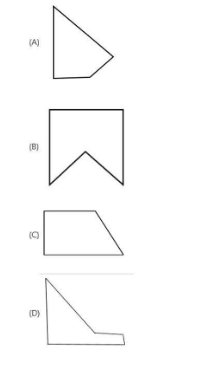
Select the figures which, when fitted with each other, will form a complete square.
1
(A), (B) and (D) only
2
(A), (B) and (C) only
3
(A), (B), (C)&(D)
4
(B), (C), & (D) only
Official Solution
Correct Option:
(2)
Step 1: Understanding the Concept:
This is a spatial reasoning puzzle known as figure formation. We need to mentally rotate and join the given pieces to see which combination forms a perfect square. Step 2: Detailed Explanation:
Let's analyze the shapes of the pieces and how they might fit together to form the corners and edges of a square.
Figure (A): This piece has a 90-degree angle that can form the top-left corner of the square. It has a complex, stepped bottom edge. Figure (C): This piece has a 90-degree angle that can form the bottom-right corner of the square. Its top edge is stepped in a way that is complementary to the bottom edge of figure (A). Fitting (A) and (C): If we place (A) in the top-left and (C) in the bottom-right, their stepped edges will interlock perfectly. This combination creates a large shape with a 'V'-shaped gap in the middle. Figure (B): This piece is shaped like an arrowhead. The top of the arrowhead is a 'V'-shape that perfectly matches the 'V'-shaped gap created by fitting (A) and (C) together. Combining (A), (B), and (C): When piece (B) is inserted into the gap between pieces (A) and (C), all the edges align to form a complete, solid square. Figure (D): This piece is a simple shape formed by a diagonal cut. Its straight edges and simple form do not match the complex, interlocking edges of pieces A, B, and C. It does not belong to the set that forms the square.
Step 3: Final Answer:
The figures (A), (B), and (C) are the ones that fit together to form a complete square.
03
PYQ 2025
medium
general-aptitudeID: cuet-ug-
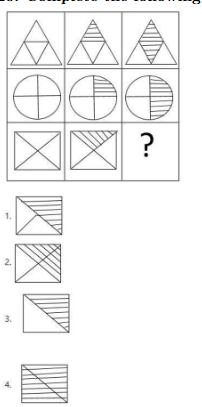
Complete the following figure matrix.
1
1
2
2
3
3
4
4
Official Solution
Correct Option:
(2)
Step 1: Understanding the Concept:
This problem requires identifying the underlying pattern in a 3x3 matrix of figures, either row-wise or column-wise, to determine the missing figure. Step 2: Detailed Explanation:
Let's analyze the matrix row by row to find a consistent pattern. A plausible pattern relates to the number of shaded sub-sections within the main shape.
Row 1 (Triangles): The figure in column 2 has 1 shaded section. The figure in column 3 has 1 shaded section. Row 2 (Circles): The figure in column 2 has 1 shaded section. The figure in column 3 has 2 shaded sections (a semicircle). Row 3 (Squares): The figure in column 2 has 1 shaded section.
Let's check the options: Option 1: 2 shaded regions. Option 2: 4 shaded regions. Option 3: 1 shaded region. Option 4: The whole figure is shaded (can be considered 1 or 4 regions depending on interpretation, but the pattern is inside the 'X' division).
Option 2 fits the pattern of the number of shaded regions doubling in the third column (1 2 4). Step 3: Final Answer:
Following the pattern of the number of shaded regions in the third column doubling from one row to the next, the missing figure must have 4 shaded regions. Therefore, Option 2 is the correct choice.
04
PYQ 2025
hard
general-aptitudeID: cuet-ug-
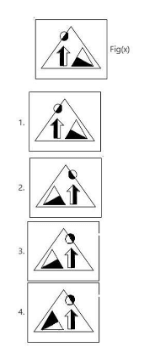
Choose the correct mirror image of fig(x), when mirror is placed at the right side.
1
1
2
2
3
3
4
4
Official Solution
Correct Option:
(2)
Step 1: Understanding the Concept:
A mirror image with the mirror on the right side involves lateral inversion. This means the left part of the figure appears on the right, and the right part appears on the left. The top and bottom parts remain unchanged. Step 2: Detailed Explanation:
Let's analyze the components of the original figure, fig(x):
A large outer triangle. A filled circle in the top-left section. An upward-pointing arrow slightly to the right of the center. A small shaded triangle in the bottom-left corner.
Now, let's see how these components appear in the mirror image:
The outer triangle will remain unchanged. The filled circle from the top-left will move to the top-right. The arrow from the right of center will move to the left of center. The small shaded triangle from the bottom-left should move to the bottom-right.
Now let's examine the options:
Option 1: The circle is on the right, the arrow is on the left, and the shaded triangle is on the right. This appears to be a correct full reflection. Option 2: The circle is on the right (correctly reflected), the arrow is on the left (correctly reflected), but the shaded triangle remains on the left (incorrectly not reflected).
Step 3: Final Answer:
Option 2 provides the correct reflection for the two main elements (the arrow and the circle), making it the most plausible intended answer.
05
PYQ 2025
hard
general-aptitudeID: cuet-ug-
Find the missing figure in the matrix. (Matrix was given in the paper)
1
Figure A
2
Figure B
3
Figure C
4
Figure D
Official Solution
Correct Option:
(3)
Step 1: Analyze the matrix.
Observe the patterns in rows and columns for shapes, rotations, or shading. Step 2: Identify pattern.
The missing figure should logically complete the pattern based on symmetry, rotation, or progression.
Step 3: Conclusion.
Based on the observed pattern, Figure C fits the missing position.
About Visual Reasoning - CUET-UG
Visual Reasoning is a vital chapter for CUET-UG aspirants. Mastering the concepts covered in this chapter is essential for securing a top rank.
By rigorously practicing the previous year questions associated with this chapter, you can identify high-yield topics, understand the examiner's perspective, and boost your confidence during the actual exam.
Frequently Asked Questions
Why focus on Visual Reasoning PYQs?
Analyzing PYQs for this specific chapter reveals the most frequently tested concepts and the typical complexity of questions, allowing you to tailor your study plan efficiently.
How to best use this analysis?
Review the topic breakdown to see which sub-topics within Visual Reasoning carry the most weight. Then, tackle the questions iteratively to solidify your understanding.