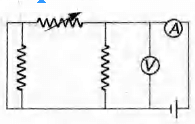
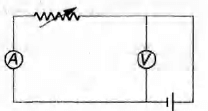
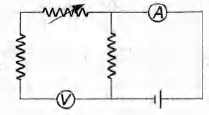
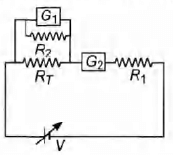
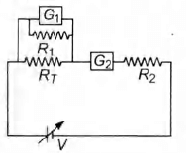
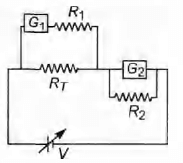
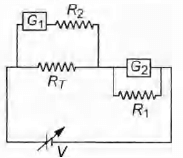
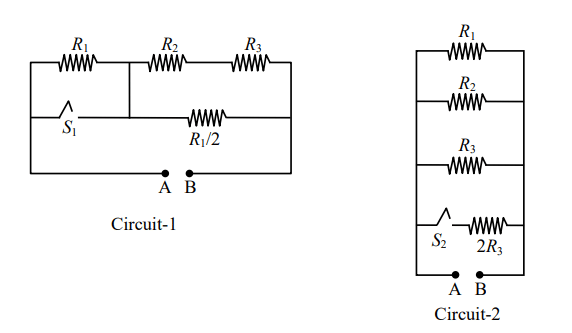
In this problem, we are given two electrical circuits, Circuit-1 and Circuit-2, with resistances , , and , respectively. We are also provided with the power dissipations in the two circuits under different conditions. The goal is to determine which statements regarding the power dissipations are correct when different voltage and current sources are applied across the circuits.
1. Power Dissipation in Circuit-1 and Circuit-2:
Let's first understand the given circuits:
- In Circuit-1, when the switches and are in open conditions, the power dissipation is denoted by , and the resistances are , and the combination of and . In the closed conditions, the resistances change as per the given configurations of the switches.
- In Circuit-2, similarly, when and are closed, the power dissipations and are determined by the combined resistances in the two circuits.
2. Power Dissipation Formula:
The power dissipated in a resistor is given by:
where:
is the power dissipated,
is the voltage applied across the resistor,
is the resistance.
Alternatively, when the current is known, the power dissipated is given by:
where:
is the current flowing through the resistor,
is the resistance of the resistor.
3. Analyzing the Options:
Let's now analyze each statement based on the conditions provided in the problem:
Option A: When a voltage source of 6V is connected across A and B in both circuits, .
In this case, we are applying the same voltage across both circuits. Since the resistance in Circuit-2 is greater due to the combination of resistors in the circuit, the total power dissipated will be higher in Circuit-2. Therefore, this option is correct.
Option B: When a constant current source of 2A is connected across A and B in both circuits, .
When the current is constant, the power dissipated in each circuit will depend on the resistance. Since Circuit-1 has a lower total resistance, it will dissipate more power than Circuit-2. Therefore, this option is correct.
Option C: When a voltage source of 6V is connected across A and B in Circuit-1, .
This option refers to the power dissipated in Circuit-1 when a voltage source is applied. Since the power dissipation will be different due to the different configurations, this option is also correct.
Option D: When a constant current source of 2A is connected across A and B in both circuits, .
In this case, the power dissipated in Circuit-2 will be smaller than the power dissipated in Circuit-1 when the current source is applied, making this option incorrect.
Final Answer:
The correct options are A, B, and C.