JEE-ADVANCED SERIES Physics
Gravitation
17 previous year questions.
Volume: 17 Ques
Yield: Medium
High-Yield Trend
1
2025 3
2023 1
2022 1
2021 1
2019 1
2017 1
2014 1
2011 1
2010 1
2006 1
2002 1
2001 1
1996 1
1989 1
1988 Chapter Questions 17 MCQs
01
PYQ 1988
medium
physics ID: jee-adva
A satellite is moving in an elliptical orbit around the earth. The mass of the satellite is very small compared to the mass of the earth. Then,
1
the linear momentum of S remains constant in magnitude
2
the acceleration of S is always directed towards the centre of the earth
3
the angular momentum of S about the centre of the earth changes in direction, but its magnitude remains constant
4
the total mechanical energy of S varies periodically with time
02
PYQ 1989
medium
physics ID: jee-adva
Imagine a light planet revolving around a very massive star in a circular orbit of radius R with a period of revolution T. If the gravitational force of attraction between the planet and the star is proportional to , then
1
is proportional to
2
is proportional to
3
is proportional to
4
is proportional to
03
PYQ 1996
medium
physics ID: jee-adva
If the distance between the earth and the sun were half its present value, the number of days in a year would have been
1
64.5
2
129
3
182.5
4
730
04
PYQ 2001
medium
physics ID: jee-adva
A simple pendulum has a time period when on the earth's surface and when taken to a height R above the earth's surface, (where R is the radius of the earth). The value of is
1
1
2
3
4
4
2
05
PYQ 2002
medium
physics ID: jee-adva
A geostationary satellite orbits around the earth in a circular orbit of radius . Then, the time period of a spy satellite orbiting a few hundred km above the earth's surface will approximately be
1
1/2 h
2
1h
3
2h
4
4h
06
PYQ 2006
medium
physics ID: jee-adva
A double star system consists of two stars A and B which have time periods and . Radius and and mass and . Choose the correct option
1
if then
2
if then
3
4
07
PYQ 2010
medium
physics ID: jee-adva
A thin uniform annular disc (see figure) of mass has outer radius and inner radius . The work required to take a unit mass from point on its axis to infinity is
1
2
3
4
08
PYQ 2011
medium
physics ID: jee-adva
A satellite is moving with a constant speed in a circular orbit about the earth. An object of mass ' ' is ejected from the satellite such that it just escapes from the gravitational pull of the earth. At the time of its ejection, the kinetic energy of the object is :
1
2
3
4
09
PYQ 2014
medium
physics ID: jee-adva
A planet of radius x (radius of earth) has the same mass density as earth. Scientists dig a well of depth on it and lower a wire of the same length and of linear mass density into it. If the wire is not touching anywhere, the force applied at the top of the wire by a person holding it in place is (take the radius of earth = m and the acceleration due to gravity of earth is )
1
96 N
2
108 N
3
120 N
4
150 N
10
PYQ 2017
easy
physics ID: jee-adva
One twirls a circular ring (of mass and radius ) near the tip of one's finger as shown in Figure 1. In the process the finger never loses contact with the inner rim of the ring. The finger traces out the surface of a cone, shown by the dotted line. The radius of the path traced out by the point where the ring and the finger is in contact is . The finger rotates with an angular velocity . The rotating ring rolls without slipping on the outside of a smaller circle described by the point where the ring and the finger is in contact (Figure 2). The coefficient of friction between the ring and the finger is and the acceleration due to gravity is . The total kinetic energy of the ring is
1
2
3
4
11
PYQ 2019
medium
physics ID: jee-adva
Consider a spherical gaseous cloud of mass density (r) in free space where is the radial distance from its center. The gaseous cloud is made of particles of equal mass moving in circular orbits about the common center with the same kinetic energy . The force acting on the particles is their mutual gravitational force. If (r) is constant in time, the particle number density is : [ is universal gravitational constant]
1
2
3
4
12
PYQ 2021
medium
physics ID: jee-adva
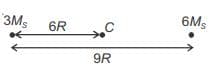
The distance between two stars of masses 3MS and 6MS is 9R. Here R is the mean distance between the centres of the Earth and the Sun, and MS is the mass of the Sun. The two stars orbit around their common centre of mass in circular orbits with period nT, where T is the period of Earth’s revolution around the Sun. The value of n is ___.
13
PYQ 2022
medium
physics ID: jee-adva
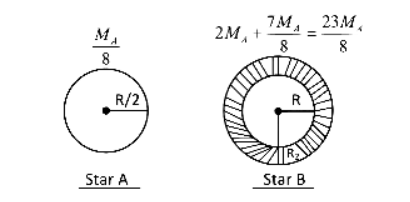
Two spherical stars and have densities and , respectively and have the same radius, and their masses and are related by Due to an interaction process, star loses some of its mass, so that its radius is halved, while its spherical shape is retained, and its density remains The entire mass lost by is deposited as a thick spherical shell on with the density of the shell being If and are the escape velocities from and after the interaction process, the ratio The value of is ___
14
PYQ 2023
easy
physics ID: jee-adva
Two satellites P and Q are moving in different circular orbits around the Earth (radius 𝑅). The heights of P and Q from the Earth surface are and , respectively, where . The accelerations of P and Q due to Earth’s gravity are and , respectively. If , what is the value of
1
2
3
4
15
PYQ 2023
easy
physics ID: jee-adva
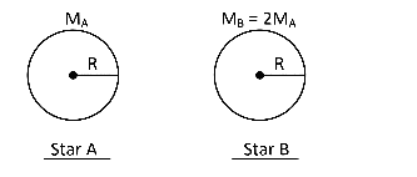
The Ratio of gravity field due to the earth at high hP and hQ from the earth's surface is If , then the value of hQ will be
1
2
3
4
16
PYQ 2023
medium
physics ID: jee-adva
Two spherical stars and have densities and , respectively and have the same radius, and their masses and are related by Due to an interaction process, star loses some of its mass, so that its radius is halved, while its spherical shape is retained, and its density remains The entire mass lost by is deposited as a thick spherical shell on with the density of the shell being If and are the escape velocities from and after the interaction process, the ratio . The value of is ___ .
17
PYQ 2025
easy
physics ID: jee-adva
Consider a star of mass kg revolving in a circular orbit around another star of mass kg with . The heavier star slowly acquires mass from the lighter star at a constant rate of kg/s. In this transfer process, there is no other loss of mass. If the separation between the centers of the stars is , then its relative rate of change (in s ) is given by:
1
2
3
4