JEE-ADVANCED SERIES
Physics

Thermodynamics

63 previous year questions.

Volume: 63 Ques
Yield: High

High-Yield Trend

5
2025
1
2024
11
2023
2
2022
3
2021
6
2020
2
2019
1
2013
1
2012
1
2011
1
2010
1
2009
1
2008
3
2005
2
2004

Chapter Questions
63 MCQs

01
PYQ 1983
medium
physics ID: jee-adva
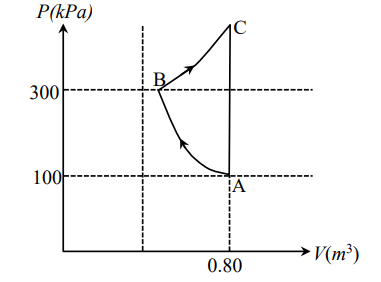
An ideal monoatomic gas is taken round the cycle as shown in the P - V diagram (see figure). The work done during the cycle is
1
2
3
4
02
PYQ 1985
medium
physics ID: jee-adva
70 cal of heat are required to raise the temperature of2 moles of an ideal diatomic gas at constant pressure from 30 C to 35 C. The amount of heat required (in calorie) to raise the temperature of the same gas through the same range (30 C to 35 C) at constant volume is
1
30
2
50
3
70
4
90
03
PYQ 1988
medium
physics ID: jee-adva
If one mole of a monoatomic gas ( = 5/ 3) is mixed with one mole of a diatomic gas ( = 7 / 5), the value of for the mixture is
1
1.4
2
1.5
3
1.53
4
3.07
04
PYQ 1988
medium
physics ID: jee-adva
A cylinder of radius R made of a material of thermal conductivity , is surrounded by a cylindrical shell of inner radius R and outer radius 2R made of a material of thermal conductivity K . The two ends of the combined system are maintained at two different temperatures. There is no loss of heat across the cylindrical surface and the system is in steady state. The effective thermal conductivity of the system is
1
2
3
4
05
PYQ 1989
medium
physics ID: jee-adva
For an ideal gas
1
the change in internal energy in a constant pressure process from temperature , to is equal to , where C is the molar heat capacity at constant volume and n the number of moles of the gas
2
the change in internal energy of the gas and the work done by the gas are equal in magnitude in an adiabatic process
3
the internal energy does not change in an isothermal process
4
no heat is added or removed in an adiabatic process
06
PYQ 1990
easy
physics ID: jee-adva
When an ideal diatomic gas is heated at constant pressure the fraction of the heat energy supplied which increases the internal energy of the gas is
1
2
3
4
07
PYQ 1993
medium
physics ID: jee-adva
An ideal gas is taken from the state A (pressure p, volume V) to the state B (pressure p /2, volume 2 V) along a straight line path in the p-V diagram. Select the correct statements from the following
1
The work done by the gas in the process A to B exceeds the work that would be done by it if the system were taken from A to B along an isotherm
2
In the T-V diagram, the path AB becomes a part of a parabola
3
In the p-T diagram, the path AB becomes a part of a hyperbola
4
In going from A to B, the temperature T of the gas first increases to a maximum value and then decreases
08
PYQ 1994
medium
physics ID: jee-adva
Two bodies A and B have thermal emissivities of 0.01 and 0.81 respectively. The outer surface areas of the two bodies are the same. The two bodies emit total radiant power at the same rate. The wavelength corresponding to maximum spectral radiancy in the radiation from B shifted from _the wavelength corresponding to maximum spectral radiancy in the radiation from A, by 1.00 pm. If the temperature of A is 5802 K.
1
the temperature of it is 1934 K
2
3
the temperature of B is i 1604 K
4
the temperature of B is 2901 K
09
PYQ 1995
medium
physics ID: jee-adva
Three rods of identical cross-sectional area and made from the same metal from the sides of an isosceles triangle ABC, right angled at B. The points A and B are maintained at temperatures T and ( )T respectively. In the steady state, the temperature of the point C is . Assuming that only heat conduction takes place, T /T is
1
2
3
4
10
PYQ 1995
medium
physics ID: jee-adva
Two metallic spheres , and S are made of the same material and have got identical surface finish. The mass of S is thrice that of S . Both the spheres are heated to the same high temperature and placed in the same room having lower temperature but are thermally insulated from each other. The ratio of the initial rate of cooling of to that of S is
1
2
3
4
11
PYQ 1998
medium
physics ID: jee-adva
A vessel contains a mixture of one mole of oxygen and two moles of nitrogen at 300 K. The ratio of the average rotational kinetic energy per O molecule to per N molecule is
1
1:01
2
1:02
3
2:01
4
depends on the moment of inertia of the two molecules
12
PYQ 1998
medium
physics ID: jee-adva
A black body is at a temperature of 2880 K. The energy of radiation emitted by this body with wavelength between 499 nm and 500 nm is , between 999 nm and 1000 nm is and between 1499 nm and 1500 nm is . The Wien constant, b = 2.88 nm-K. Then,
1
2
3
4
13
PYQ 1998
easy
physics ID: jee-adva
During the melting of a slab of ice at at atmospheric pressure
1
positive work is done by the ice-water system on the atmosphere
2
positive work is done on the ice-water system by the atmosphere
3
internal energy of ice-water system decreases
4
none of the above
14
PYQ 2000
medium
physics ID: jee-adva
A monoatomic ideal gas, initially at temperature , is enclosed in a cylinder fitted with a frictionless piston. The gas is allowed to expand adiabatically to a temperature T by releasing the piston suddenly. If L and L are the lengths of the gas column before and after expansion respectively, then is given by
1
2
3
4
15
PYQ 2000
medium
physics ID: jee-adva
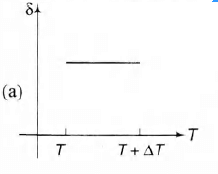
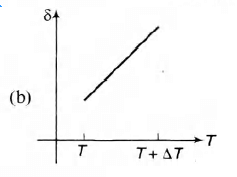
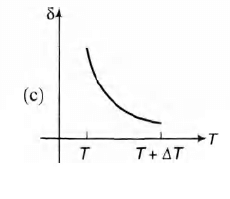
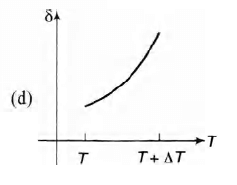
An ideal gas is initially at temperature T and volume V. Its volume is increased by V due to an increase in temperature T, pressure remaining constant. The quantity 5 = V / V T varies with temperature as
1
2
3
4
16
PYQ 2000
medium
physics ID: jee-adva
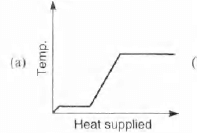
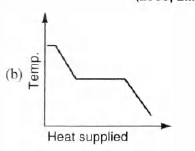
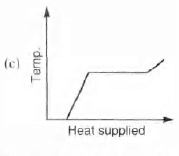
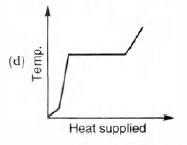
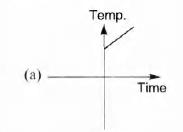
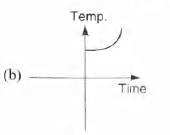
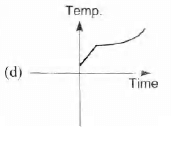
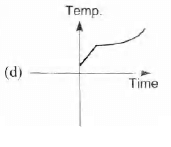
A block of ice at I0 C is slowly heated and converted to steam at 100 C. Which of the following curves represents the phenomena qualitatively?
1
2
3
4
17
PYQ 2001
medium
physics ID: jee-adva
In a given process of an ideal gas, and . Then for the gas
1
the temperature will decrease
2
the volume will increase
3
the pressure will remain constant
4
the temperature will increase
18
PYQ 2001
medium
physics ID: jee-adva
p-V plots for two gases during adiabatic processes are shown in the figure. Plots 1 and 2 should correspond respectively to
1
He and
2
and He
3
He and Ar
4
and
19
PYQ 2002
medium
physics ID: jee-adva
An ideal gas is taken through the cycle A B C A, as shown in the figure. If the net heat supplied to the gas in the cycle is 5 J, the work done by the gas in the process C A is
1
-5 J
2
-10 J
3
-15 J
4
-20 J
20
PYQ 2002
medium
physics ID: jee-adva
An ideal black-body at room temperature is thrown into a furnace. It is observed that
1
initially it is the darkest body and at later times the brightest
2
it is the darkest body at all times
3
it cannot be distinguished at all times
4
initially it is the darkest body and at later times it cannot be distinguished
21
PYQ 2003
medium
physics ID: jee-adva
2 kg of ice at -20 C is mixed with 5 kg of water at 20 C in an insulating vessel having a negligible heat capacity. Calculate the final mass of water remaining in the container. It is given that the specific heats of water and ice are 1 kcal/kg / C and 0.5 kcal/kg / C while the latent heat of fusion of ice is 80 kcal/kg
1
7 kg
2
6 kg
3
4 kg
4
2 kg
22
PYQ 2003
medium
physics ID: jee-adva
Two rods,one of aluminium and the other made of steel ,having initial length . are connected together to form a single rod of length . The coefficients of linear expansion for aluminium and steel are and respectively. if the lenght of each rod increases by the same amount when their temperature are raised by t then find the ratio
1
2
3
4
23
PYQ 2004
medium
physics ID: jee-adva
An ideal gas expands isothermally from a volume to and then compressed to original volume adiabatically. Initial pressure is p and final pressure is p . The total work done is W. Then,
1
2
3
4
24
PYQ 2004
medium
physics ID: jee-adva
Liquid oxygen at 50 K is heated to 300 K at constant pressure of 1 atm. The rate of heating is constant. Which of the following graphs represent the variation of temperature with time?
1
2
3
4
25
PYQ 2005
easy
physics ID: jee-adva
Water of volume 2 L in a container is heated with a coil of 1 kW at 27 C. The lid of the container is open and energy dissipates at rate of 160 J/s. In how much time temperature will rise from 27 C to 77 C? [Specific heat of water is 4.2 kJ/kg]
1
8 min 20 s
2
6 min 2 s
3
7 min
4
14 min
26
PYQ 2005
medium
physics ID: jee-adva
In which of the following process, convection does not take place primarily?
1
Sea and land breeze
2
Boiling of water
3
Warming of glass of bulb due to filament
4
Heating air around a furnace
27
PYQ 2005
medium
physics ID: jee-adva
Calorie is defined as the amount of heat required to raise temperature of 1 g of water by 1 C and it is defined under which of the following conditions ?
1
From 14.5 C to 15.5 C at 760 mm of Hg
2
From 98.5 C to 99.5 C at 760 mm of Hg
3
From 13.5 C to 14.5 C at 76 mm of Hg
4
From 3.5 C to 4.5 C at 76 mm of Hg
28
PYQ 2008
medium
physics ID: jee-adva
An ideal gas is expanding such that pT = constant. The coefficient of volume expansion of the gas is
1
2
3
4
29
PYQ 2009
easy
physics ID: jee-adva
The figure shows the p-V plot an ideal gas taken through a cycle ABCDA. The part ABC is a semi-circle and CDA is half of an ellipse. Then,
1
the process during the path A B is isothermal
2
heat flows out of the gas during the path B C D
3
work done during the path A B C is zero
4
positive work is done by the gas in the cycle ABCDA
30
PYQ 2010
medium
physics ID: jee-adva
One mole of an ideal gas in initial state A undergoes a cyclic process ABC A, as shown in the figure. Its pressure at A is p . Choose the correct option(s) from the following.
1
Internal energies at A and B are the same
2
Work done by the gas in process AB is p In 4
3
Pressure at C' is
4
Temperature at C is
31
PYQ 2011
medium
physics ID: jee-adva
5.6 L of helium gas at STP is adiabatically compressed to 0.7 L. Taking the initial temperature to be , the work done in the process is
1
2
3
4
32
PYQ 2012
medium
physics ID: jee-adva
A mixture of 2 moles of helium gas (atomic mass = 4 amu) and 1 mole of argon gas (atomic mass = 40 amu) is kept at 300 K in a container. The ratio of the rms speeds is
1
0.32
2
0.45
3
2.24
4
3.16
33
PYQ 2013
medium
physics ID: jee-adva
Two rectangular blocks, having identical dimensions, can be arranged either in configuration I or in configuration II as shown in the figure. One of the blocks has thermal conductivity and the other The temperature difference between the ends along the -axis is the same in both the configurations. It takes to transport a certain amount of heat from the hot end to the cold end in the configuration I. The time to transport the same amount of heat in the configuration II is
1
2.0 s
2
3.0 s
3
4.5 s
4
6.0 s
34
PYQ 2019
hard
physics ID: jee-adva
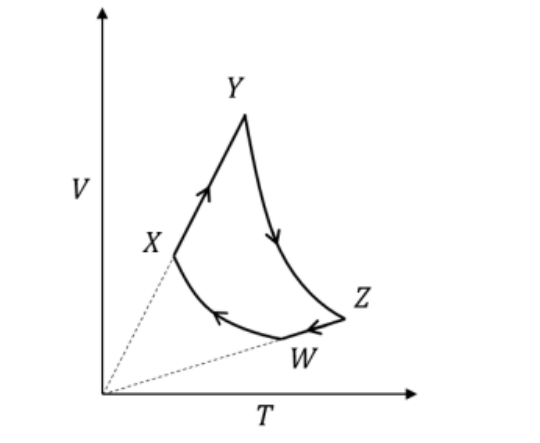
One mole of a monatomic ideal gas goes through a thermodynamic cycle, as shown in the volume versus temperature ( ) diagram. The correct statement(s) is/are: [ is the gas constant]
1
Work done in this thermodynamic cycle is
2
The above thermodynamic cycle exhibits only isochoric and adiabatic processes
3
The ratio of heat transfer during processes and
4
The ratio of heat transfer during processes and
35
PYQ 2019
easy
physics ID: jee-adva
Name the process in which Boyle's law is applicable?
1
Adiabatic process
2
Isochoric process
3
Isobaric process
4
Isothermal process
36
PYQ 2020
medium
physics ID: jee-adva
A hot air balloon is carrying some passengers, and a few sandbags of mass each so that its total mass is . Its effective volume giving the balloon its buoyancy is . The balloon is floating at an equilibrium height of . When number of sandbags are thrown out, the balloon rises to a new equilibrium height close to with its volume remaining unchanged. If the variation of the density of air with height from the ground is , where and , the value of is _______
37
PYQ 2020
medium
physics ID: jee-adva
A spherical bubble inside water has radius . Take the pressure inside the bubble and the water pressure to be . The bubble now gets compressed radially in an adiabatic manner so that its radius becomes For the magnitude of the work done in the process is given by , where is a constant and . The value of is ______
38
PYQ 2020
medium
physics ID: jee-adva
The filament of a light bulb has surface area The filament can be considered as a black body at temperature emitting radiation like a point source when viewed from far At night the light bulb is observed from a distance of . Assume the pupil of the eyes of the observer to be circular with radius Then (Take Stefan-Boltzmann constant = , , Wien's displacement constant = , , Planck's constant = , speed of light in vacuum =
1
power radiated by the filament is in the range to
2
radiated power entering into one eye of the observer is in the range to
3
the wavelength corresponding to the maximum intensity of light is
4
taking the average wavelength of emitted radiation to be , the total number of photons entering per second into one eye of the observer is in the range to
39
PYQ 2020
medium
physics ID: jee-adva
Consider one mole of helium gas enclosed in a container at initial pressure and volume . It expands isothermally to volume . After this, the gas expands adiabatically and its volume becomes . The work done by the gas during isothermal and adiabatic expansion processes are and respectively. If the ratio , then is ?
40
PYQ 2020
medium
physics ID: jee-adva
The filament of a light bulb has surface area The filament can be considered as a black body at temperature emitting radiation like a point source when viewed from far At night the light bulb is observed from a distance of . Assume the pupil of the eyes of the observer to be circular with radius Then (Take Stefan-Boltzmann constant = , , Wien's displacement constant = , , Planck's constant = , speed of light in vacuum =
1
power radiated by the filament is in the range to
2
radiated power entering into one eye of the observer is in the range to
3
the wavelength corresponding to the maximum intensity of light is
4
taking the average wavelength of emitted radiation to be , the total number of photons entering per second into one eye of the observer is in the range to
41
PYQ 2020
medium
physics ID: jee-adva
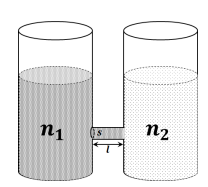
As shown schematically in the figure, two vessels contain water solutions (at temperature ) of potassium permanganate of different concentrations and molecules per unit volume with . When they are connected by a tube of small length and cross-sectional area starts to diffuse from the left to the right vessel through the tube. Consider the collection of molecules to behave as dilute ideal gases and the difference in their partial pressure in the two vessels causing the diffusion. The speed of the molecules is limited by the viscous force on each molecule, where is a constant. Neglecting all terms of the order , which of the following is/are correct? ( is the Boltzmann constant)
two vessels contain water solutions (at temperature T )
1

the force causing the molecules to move across the tube is ∆𝑛𝑘𝐵𝑇𝑆

2

force balance implies 𝑛1𝛽𝑣𝑙 = ∆𝑛𝑘𝐵𝑇

3
total number of molecules going across the tube per is
4
rate of molecules getting transferred through the tube does not change with time
42
PYQ 2021
medium
physics ID: jee-adva
An ideal gas undergoes a four step cycle as shown in the diagram below During this cycle, heat is absorbed by the gas in
An ideal gas undergoes a four step cycle as shown in the <span class= diagram below During this cycle, heat is absorbed by the gas in">
1
steps 1 and 2
2
steps 1 and 3
3
steps 1 and 4
4
steps 2 and 4
43
PYQ 2021
medium
physics ID: jee-adva
A thermally insulating cylinder has a thermally insulating and frictionless movable partition in the middle, as shown in the figure below On each side of the partition, there is one mole of an ideal gas, with specific heat at constant volume, Here, is the gas constant Initially, each side has a volume and temperature The left side has an electric heater, which is turned on at very low power to transfer heat to the gas on the left side As a result the partition moves slowly towards the right reducing the right side volume to Consequently, the gas temperatures on the left and the right sides become and , respectively Ignore the changes in the temperatures of the cylinder, heater and the partition The value of is
1
2
3
4
44
PYQ 2021
easy
physics ID: jee-adva

A thermally insulating cylinder has a thermally insulating and frictionless movable partition in the middle, as shown in the figure below. On each side of the partition, there is one mole of an ideal gas, with specific heat at constant volume, . Here, is the gas constant Initially, each side has a volume and temperature The left side has an electric heater, which is turned on at very low power to transfer heat to the gas on the left side. As a result the partition moves slowly towards the right reducing the right side volume to . Consequently, the gas temperatures on the left and the right sides become and , respectively. Ignore the changes in the temperatures of the cylinder, heater and the partition
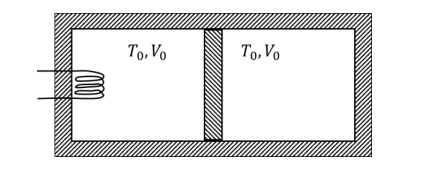
thermally insulating cylinder
45
PYQ 2022
medium
physics ID: jee-adva
In the given diagram, a monoatomic gas is first compressed adiabatically from state to state . Then it expands isothermally from state to state [Given: ].
a monoatomic gas
Which of the following statement(s) is(are) correct?
1
The magnitude of the total work done in the process is .
2
The magnitude of the work done in the process is .
3
The magnitude of the work done in the process is .
4
The magnitude of the work done in the process is zero.
46
PYQ 2022
medium
physics ID: jee-adva

List I describes thermodynamic processes in four different systems List II gives the magnitudes (either exactly or as a close approximation) of possible changes in the internal energy of the system due to the process

List I

List II

I

of water at is converted to steam at the same temperature, at a pressure of .The volume of the system changes from to in the process .Latent heat of water

P

2KJ

II

moles of a rigid diatomic ideal gas with volume at temperature undergoes an isobaric expansion to volume Assume

Q

7KJ

III

On mole of a monatomic ideal gas is compressed adiabatically from volume and pressure to volume

R

4KJ

IV

Three moles of a diatomic ideal gas whose molecules can vibrate, is given of heat and undergoes isobaric expansion

S

5KJ

T

3KJ

Which one of the following options is correct?
1
I T, II R, III S, IV Q
2
I S, II P, III T, IV P
3
I P, II R, III T, IV Q
4
I Q, II R, III S, IV T
47
PYQ 2023
hard
physics ID: jee-adva
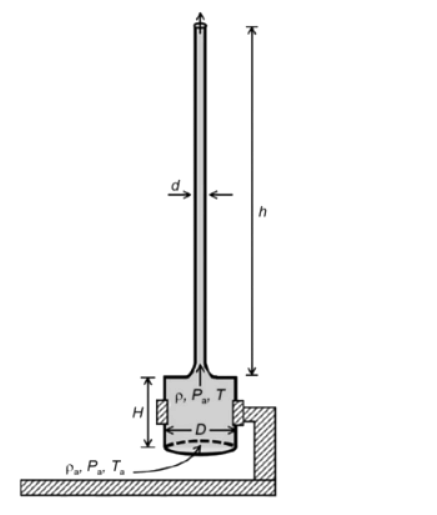
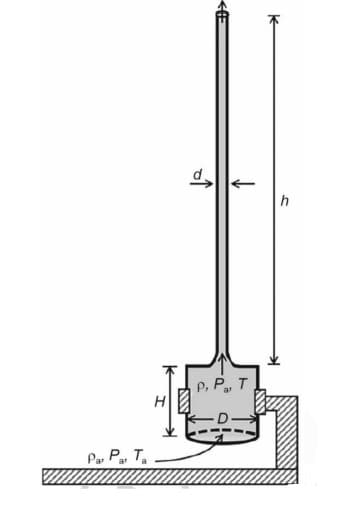
A cylindrical furnace has height (𝐻) and diameter (𝐷) both 1 m. It is maintained at a temperature of 360 K. The air gets heated inside the furnace at constant pressure 𝑃𝑎 and its temperature becomes 𝑇 = 360 𝐾. The hot air with density 𝜌 rises up a vertical chimney of diameter 𝑑 = 0.1 m and height ℎ = 9 m above the furnace and exits the chimney (see the figure). As a result, atmospheric air of density 𝜌𝑎 = 1.2 kg m−3, pressure 𝑃𝑎 and temperature 𝑇𝑎 = 300 K enter the furnace. Assume air as an ideal gas, neglecting the variations in 𝜌 and 𝑇 inside the chimney and the furnace. Also, ignore the viscous effects. [Given: The acceleration due to gravity 𝑔 = 10 m s−2 and 𝜋 = 3.14] Considering the airflow to be streamlined, the steady mass flow rate of air exiting the chimney is _______ gm s−1.
48
PYQ 2023
hard
physics ID: jee-adva
An ideal gas is in thermodynamic equilibrium. The number of degrees of freedom of a molecule of the gas is 𝑛. The internal energy of one mole of the gas is 𝑈𝑛 and the speed of sound in the gas is v𝑛. At a fixed temperature and pressure, which of the following is the correct option?
1
v3 < v6 and 𝑈3 > 𝑈6
2
v5 > v3 and 𝑈3 > 𝑈5
3
v5 > v7 and 𝑈5 < 𝑈7
4
v6 < v7 and 𝑈6 < 𝑈7
49
PYQ 2023
medium
physics ID: jee-adva
A closed container constrains a homogeneous mixture made of, 2 moles of an ideal monatomic gas( ) and one mole of an ideal diatomic gas( ). Here, γ is the ratio of the specific heat at content pressure and constant volume of an ideal gas. The gas mixture does a work of 66 joules when heated at constant pressure. The change in its internal energy is ____Joule.
1
-187J
2
121J
3
-121J
4
187J
50
PYQ 2023
easy
physics ID: jee-adva
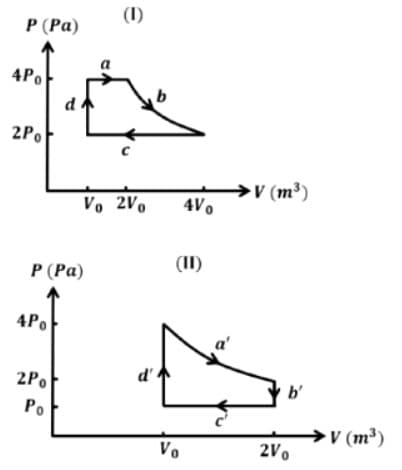
One mole of an ideal gas undergoes two different cyclic processes I and I, as shown in the P-V diagrams below. In cycle, I processes a, b, c and d are isobaric, isothermal, isobaric, and isochoric, respectively. In cycle II, processes a',b',c', and d' are isothermal, isochoric, isobaric, and isochoric, respectively. The total work done during cycle I is 𝑊I and that during cycle II is 𝑊II. The ratio WI/WII is
51
PYQ 2023
medium
physics ID: jee-adva
A closed container constrains a homogeneous mixture made of, 2 moles of an ideal monatomic gas( ) and one mole of an ideal diatomic gas( ). Here, γ is the ratio of the specific heat at content pressure and constant volume of an ideal gas. The gas mixture does a work of 66 joules when heated at constant pressure. The change in its internal energy is ____Joule.
52
PYQ 2023
hard
physics ID: jee-adva

PARAGRAPH "II" A cylindrical furnace has height (𝐻) and diameter (𝐷) both 1 m. It is maintained at temperature 360 K. The air gets heated inside the furnace at constant pressure 𝑃𝑎 and its temperature becomes 𝑇 = 360 𝐾. The hot air with density 𝜌 rises up a vertical chimney of diameter 𝑑 = 0.1 m and height ℎ = 9 m above the furnace and exits the chimney (see the figure). As a result, atmospheric air of density 𝜌𝑎 = 1.2 kg m−3, pressure 𝑃𝑎 and temperature 𝑇𝑎 = 300 K enters the furnace. Assume air as an ideal gas, neglect the variations in 𝜌 and 𝑇 inside the chimney and the furnace. Also ignore the viscous effects. [Given: The acceleration due to gravity 𝑔 = 10 m s−2 and 𝜋 = 3.14] Considering the air flow to be streamline, the steady mass flow rate of air exiting the chimney is _______ gm s−1.
53
PYQ 2023
medium
physics ID: jee-adva
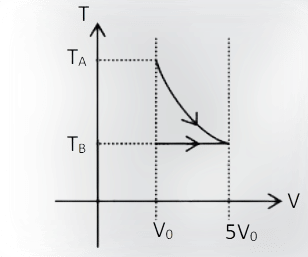
One mole of an ideal gas expands adiabatically from an initial state(TA, V0) to a final state (Tf,5V0). Another mole of the same gas expands isothermally from a different initial state (TB, V0) to the same final state (Tf,5V0). The ratio of the specific heat of constant pressure and constant volume of the ideal gas is λ. What is the ratio of ?
1
5
2
5γ-1
3
51+γ
4
51-γ
54
PYQ 2023
easy
physics ID: jee-adva
Match the temperature of a black body given in L-I with an appropriate statement in L-II and choose the correct option. (given: wien is constant as m.k.
List-I List-II
(P)2000 K(1)The radiation at peek wavelength can lead to the emission of photo e from a metal of work function 4 eV
(Q)3000 K(2)The radiation at peek wavelength is visible to the human eye
(R)5000K(3)The radiation at peek emission wavelength will result in the widest central maximum of a single slit diffraction
(S)10000K(4)The power emitted per unit area is of that emitted by a black body at a temperature of 6000K.
(5)The radiation at peak emission wavelength can be used to image human bone.
55
PYQ 2023
medium
physics ID: jee-adva
A cylindrical furnace has height (𝐻) and diameter (𝐷) both 1 m. It is maintained at a temperature of 360 K. The air gets heated inside the furnace at constant pressure 𝑃𝑎 and its temperature becomes 𝑇 = 360 𝐾. The hot air with density 𝜌 rises up a vertical chimney of diameter 𝑑 = 0.1 m and height ℎ = 9 m above the furnace and exits the chimney (see the figure). As a result, atmospheric air of density 𝜌𝑎 = 1.2 kg m−3, pressure 𝑃𝑎 and temperature 𝑇𝑎 = 300 K enter the furnace. Assume air as an ideal gas, neglecting the variations in 𝜌 and 𝑇 inside the chimney and the furnace. Also, ignore the viscous effects. [Given: The acceleration due to gravity 𝑔 = 10 m s−2 and 𝜋 = 3.14] Considering the airflow to be streamlined, the steady mass flow rate of air exiting the chimney is _______ gm s−1.
A cylindrical furnace has height (𝐻) and diameter (𝐷) both 1 m
56
PYQ 2023
easy
physics ID: jee-adva
A cylindrical furnace has height (𝐻) and diameter (𝐷) both 1 m. It is maintained at temperature 360 K. The air gets heated inside the furnace at constant pressure 𝑃𝑎 and its temperature becomes 𝑇 = 360 𝐾. The hot air with density 𝜌 rises up a vertical chimney of diameter 𝑑 = 0.1 m and height ℎ = 9 m above the furnace and exits the chimney (see the figure). As a result, atmospheric air of density 𝜌𝑎 = 1.2 kg m−3, pressure 𝑃𝑎 and temperature 𝑇𝑎 = 300 K enters the furnace. Assume air as an ideal gas, neglect the variations in 𝜌 and 𝑇 inside the chimney and the furnace. Also ignore the viscous effects. [Given: The acceleration due to gravity 𝑔 = 10 ms−2 and 𝜋 = 3.14] Considering the air flow to be streamline, the steady mass flow rate of air exiting the chimney is _______ gm s−1.
A cylindrical furnace has height (𝐻) and diameter (𝐷) both 1 m
57
PYQ 2023
hard
physics ID: jee-adva
One mole of an ideal gas undergoes two different cyclic processes I and I, as shown in the P-V diagrams below. In cycle, I processes a, b, c and d are isobaric, isothermal, isobaric, and isochoric, respectively. In cycle II, processes a',b',c', and d' are isothermal, isochoric, isobaric, and isochoric, respectively. The total work done during cycle I is 𝑊I and that during cycle II is 𝑊II. The ratio WI/WII is
58
PYQ 2024
medium
physics ID: jee-adva
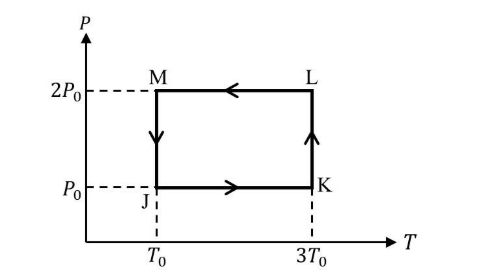
One mole of a monatomic ideal gas undergoes the cyclic process J→ K→ L→ M→ J, as shown in the P-T diagram.Match the quantities mentioned in List-I with their values in List-II and choose the correct option.
Alternative_text
Match the quantities mentioned in List-I with their values in List-II and choose the correct option. [ℛ is the gas constant.]
List-IList-II
PWork done in the complete cyclic processI
QChange in the internal energy of the gas in the process JKII
RHeat given to the gas in the process KLIII
SChange in the internal energy of the gas in the process MJIV
1

P → 1; Q → 3; R → 5; S → 4

2
P → 4; Q → 3; R → 5; S → 2
3
P → 4; Q → 1; R → 2; S → 2
4
P → 2; Q → 5; R → 3; S → 4
59
PYQ 2025
medium
physics ID: jee-adva

An ideal monatomic gas of moles is taken through a cycle consisting of consecutive adiabatic and isobaric quasi-static processes, as shown in the schematic diagram. The volume of the gas at and points are, , and , respectively. If the absolute temperature of the gas at the point is such that ( is the universal gas constant), then the amount of heat absorbed (in J) by the gas along the path is
60
PYQ 2025
medium
physics ID: jee-adva

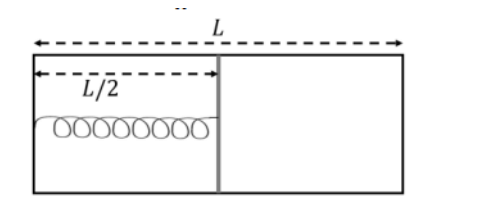
The left and right compartments of a thermally isolated container of length are separated by a thermally conducting, movable piston of area . The left and right compartments are filled with and 1 moles of an ideal gas, respectively. In the left compartment the piston is attached by a spring with spring constant and natural length . In thermodynamic equilibrium, the piston is at a distance from the left and right edges of the container as shown in the figure. Under the above conditions, if the pressure in the right compartment is , then the value of is ____
61
PYQ 2025
medium
physics ID: jee-adva
The efficiency of a Carnot engine operating with a hot reservoir kept at a temperature of 1000 K is 0.4. It extracts 150 J of heat per cycle from the hot reservoir. The work extracted from this engine is being fully used to run a heat pump which has a coefficient of performance 10. The hot reservoir of the heat pump is at a temperature of 300 K. Which of the following statements is/are correct:
1
Work extracted from the Carnot engine in one cycle is 60 J.
2
Temperature of the cold reservoir of the Carnot engine is 600 K.
3
Temperature of the cold reservoir of the heat pump is 270 K.
4
Heat supplied to the hot reservoir of the heat pump in one cycle is 540 J.
62
PYQ 2025
easy
physics ID: jee-adva

The left and right compartments of a thermally isolated container of length are separated by a thermally conducting, movable piston of area . The left and right compartments are filled with and 1 moles of an ideal gas, respectively. In the left compartment the piston is attached by a spring with spring constant and natural length . In thermodynamic equilibrium, the piston is at a distance from the left and right edges of the container as shown in the figure. Under the above conditions, if the pressure in the right compartment is , then the value of is ____

63
PYQ 2025
medium
physics ID: jee-adva

An ideal monatomic gas of moles is taken through a cycle consisting of consecutive adiabatic and isobaric quasi-static processes, as shown in the schematic diagram. The volume of the gas at and points are, , and , respectively. If the absolute temperature of the gas at the point is such that ( is the universal gas constant), then the amount of heat absorbed (in J) by the gas along the path is