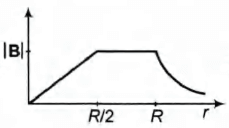
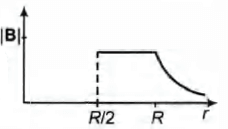
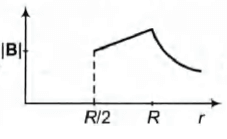
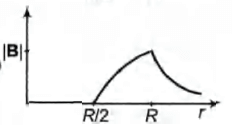
A conducting circular loop of radius r carries a constant current i . It is placed in a uniform magnetic field such that is perpendicular to the plane of the loop. The magnetic force acting on the loop is
1
2
3
zero
4
Official Solution
Correct Option: (3)
Magnetic force on a current carrying loop in uniform magnetic field is zero.
02
PYQ 1985
hard
physicsID: jee-adva
A proton moving with a constant velocity passes through a region of space without any change in its velocity. If E and B represent the electric and magnetic fields respectively. Then, this region of space may have
1
E = 0, B = 0
2
E= 0, B 0
3
E 0, B = 0
4
E 0, B 0
Official Solution
Correct Option: (4)
If both E and B are zero, then and both are zero. Hence, velocity may remain constant. Therefore, option (a) is correct. If E = 0, B 0 but velocity is parallel or antiparallel to magnetic field, then also both are zero. Hence, option (b) is also correct. If then also velocity may remain constant or option (d) is also correct.
03
PYQ 1985
medium
physicsID: jee-adva
A rectangular loop carrying a current i is situated near a long straight wire such that the wire is parallel to one of the sides of the loop and is in the plane of the loop. If steady current I is established in the wire as shown in the figure, the loop will
1
rotate about an axis parallel to the wire
2
move away from the wire
3
move towards the wire
4
remain stationary
Official Solution
Correct Option: (3)
Straight wire will produce a non-uniform field to the right of it. will be calculated by integration but these two forces will cancel each other. Further force on wire ab will be towards the long wire and on wire cd will be away from thelong wire. But since the wire ab is nearer to the long wire force of attraction towards the long wire will be more. Hence, the loop will move towards the wire. Correct option is (c).
04
PYQ 1986
medium
physicsID: jee-adva
Two thin long parallel wires separated by a distance b are carrying a current i ampere each. The magnitude of the force per unit length exerted by one wire on the other is
1
2
3
4
Official Solution
Correct Option: (2)
Force per unit length between two wires carrying currents and at distance r is given by
Here,
Correct option is (b).
05
PYQ 1988
easy
physicsID: jee-adva
Two particles X and Y having equal charges, after being accelerated through the same potential difference, enter a region of uniform magnetic field and describe circular paths of radii and respectively. The ratio of the mass of X to that of Y is
1
2
3
4
Official Solution
Correct Option: (3)
Correct option is (c).
06
PYQ 1993
easy
physicsID: jee-adva
A current I flows along the length of an infinitely long, straight, thin-walled pipe. Then
1
the magnetic field at all points inside the pipe is the same, but not zero
2
the magnetic field at any point inside the pipe is zero
3
the magnetic field is zero only on the axis of the pipe
4
the magnetic field is different at different points inside the pipe
Official Solution
Correct Option: (2)
Using Ampere's circuital law over a circular loop of any radius less than the radius of the pipe, we can see that net current inside the loop is zero. Hence, magnetic field at every point inside the loop will be zero.
07
PYQ 1995
medium
physicsID: jee-adva
A battery is connected between two points A and B on the circumference of a uniform conducting ring of radius r andresistance R. One of the arcs AB of the ring subtends an angle at the centre. The value of the magnetic induction at the centre due to the current in the ring is
1
proportional to
2
inversely proportional to r
3
zero, only if
4
zero for all values of
Official Solution
Correct Option: (4)
For a current flowing into a circular arc, the magnetic induction at the centre is
In the given problem, the total current is divided into two arcs
i.e. magnetic field at centre due to arc AB is equal and opposite to the magnetic field at centre due to arc ACB. Or the net magnetic field at centre is zero.
08
PYQ 1997
medium
physicsID: jee-adva
A proton, a deuteron and alpha particle having the same kinetic energy are moving in circular trajectories in a constant magnetic field. and denote respectively the radii of the trajectories of these particles, then
1
2
3
4
Official Solution
Correct Option: (1)
Radius of the circular path is given by
Here, K is the kinetic energy to the particle. Therefore, if K and 5 are same.
Hence,
09
PYQ 1999
medium
physicsID: jee-adva
A charged particle is released from rest in a region of steady and uniform electric and magnetic fields which are parallel to each other. The particle will move in a
1
straight line
2
Circle
3
helix
4
cycloid
Official Solution
Correct Option: (1)
The charged particle will be accelerated parallel (if it is a positive charge) or antiparallel (if it is a negative charge) to the electric field, i.e. the charged particle will move parallel or antiparallel to electric and magnetic field. Therefore, net magnetic force on it will be zero and its path will be a straight line.
10
PYQ 2000
medium
physicsID: jee-adva
An ionized gas contains both positive and negative ions. If it is subjected simultaneously to an electric field along the + x-direction and a magnetic field along the +z-direction, then
1
positive ions deflect towards +y-direction and negative ions towards -y-direction
2
all ions deflect towards +y-direction
3
all ions deflect towards y-direction
4
positive ions deflect towards -y-direction and negative ions towards -y-direction
Official Solution
Correct Option: (3)
We can write and Velocity of the particle will be along E direction. Therefore, we can write
In E, B and v. A, E and 5 are positive constants while q can be positive or negative Now, magnetic force on the particle will be
Since, is along negative y-axis, no matter what is the sign of charge' Therefore, all ions will deflect towards negative y-direction.
11
PYQ 2000
medium
physicsID: jee-adva
An infinitely long conductor PQR is bent to form a right angle as shown in figure. A current I flows through PQR. The magnetic field due to this current at the point M is . Now, another infinitely long straight conductor QS is connected at Q, so that current is I/2 in QR as well as in QS, the current in PQ remaining unchanged. The magnetic field at M is now The ratio is given by
1
44563
2
1
3
44595
4
2
Official Solution
Correct Option: (3)
= Magnetic field at M due to PQ + Magnetic field at M due to QR But magnetic field at M due to QR = 0 Magnetic field at M due to PQ (or due to current 1 in PQ) Now = Magnetic field at M due to PQ (current I) + magnetic field at M due to QS (current 1/2) + magnetic field at M due to QR
NOTE Magnetic field at any point lying on the current carrying straight conductor is zero.
12
PYQ 2001
medium
physicsID: jee-adva
A non-planar loop of conducting wire carrying a current I is placed as shown in the figure. Each of the straight sections of the loop is of length 2a. The magnetic field due to this loop at the point P (a, 0, a) points in the direction
1
2
3
4
Official Solution
Correct Option: (4)
The magnetic field at P(a, 0, a) due to the loop is equal to the vector sum of the magnetic fields produced by loops ABCDA and AFEBA as shown in the figure. Magnetic field due to loop ABCDA will be along and due to loop AFEBA, along Magnitude of magnetic field due to both the loops will be equal. Therefore, direction of resultant magnetic field at P will be NOTE This is a common practice, when by assuming equal currents in opposite directions in an imaginary wire (here AB) loops are completed and solution becomes easy.
13
PYQ 2002
medium
physicsID: jee-adva
A long straight wire along the z-axis carries a current I in the negative z-direction. The magnetic vector field B at a point having coordinate (x, y ) on the z = 0 plane is
1
2
3
4
Official Solution
Correct Option: (1)
Magnetic field at P is B, perpendicular to OP in the direction shown in figure. So, Here,
14
PYQ 2003
medium
physicsID: jee-adva
A current carrying loop is placed in a uniform magnetic field in four different orientations, I, II, III and IV, arrange them in the decreasing order of potential energy
1
I > III > II > IV
2
I > II > III > IV
3
I > IV > II > III
4
III > IV > I > II
Official Solution
Correct Option: (3)
U = - MB = - Here, M = magnetic moment of the loop 9 = angle between M and B U is maximum when = 180 and minimum when = 0 . So, as decreases from 180 to 0 its PE also decreases.
15
PYQ 2003
medium
physicsID: jee-adva
For a positively charged particle moving in a x-y plane initially along the x-axis, there is a sudden change in its path due to the presence of electric and/or magnetic fields beyond P. The curved path is shown in the x - y plane and is found to be non-circular. Which one of the following combinations is possible?
1
2
3
4
Official Solution
Correct Option: (2)
Electric field can deviate the path of the particle in the shown direction only when it is along negative y-direction. In the given options E is either zero or along x-direction. Hence, it is the magnetic field which is really responsible for its curved path. Options (a) and (c) cannot be accepted as the path will be circular in that case. Option (d) is wrong because in that case component of net force on the particle also comes in direction which is not acceptable as the particle is moving in x-y plane. Only in option (b) the particle can move in x-y plane. In option (d)
Initial velocity is along x-direction. So, let
In option (b)
16
PYQ 2004
easy
physicsID: jee-adva
An electron moving with a speed u along the positive x-axis at y = 0 enters a region of uniform magnetic field which exists to the right of v-axis. The electron exits from the region after sometime with the speed v at coordinate y, then
1
v > u, y < 0
2
v = u, y > 0
3
v > u, y > 0
4
v = u, y < 0
Official Solution
Correct Option: (4)
Magnetic force does not change the speed of charged particle. Hence, v = u. Further magnetic field on the electron in the given condition is along negative y-axis in the starting. Or it describes a circular path in clockwise direction. Hence, when it exits from the field, y < 0
17
PYQ 2006
medium
physicsID: jee-adva
Which of the following statement is (are) correct in the given figure ?
1
Net force on the loop is zero
2
Net torque on the loop is zero
3
Loop will rotate clockwise about axis OO' when seen from O
4
Loop will rotate anticlockwise about OO' when seen from O
Official Solution
Correct Option: (3)
, =0, because magnetic lines are parallel to this wire. , because magnetic lines are antiparallel to this wire.
is perpendicular to paper outwards and is perpendicular to paper inwards. These two forces (although calculated by integration) cancel each other but produce a torque which tend to rotate the loop in clockwise direction about an axis OO'
18
PYQ 2007
medium
physicsID: jee-adva
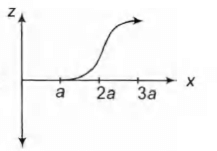
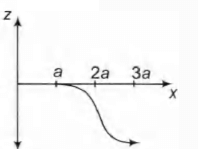
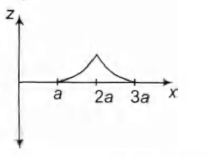
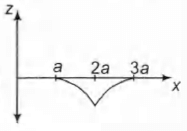
A magnetic field exists in the region a < x < 2 a and in the region 2a < x < 3a, where is a positive constant. A positive point charge moving with a velocity where is a positive constant, enters the magnetic field at x = a. The trajectory of the charge in this region can be like
1
2
3
4
Official Solution
Correct Option: (1)
Correct option is (a)
19
PYQ 2008
medium
physicsID: jee-adva
A particle of mass and charge , moving with velocity enters Region II normal to the boundary as shown in the figure. Region II has a uniform magnetic field B perpendicular to the plane of the paper. The length of the Region II is . Choose the correct choice (s).
1
The particle enters Region III only if its velocity v >
2
The particle enters Region III only if its velocity v <
3
Path length of the particle in Region II is maximum when velocity v = qlB / m
4
Time spent in Region II is same for any velocity v as long as the particle returns to Region I
Official Solution
Correct Option: (4)
v B in region II. Therefore, path of particle is circle in region II. Particle enters in region III if, radius of circular path, r > l
If particle will turn back and path length will be maximum. If particle returns to region I, time spent in region II will be
which is independent of v. Correct options are (a), (c) and (d).
20
PYQ 2012
medium
physicsID: jee-adva
An infinitely long hollow conducting cylinder with inner radius and outer radius carries a uniform current density along its length. The magnitude of the magnetic field, as a function of the radial distance from the axis is best represented by
1
2
3
4
Official Solution
Correct Option: (4)
r = distance of a point from centre For r R/2 Using Ampere's circuital law,
Since,
Here = current per unit area. Substituting in E (i), we have
At At For e (say) Therefore, substituting in E (i), we have
21
PYQ 2013
medium
physicsID: jee-adva
A steady current flows along an infinitely long hollow cylindrical conductor of radius . This cylinder is placed coaxially inside an infinite solenoid of radius . The solenoid has turns per unit length and carries a steady current . Consider a point at a distance from the common axis. The correct statement(s) is (are)
1
In the region 0 < r < R, the magnetic field is non-zero
2
In the region R < r < 2R, the magnetic field is along the common axis
3
In the region R < r < 2R. the magnetic field is tangential to the circle of radius r, centered on the axis
4
In the region r > 2R, the magnetic field is non-zero
Official Solution
Correct Option: (4)
In the region, 0< r < R
along the axis
In the region. R < r < 2 R tangential to the circle of radius r, centred on the axis. along the axis. neither in the directions mentioned in options (b) or (c). In region, r> 2R
22
PYQ 2013
medium
physicsID: jee-adva
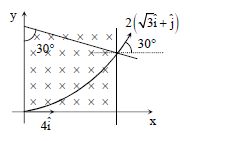
A particle of mass and positive charge , moving with a constant velocity , enters a region of uniform static magnetic field normal to the -y plane. The region of the magnetic field extends from 0 to for all values of . After passing through this region, the particle emerges on the other side after 10 milliseconds with a velocity . The correct statement(s) is (are)
1
the direction of the magnetic field is - z direction.
2
the direction of the magnetic field is +z direction
3
the magnitude of the magnetic field is units.
4
the magnitude of the magnetic field is units.
Official Solution
Correct Option: (3)
So magnetic field is along -direction. Time taken in the magnetic field
23
PYQ 2015
medium
physicsID: jee-adva
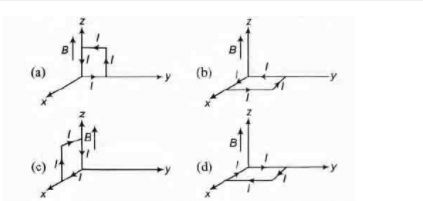
A rectangular loop of sides and carrying a current of is placed in different orientations as shown in the figures below, If there is a uniform magnetic field of in the positive -direction in which orientations the loop would be in (i) stable equilibrium and (ii) unstable equilibrium?
1
(a) and (b) respectively
2
(b) and (d) respectively
3
(a) and (c) respectively
4
(b) and (c) respectively
Official Solution
Correct Option: (2)
For equilibrium
If, If angle between and is zero, then stable equilibrium If angle between and is , then unstable equilibrium
24
PYQ 2015
medium
physicsID: jee-adva
A conductor (shown in the figure) carrying constant current is kept in the plane in a uniform magnetic field . If is the magnitude of the total magnetic force acting on the conductor, then the correct statement(s) is(are)
1
If is along , F
2
If is along ,
3
If is along , F (L + R)
4
If is along ,
Official Solution
Correct Option: (3)
Option A if B is along z axis i.e B
option A is correct answer. Option B if B is along x axis i.e B then option B is correct answer Option C if B is along y axis i.e. B then
option is correct answer.
25
PYQ 2022
hard
physicsID: jee-adva
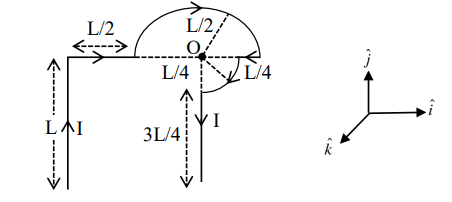
Which one of the following options represents the magnetic field at due to the current flowing in the given wire segments lying on the plane?
1
2
3
4
Official Solution
Correct Option: (3)
To solve this problem, we need to use Ampère’s law to find the magnetic field at the origin due to the given current-carrying wire segments.
1. Understanding the Setup: We are given a wire that lies in the -plane with current flowing through it. The segments of the wire have different lengths and are arranged as shown in the diagram. We need to determine the magnetic field at the origin , where the wire segments are positioned symmetrically around the point.
2. Using Ampère's Law: The magnetic field due to a current-carrying straight wire is given by the Biot-Savart law, which in this case simplifies to Ampère's law for straight segments of the wire. The magnetic field at a point due to a current in a straight segment of wire is given by:
where: - is the permeability of free space, - is the current, - is the perpendicular distance from the wire to the point of interest (here, the origin).
3. Magnetic Field Contribution from the First Segment: The first segment of the wire has length , and the current is flowing along the -axis. The magnetic field at the origin from this segment will be along the -axis, as the current creates a circular magnetic field around the wire. Using the formula, the magnetic field at the origin due to this segment is:
4. Magnetic Field Contribution from the Second Segment: The second segment of the wire has length , and the current is flowing along the -axis. Similarly, the magnetic field at the origin from this segment is:
5. Net Magnetic Field at the Origin: The magnetic field from the two segments combine. Since both segments contribute to the magnetic field along the same axis, we add the magnitudes of their fields:
6. Final Expression: The total magnetic field at the origin is:
Final Answer: The correct option is C.
26
PYQ 2022
easy
physicsID: jee-adva
In a particular system of units, a physical quantity can be expressed in terms of the electric charge e, electron mass me, Planck’s constant h, and Coulomb’s constant , where ε0 is the permittivity of vacuum. In terms of these physical constants, the dimension of the magnetic field is [B] = [e]α [me]β [h]γ [k]δ. The value of α + β + γ + δ is ______.
Official Solution
Correct Option: (1)
Now, equating the dimensions:
This results in the following system of equations:
(1)
(2)
(3)
(4)
Solving equations (1), (2), (3), and (4), we get:
Finally,
27
PYQ 2024
medium
physicsID: jee-adva
Two beads, each with charge q and mass m, are on a horizontal, frictionless, non-conducting, circular hoop of radius R. One of the beads is glued to the hoop at some point, while the other one performs small oscillations about its equilibrium position along the hoop. The square of the angular frequency of the small oscillations is given by [ is the permittivity of free space.]
1
2
3
4
Official Solution
Correct Option: (2)
The equilibrium position of the oscillating bead is diametrically
opposite to the fixed bead, because that is where the electrostatic
force is minimized (and potential energy is minimized). Let the angular
displacement from this equilibrium position be . The distance between the beads is
then given by using the law of cosines: For small , we can approximate . Therefore,
The electrostatic potential energy is then:
The potential energy is approximately
The kinetic energy of the oscillating bead is given by
The Lagrangian is .
The equation of motion can be derived using Euler-Lagrange equation,
,