JEE-ADVANCED SERIES Physics
Waves
26 previous year questions.
Volume: 26 Ques
Yield: High
High-Yield Trend
1
2025 2
2021 1
2020 1
2017 2
2014 1
2013 1
2012 1
2011 1
2009 1
2008 1
2004 2
2003 1
2002 2
2001 1
2000 Chapter Questions 26 MCQs
01
PYQ 1986
easy
physics ID: jee-adva
A tube closed at one end containing air produces fundamental note of frequency . If the tube is open at both the ends, the fundamental frequency will be
1
1024 Hz
2
256 Hz
3
1280 Hz
4
768 Hz.
02
PYQ 1990
medium
physics ID: jee-adva
A wave is represented by the equation ; where, x is in metre and t is in second. The expression represents
1
a wave travelling in the positive x-direction with a velocity 1.5 m/s
2
a wave travelling in the negative x-direction with a velocity 1.5 m/s
3
a wave travelling in the negative x-direction with a wavelength 0.2 m
4
a wave travelling in the positive x-direction with a wavelength 0.2 m
03
PYQ 1992
medium
physics ID: jee-adva
A cylindrical tube open at both the ends has a fundamental frequency of in air. If of the tube is immersed vertically in water the fundamental frequency of air column is
1
130 Hz
2
390 Hz
3
520 Hz
4
260 Hz
04
PYQ 1996
medium
physics ID: jee-adva
The extension in a string, obeying Hooke's law, is x. The speed of transverse wave in the stretched string is v. If the extension in the string is increased to 1.5 x, the speed of transverse wave will be
1
1.22 v
2
0.61 v
3
1.50 v
4
0.75 v
05
PYQ 1997
medium
physics ID: jee-adva
A whistle giving out 450 Hz approaches a stationary observer at a speed of 33 m/s. The frequency heard by the observer (in Hz) is (Speed of sound = 330 m/s) .
1
409
2
429
3
517
4
500
06
PYQ 1998
medium
physics ID: jee-adva
A string of length 0.4 m and mass is tightly clamped at its ends. The tensior in the string is 1.6 N. Identical wave pulses are produced at one end at equal intervals of time The minimum value of which allows constructive interference between successive pulses, is
1
0.05 s
2
0.10 s
3
0.20 s
4
0.40 s
07
PYQ 1999
medium
physics ID: jee-adva
A particle of mass M at rest decays into two particles of masses having non-zero velocities. The ratio of the de-Broglie wavelengths of the particles is
1
2
3
1
4
08
PYQ 2000
medium
physics ID: jee-adva
A train moves towards a stationary observer with speed 34 m/s. The train sounds a whistle and its frequency registered by the observer is . If the train's speed is reduced to 17 m/s, the frequency registered is . If the speed of sound is 340 m/s, then the ratio is
1
18/19
2
44563
3
2
4
19/18
09
PYQ 2001
medium
physics ID: jee-adva
Two pulses in a stretched string, whose centres are initially 8 cm apart, are moving towards each other as shown in the figure. The speed of each pulse is 2 cm/s. After 2 s the total energy of the pulses will be
1
zero
2
purely kinetic
3
purely potential
4
partly kinetic and partly potential
10
PYQ 2001
medium
physics ID: jee-adva
The ends of a stretched wire of length L are fixed at x = 0 and x = L. In one experiment the displacement of the wire is and energy is and in other experiment its displacement is and energy is .Then
1
2
3
4
11
PYQ 2002
medium
physics ID: jee-adva
A siren placed at a railway platform is emitting sound of frequency 5 kHz. A passenger sitting in a moving train A records a frequency of 5.5 kHz, while the train approaches the siren. During his return journey in a different train B he records a frequency of 6.0 kHz while approaching the same siren. The ratio of the velocity of train B to that of train A is.
1
242/252
2
2
3
44687
4
44871
12
PYQ 2003
medium
physics ID: jee-adva
A police car moving at 22 m/s chases a motorcyclist. The police man sounds his hom at 176 Hz, while both of them move towards a stationary siren of frequency 165 Hz. Calculate the speed of the motorcycle, if it is given that the motorcyclist does not observe any beats (speed of sound = 330 m/s).
1
33 m/s
2
22 m/s
3
Zero
4
11 m/s
13
PYQ 2003
medium
physics ID: jee-adva
In the experiment for the determination of the speed of sound in air using the resonance column method, the length of the air column that resonates in the fundamental mode, with a tuning for k is 0.1 m. When this length is changed to 0.35 m, the same tuning fork resonates with the first overtone. Calculate the end correction.
1
0.012 m
2
0.025 m
3
0.005 m
4
0.024 m
14
PYQ 2004
medium
physics ID: jee-adva
A source of sound of frequency 600 Hz is placed inside water. The speed of sound in water is 1500m/s and in air it is
300 m/s. The frequency of sound recorded by an observer who is standing in air is
1
200 Hz
2
3000 Hz
3
120 Hz
4
600 Hz
15
PYQ 2008
medium
physics ID: jee-adva
A vibrating string of certain length under a tension resonates with a mode corresponding to the first overtone (third harmonic) of an air column of length inside a tube closed at one end. The string also generates when excited along with a tuning fork of frequency . Now when the tension of the string is slightly increased the number of beats reduces to per second. Assuming the velocity of sound in air to be , the frequency of the tuning fork in is
1
344
2
336
3
117.3
4
109.3
16
PYQ 2009
medium
physics ID: jee-adva
A student performed the experiment to measure the speed of sound in air using resonance air-column method. Two resonances in the air-column were obtained by lowering the water level. The resonance with the shorter air-column is the first resonance and that with the longer air column is the second resonance. Then,
1
the intensity of the sound heard at the first resonance was more than that at the second resonance
2
the prongs of the tuning fork were kept in a horizontal plane above the resonance tube
3
the amplitude of vibration of the ends; of the prongs is typically around 1 cm
4
the length of the air-column at the first resonance was somewhat shorter than 1 /4th of the wavelength of the sound in air
17
PYQ 2011
medium
physics ID: jee-adva
A police car with a siren of frequency is moving with uniform velocity towards a tall building which reflects the sound waves. The speed of sound in air is . The frequency of the siren heard by the car driver is
1
8.50 kHz
2
9.50 kHz
3
7.75 kHz
4
7.50 kHz
18
PYQ 2012
medium
physics ID: jee-adva
A person blows into open-end of a long pipe. As a result, a high-pressure pulse of air travels down the pipe. When this pulse reaches the other end of the pipe,
1
a high-pressure pulse starts travelling up the pipe, if the other end of the pipe is open
2
a low-pressure pulse starts travelling up the pipe, if the other end of the pipe is open
3
a low-pressure pulse starts travelling up the pipe, if the other end of the pipe is closed
4
a high-pressure pulse starts travelling up the pipe, if the other end of the pipe is closed
19
PYQ 2013
easy
physics ID: jee-adva
A circular loop of radius 0.3 cm lies parallel to a much bigger circular loop of radius 20 cm. The centre of the smaller loop is on the axis of the bigger loop. The distance between their centres is 15 cm. If a current of 2.0 A flows through the bigger loop, then the flux linked with smaller loop is
1
9.1
2
3
3.3
4
20
PYQ 2014
medium
physics ID: jee-adva
A student is performing an experiment using a resonance column and a tuning fork of frequency . He is told that the air in the tube has been replaced by another gas (assume that the column remains filled with the gas). If the minimum height at which resonance occurs is , the gas in the tube is (Useful information: . The molar masses in grams are given in the options. Take the values of for each gas as given there.)
1
Neon
2
Nitrogen
3
Oxygen
4
Argon
21
PYQ 2014
medium
physics ID: jee-adva
One end of a taut string of length along the axis is fixed at . The speed of the waves in the string is . The other end of the string is vibrating in the y direction so that stationary waves are set up in the string. The possible waveform(s) of these stationary waves is (are)
1
2
3
4
22
PYQ 2017
medium
physics ID: jee-adva
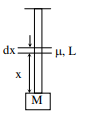
A block hangs vertically at the bottom end of a uniform rope of constant mass per unit length. The top end of the rope is attached to a fixed rigid support at . A transverse wave pulse (Pulse 1) of wavelength is produced at point on the rope. The pulse takes time to reach point . If the wave pulse of wavelength is produced at point (Pulse 2) without disturbing the position of it takes time to reach point . Which of the following options is/are correct?
1
The time
2
The velocities of the two pulses (Pulse 1 and Pulse 2) are the same at the midpoint of rope
3
The wavelength of Pulse 1 becomes longer when it reaches point
4
The velocity of any pulse along the rope is independent of its frequency and wavelength
23
PYQ 2020
medium
physics ID: jee-adva
A stationary tuning fork is in resonance with an air column in a pipe. If the tuning fork is moved with a speed of in front of the open end of the pipe and parallel to it, the length of the pipe should be changed for the resonance to occur with the moving tuning fork. If the speed of sound in air is , the smallest value of the percentage change required in the length of the pipe is ______.
24
PYQ 2021
medium
physics ID: jee-adva
A source, approaching with speed towards the open end of a stationary pipe of length , is emitting a sound of frequency . The farther end of the pipe is closed .The speed of sound in air is and is the fundamental frequency of the pipe. For which of the following combination(s) of and , will the sound reaching the pipe lead to a resonance?
1
and
2
and
3
and
4
and
25
PYQ 2021
medium
physics ID: jee-adva
A source, approaching with speed towards the open end of a stationary pipe of length , is emitting a sound of frequency . The farther end of the pipe is closed .The speed of sound in air is and is the fundamental frequency of the pipe. For which of the following combination(s) of and , will the sound reaching the pipe lead to a resonance?
1
and
2
and
3
and
4
and
26
PYQ 2025
medium
physics ID: jee-adva
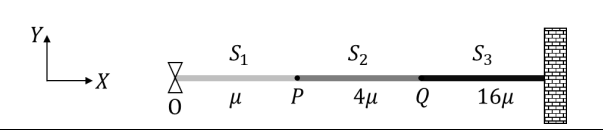
Consider a system of three connected strings, and with uniform linear mass densities and , respectively, as shown in the figure. and are connected at point , whereas and are connected at the point , and the other end of is connected to a wall. A wave generator is connected to the free end of . The wave from the generator is represented by cm, where and are constants of appropriate dimensions. Which of the following statements is/are correct: 
1
When the wave reflects from for the first time, the reflected wave is represented by cm, where is a positive constant.
2
When the wave transmits through for the first time, the transmitted wave is represented by cm, where is a positive constant.
3
When the wave reflects from for the first time, the reflected wave is represented by cm, where is a positive constant.
4
When the wave transmits through for the first time, the transmitted wave is represented by cm, where is a positive constant. \bigskip