JEE-ADVANCED SERIES
Physics

Reflection Of Light By Spherical Mirrors

6 previous year questions.

Volume: 6 Ques
Yield: Medium

High-Yield Trend

1
2024
1
2023
1
2004
2
1999
1
1983

Chapter Questions
6 MCQs

01
PYQ 1983
easy
physics ID: jee-adva
A ray of light from a denser medium strikes a rarer medium at an angle of incidence i (see figure). The reflected and refracted rays make an angle of with each other. The angles of reflection and refraction are r and r'. The critical angle is
1
(tan r)
2
(cot i)
3
(tan r')
4
(tan i)
02
PYQ 1999
medium
physics ID: jee-adva
Yellow light is used in a single slit diffraction experiment with slit width of 0.6 mm. If yellow light is replaced by X-rays, then the observed pattern will reveal
1
that the central maximum is narrower
2
more number of fringes
3
less number of fringes
4
no diffraction pattern
03
PYQ 1999
medium
physics ID: jee-adva
Yellow light is used in a single slit diffraction experiment with slit width of 0.6 mm. If yellow light is replaced by X-rays, then the observed pattern will reveal
1
that the central maximum is narrower
2
more number of fringes
3
less number of fringes
4
no diffraction pattern
04
PYQ 2004
easy
physics ID: jee-adva
White light is incident on the interface of glass and air as shown in the figure. If green light is just totally internally reflected then the emerging ray in air contains.
1
yellow, orange, red
2
violet, indigo, blue
3
all colours
4
all colours except green
05
PYQ 2023
easy
physics ID: jee-adva
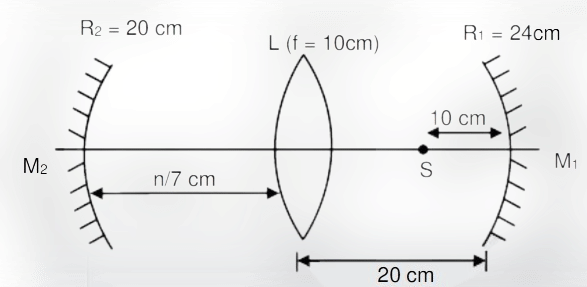
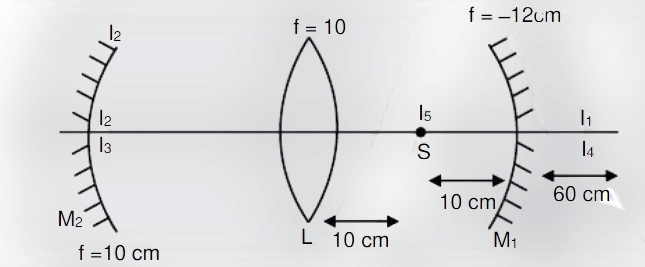
first reflection

Taking the first reflection of M1. If the final image coincides with s, then find n.
06
PYQ 2024
medium
physics ID: jee-adva
A light ray is incident on the surface of a sphere of refractive index n at an angle of incidence . The ray partially refracts into the sphere with angle of refraction and then partly reflects from the back surface. The reflected ray then emerges out of the sphere after a partial refraction. The total angle of deviation of the emergent ray with respect to the incident ray is . Match the quantities mentioned in List-I with their values in List-II and choose the correct option.
List-IList-II
PIf and , then all the possible values of will beI or
QIf and , then all the possible values of will beII or
RIf and , then all the possible values of will beIII or
SIf and , then all the possible values of will beIV
1
P → 5; Q → 2; R→ 1; S→ 4
2
P → 5; Q → 1; R→ 2; S→ 4
3
P → 3; Q → 2; R→ 1; S→ 4
4
P → 3; Q → 1; R→ 2; S→ 5

About Reflection Of Light By Spherical Mirrors - JEE-ADVANCED

Reflection Of Light By Spherical Mirrors is a vital chapter for JEE-ADVANCED aspirants. Mastering the concepts covered in this chapter is essential for securing a top rank.

By rigorously practicing the previous year questions associated with this chapter, you can identify high-yield topics, understand the examiner's perspective, and boost your confidence during the actual exam.

Frequently Asked Questions

Why focus on Reflection Of Light By Spherical Mirrors PYQs?

Analyzing PYQs for this specific chapter reveals the most frequently tested concepts and the typical complexity of questions, allowing you to tailor your study plan efficiently.

How to best use this analysis?

Review the topic breakdown to see which sub-topics within Reflection Of Light By Spherical Mirrors carry the most weight. Then, tackle the questions iteratively to solidify your understanding.