Electrostatics
6 previous year questions.
High-Yield Trend
Chapter Questions 6 MCQs
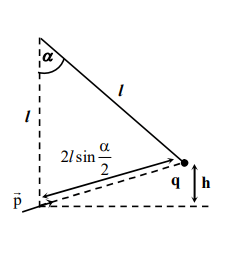
(Note that for three coplanar forces keeping a point mass in equilibrium, is the same for all forces, where is any one of the forces and is the angle between the other two forces)
A container has a base of 50 cm × 5 cm and height 50 cm, as shown in the figure. It has two parallel electrically conducting walls each of area 50 cm × 50 cm. The remaining walls of the container are thin and non-conducting. The container is being filled with a liquid of dielectric constant 3 at a uniform rate of 250 cm3s−1. What is the value of the capacitance of the container after 10 seconds? [Given: Permittivity of free space 𝜖0 = 9 × 10⁻¹² C2N−1m−2, the effects of the non-conducting walls on the capacitance are negligible]
27 pF
63 pF
81 pF
135 pF
List-I shows four configurations, each consisting of a pair of ideal electric dipoles. Each dipole has a dipole moment of magnitude , oriented as marked by arrows in the figures. In all the configurations the dipoles are fixed such that they are at a distance apart along the -direction. The midpoint of the line joining the two dipoles is . The possible resultant electric fields at are given in List-II. Choose the option that describes the correct match between the entries in List-I to those in List-II. 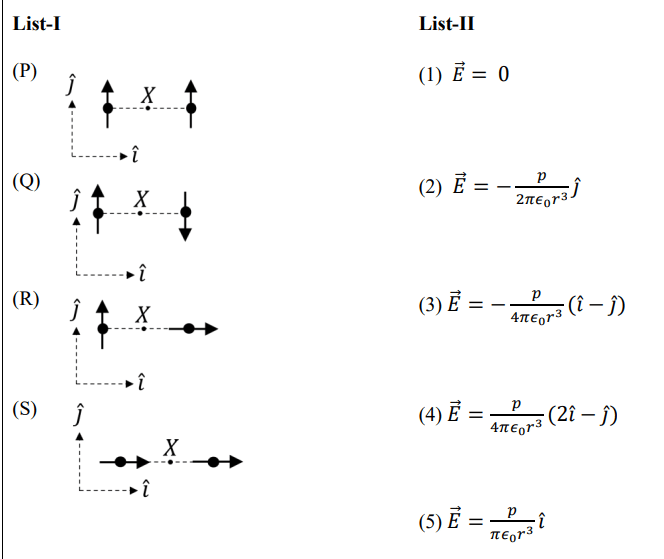
P 2, Q 1, R 3, S 5
About Electrostatics - JEE-ADVANCED
Electrostatics is a vital chapter for JEE-ADVANCED aspirants. Mastering the concepts covered in this chapter is essential for securing a top rank.
By rigorously practicing the previous year questions associated with this chapter, you can identify high-yield topics, understand the examiner's perspective, and boost your confidence during the actual exam.
Frequently Asked Questions
Why focus on Electrostatics PYQs?
Analyzing PYQs for this specific chapter reveals the most frequently tested concepts and the typical complexity of questions, allowing you to tailor your study plan efficiently.
How to best use this analysis?
Review the topic breakdown to see which sub-topics within Electrostatics carry the most weight. Then, tackle the questions iteratively to solidify your understanding.