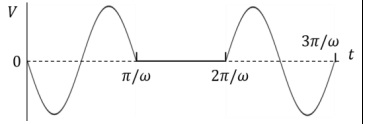
To solve this problem, we need to determine the induced electromotive force (e.m.f., ) in a square loop rotating in a time-varying magnetic field. Let’s break it down step by step.
Step 1: Understand the Setup
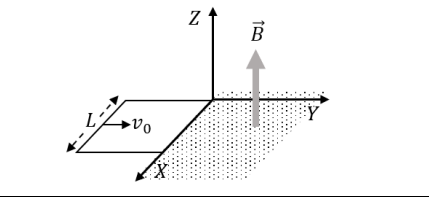
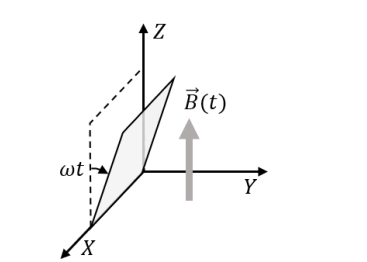
- The square loop lies in the -plane at , with its lower edge hinged along the -axis.
- The loop rotates with a constant angular speed about the -axis in the clockwise direction (as viewed from the positive -axis). Clockwise rotation from this perspective means the loop rotates from the -axis toward the negative -axis.
- The magnetic field exists only in the region and is given by , where is a constant, and is the unit vector along the -axis. The field is zero for .
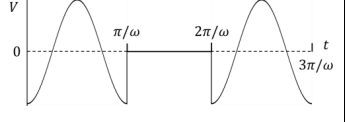
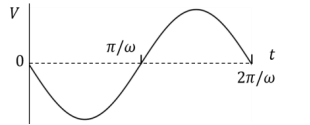
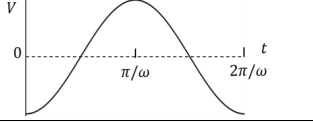
- We need to find the induced e.m.f. as a function of time and match it with the given plots.
Step 2: Define the Loop’s Position and Area Vector Assume the square loop has a side length , so its area is . At , the loop lies in the -plane, meaning its area vector (normal to the plane) points along the -axis (positive -direction, ). The loop rotates about the -axis with angular speed . The angle of rotation at time is: Since the rotation is clockwise as viewed from the positive -axis, the loop’s plane tilts from the -plane (where the normal is along ) toward the negative -axis. Let’s define the position:
- At , the loop is in the -plane, and the area vector .
- After time , the loop has rotated by an angle . The normal vector (area vector direction) rotates in the -plane.
The normal vector’s direction after rotation: Initially (at ), the normal is along . After rotating by clockwise (from to ), we can determine the new normal using the rotation matrix about the -axis. For a clockwise rotation by about the -axis: The initial normal is .
After rotation:
So, the area vector becomes:
Step 3: Calculate the Magnetic Flux The magnetic flux through the loop is: The magnetic field is , and it exists only in the region . This complicates things because part of the loop may be in , where . Let’s first compute the flux assuming the field were uniform across the loop, then adjust for the condition: So, if the field were uniform: However, the field is only present for . As the loop rotates, its position in the -coordinate changes:
- At , the loop is in the -plane ( ), so the entire loop is at the boundary of the field region.
- As increases, the loop tilts, and the -coordinate of points on the loop ranges from 0 (at the hinged edge along the -axis) to at the opposite edge (since it moves toward the negative -axis).
When , the loop is entirely at , so it’s in the field region. When , the loop is in the -plane, with ranging from 0 to , so half the loop (on average) is in , where .
Step 4: Adjust for the Field Region The flux depends on the area of the loop in the region . Let’s parameterize the loop:
- The loop’s hinged edge is along the -axis (from to , , ).
- The opposite edge, initially at , rotates. Its -coordinate becomes , and .
As the loop rotates, the -coordinate of a point at height (before rotation) becomes: The original -coordinate ranges from 0 to . So, ranges from 0 to . The condition means: Since , when , no part of the loop satisfies except at the hinge ( ). This suggests we need to compute the effective area in . Instead, let’s reconsider the flux by integrating over the loop’s surface. The fraction of the loop in decreases as increases. At , ranges from 0 to , so half the loop is in . The effective area in the field region depends on the angle.
Step 5: Induced e.m.f. The induced e.m.f. is given by Faraday’s Law: Let’s approximate the flux by considering the effective area. Notice the field and rotation have the same frequency , suggesting resonance effects. Let’s compute using the uniform flux and adjust: This e.m.f. oscillates with frequency , which matches the period in the plots ( ).
Step 6: Account for Condition When , the loop is half in , so the flux is halved, but the derivative (e.m.f.) depends on the rate of change. The form arises from the product of (from the field) and (from the area vector’s -component), and the condition modulates the amplitude, not the frequency.
Step 7: Match with Plots
- The e.m.f. has a period of .
- Option (A) shows a period of , matching .
- Option (B) shows a period of , incorrect.
- Option (C) shows a period of , incorrect.
- Option (D) shows a period of , but the phase differs.
Since starts at a maximum, option (A) matches best.
Final Answer