Keplers Laws
High-Yield Trend
Questions 4 MCQs
The figure shows the elliptical orbit of a planet about the sun The shaded area is twice the shaded area If is the time for the planet to move from to and is the time to move from to then:
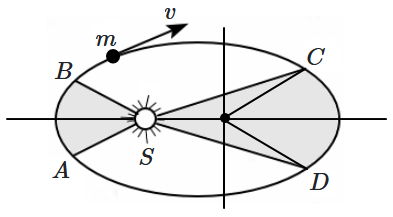
| 1. | 2. | ||
| 3. | 4. |
A planet moving along an elliptical orbit is closest to the sun at a distance r1 and farthest away at a distance of r2. If v1 and v2 are the linear velocities at these points respectively, then the ratio is:
1.
2.
3.
4.
The kinetic energies of a planet in an elliptical orbit around the Sun, at positions are respectively. is the major axis and is perpendicular to at the position of the Sun , as shown in the figure. Then:
1.
2.
3.
4.
1. earth days
2. earth days
3. earth days
4. earth days
Preparing Keplers Laws for NEET
Keplers Laws is a specific sub-topic that frequently appears in the NEET examination. Understanding the underlying principles and practicing targeted questions is key to mastering this concept.
The questions compiled above are previous year questions (PYQs) directly related to Keplers Laws. Practicing these specific questions helps you understand the difficulty level and the examiner's approach to this topic.
Topic Frequently Asked Questions
Is Keplers Laws a high-weightage topic?
You can refer to the priority and consistency badges at the top of this page. High priority topics should be thoroughly revised multiple times before the exam.
Should I memorize the solutions?
No, it is highly recommended to understand the core concept and methodology behind each solution rather than memorizing them, as exact questions are rarely repeated, but the concepts definitely are.